Showing posts with label plays. Show all posts

Friday, November 26, 2010

songs for nobodies

Regular readers of this blog will have heard me frequently sigh over my secret boyfriends including, but not limited to: David Tennant, Antonio Banderas, Rupert Grint, and Robert Rodriguez. One thing I have not had until today has been a secret girlfriend. Bernadette Robinson has completely changed that and is now a contender for my heart.

Songs for Nobodies was the final play for our final Melbourne Theatre Company subscription, as the prices for subs when you’re thirty or older become far too expensive. (I hold Chris entirely to blame; I don’t turn thirty for another year, but refuse to see plays by myself because then who will I be able to whisper “they were on the telly!” to?) Fittingly, we saw our first and last plays in the same theatre—the Fairfax, in the Arts Centre—and we were also running late, as we were for our first play. Here I should mention how lovely MTC staff are when you turn up late, wracked with guilt and apologetic—they tell you how long until you can enter, set you up in a chair, and turn on a television that fuzzily broadcasts the play as it is performed. The people we had to clamber in front of were less excited, but hey guys, YOU try turning right in our car at the moment: it’s a fine and stupid art.

Songs for Nobodies follows the story of five separate women: the first, a woman who meets Judy Garland (this is the bit we arrived late for, so I am not as clear as I wish I was); an American usher glowing after her experience with Patsy Cline; an New Yawk journalist setting up an interview with Billie Holiday; an English librarian recounting how Edith Piaf saved her father’s life; a young Irish woman working on a cruise ship packed with temperamental celebrities, including Maria Callas. In each story, the most notable tunes by those singers will also be performed along with a band and—while many of the tunes are not particularly high on my list of favourites because I have heard them so much during my life—listening to them performed six feet in front of you by an artist who gets them all absolutely pitch-perfect was one of the most amazing theatrical experiences I’ve had.

Without a performer of the calibre of Bernadette Robinson, this play would be nothing. But listening to her get every accent right, all while wearing the same sharp outfit, utilising the minimalist, slightly art-deco set, and becoming five completely different people—she is incredible. As the librarian, she looks austere, walks with her head held high and speaks in a clipped accent that is nothing less than convincing. As the Irish teenager, fresh out of a relationship with an “evil bastard...no, he isn’t a bastard, but he is evil”, she is all sass and and lopes around the stage, recounting her tale with delicious drama. And when she sings—oh—you’ve never heard anything like it. Or you have, because she sounds so much like the singers she’s emulating that the hairs raised up on my arms and I leaned forward in my chair, beaming at this woman who, moments before, had been an aspiring journalist nicknamed Too Junior Jones, and then suddenly became Billie Holiday, singing the always moving Strange Fruit. It really is something.

The play isn’t all singing, though, and the little snippets of existence we get from the women are of equal interest. They are funny, and smart, and appealing. When the librarian makes a crass joke with her beautiful voice you can’t help but giggle; when the usher accidentally walks in on Patsy Cline you are excited for her, meeting her idol. Bernadette Robinson is an absolute revelation—to me, anyway, as she is a well-known performer. Joanna Murray-Smith wrote the play for Bernadette, and it is hard to imagine anyone else in these roles, able to sing as five loved stars, and to act as five anonymous women whose lives were changed by them.

I didn’t even make any jokes in this review. That’s how blown away I was by this play. It took away my propensity to be ridiculous and filled that part of my brain with awe.

In summary: Exceeds Expectations and the perfect end to our subscription. I also want to know who styled Bernadette’s hair, because it was great. If I could complain about anything, it would be that it started on time so we missed the beginning. Damn efficient MTC.

The Songs for Nobodies season runs from November 5 to January 15, already having been extended, probably due to an excess of awesome.


Friday, August 6, 2010

dead man’s cell phone

As you get your ticket checked for the theatre you are often confronted with a sign warning you of certain things happening in the play you’re about to watch. For example, we’ve been warned in the past for nut-related food fights that may rain upon the front rows. And as we went into our most recent Melbourne Theatre Company play—Sarah Ruhl’s Dead Man’s Cell Phone—I was accosted by a sign warning me of theatrical smoke and nudity. And as I got into my seat, third row from the front, I thought to myself, well, someone’s going to get their boobs out, and everyone’s going to smoke like it’s cool. And I sighed. And then it happened.

The play opened with all the lights still on and the audience still gossiping away. The setting: a cafe and Laundromat. A man walked casually across the stage, completely naked, to retrieve his clothes from the dryer and put them on. The audience’s chattering died away. The man walked offstage; by then, everyone was silent. And so it began. And I was already pleased.

In an American cafe, a man’s cell phone rings and rings and he doesn’t answer it. The only other customer, Jean (a too cute Lisa McCune), is irritated, and says so—until she realises he’s not ignoring the phone because he likes to torment others with his choice of ringtone, but is ignoring it because he is dead. Lost in the moment, she answers the phone.

Soon she becomes involved with the dead man’s family, feeling obliged, as the person with Gordon when he died, to comfort them. She meets his bitter wife, Hermia (Sarah Sutherland); his cold mother, Harriet (Sue Jones); his saucy mistress, played by Emma Jackson; and his unloved brother, Dwight (Daniel Frederiksen). Hoping to help them through their grief, she begins to tell some little white lies about his final moments, including that he wanted her to have his phone, which keeps ringing, and ringing...

From its wonderful wang-filled opening, Dead Man’s Cell Phone is hilarious and enjoyable; while Jean is so eager-to-please it is a mite painful, and her motivations are sketchy, the characters are all such delightful exaggerations you can’t help but adore them. Harriet is monstrous in her way, but trips about in gorgeous shoes and says to Jean, “You very comforting. I don’t know why. You’re like a very small casserole. Has anyone ever told you that?” Hermia is very proper until she is drunk, then she is glorious; Dwight is just as awkward and pained as Jean. Gordon’s mistress is sexy and dramatic and underused, and clad in the most gorgeous coats around. In fact, the costumes might have been my favourite character. All ’40s lines, jaunty hats and big hair, all the characters were enormously visually appealing (and that’s even without Frederiksen
’s nudity and the later topless stint by the alarmingly triangular John Adam.) Jean is a little less forties and more layered, to the point where I thought she was the best actor solely because she hadn’t fainted under the lights despite them: ribbed tights, socks, boots, turtleneck, dress, cardigan, jacket, coat. The music was fantastic as well; film noir-inspired dramatic chords constrasting with beautiful tinkling background sounds.

As with some other plays, I couldn’t help being irritated by the accents. It hadn’t even occurred to me that the play was American—though the “Cell Phone” in the title should have been a fairly obvious giveaway—and with Lisa McCune’s first “Excuse me?” barked in a shrill New-Yawk accent, I was a bit broken hearted. With Boston Marriage, I at least understood that it was set in a certain place and time, but this would have worked just as well with Australian accents. I mean, despite the semi-period clothes and music, the fact remains that with a title I have since renamed Dead Man’s iPhone (they used them) it is set now, and nothing implies it needs to be set in America. Admittedly I did enjoy Hermia’s squawking dramatics as she drank cocktails and lamented the demise of her marriage, and perhaps the accent made it a little more surreal and injected more humour. But it’s always so unnatural in person—even though they all seemed to do very good jobs, as far as I can tell (and I have absolutely no expertise in the area, so don
’t even assume that I’m right about the accent’s region.)

After its initial hilarity, the script did descend in the end into something a little too farcical and twee by the end. Because of the play’s light touch, you kind of roll with the farce for a while, but for me it reached a certain point where I felt like I was in a different, fantastical play that was out of place there. It still remained enjoyable, but just a little silly, like that annoying friend who won’t understand when to stop being ridiculous. (I am guilty of mostly being that friend.)

The set design was interesting, yet to me a bit flawed (though Chris liked it.) The Laundromat format remains throughout, with tumble dryers everywhere to open and retrieve things from; tables are moved to form a church, drapes are pulled out to represent a home, but it was still, well, a Laundromat. I went with it until the end, when I felt I needed a firmer grasp of where exactly characters they were to figure out what the hell was happening.

Well, now that I’ve fussed over all the little details, the larger story is about our reliance on the phone: the little buzzy object we all adore so much (I am guilty of this also) and have such trouble ignoring, even if it is not ours. As Jean herself says, “When something rings, you have to answer it, don’t you?” While most normal people wouldn’t quite go to Jean’s lengths with a stranger’s phone, we can’t deny that the arrival of it has changed social interactions, and that we haven’t wanted to snatch away someone’s mobile and do something with it: throw it away, change their story, bop them with it for talking on it while you’re trying to serve them (not that this is a personal bugbear, of course.) And this was summarised perfectly by the discussion that immediately arose from the audience around us once the play ended, regarding one phone that suffered a terrible fate: “They didn’t really smash that phone, did they?” One boy said, sounding upset. Another replied wisely, “No, they couldn’t have. If it was a real iPhone, it wouldn’t have broken.” Truer words I have never heard.

Wednesday, July 7, 2010

boston marriage

Not a review for the time I got drunk on a trip to the Massachusetts capital and woke up the next morning hitched to a local, but for David Mamet’s play and my third Melbourne Theatre Company visit this year. With poetic repartee, Claire and Anna, together again after a long time apart, spar when their reunion doesn’t go quite as planned. Anna has found herself a “protector”, a man who is devoted to her and who can keep her (and Claire) in the manner to which she has become accustomed. Claire has also met someone new, but her disclosure—that of being in love with them—is much more devastating.

As the kind man trying to sell us programmes for the play explained to me, a “Boston Marriage” is a term coined around the nineteenth century and used to describe two females who live together. I am a sucker for a kindly salesman, so I can now tell you that the programme elaborated on that, explaining that the situation was often that the women were unmarriageable, or wanting to stay free of the constraints of education-ending marriage, or in love. The “Boston” aspect came from the fact that many universities opened up nearby at the time. Mamet’s play is set in the Boston itself in the late 1800s, in Anna’s luxuriously decorated townhouse, and populated by three women: Anna, Claire, and Anna’s maid, the slightly unhinged Catherine. The parts are performed by (respectively) Pamela Rabe (God of Carnage, reviewed here), Margaret Mills (many things I haven’t seen) and Sara Gleeson (Poor Boy, reviewed badly by me in a different, even more disjointed blog I refuse to link to).

As Mamet himself says, “[Mine is] a poetic language. It’s not an attempt to capture language as much as it is an attempt to create language.” Well, that’s all very well and good, but nothing screams “you’re watching a play” more than people having lengthy conversations without a single realistic moment in them. While Claire and Anna come up with wordy zingers every few seconds and the audience laughed, I couldn’t enjoy it. This is obviously personal preference; consensus from eavesdropping on the crowd as we picked our way outside was “oo-er, that was lovely” and “there’s been a few disappointments so far this year, but that was wonderful”. I would like to say that I could appreciate it as an art piece, but I just found it frustrating hearing them so ridiculously melodramatic and eloquent while steeped in grief, and the characters really all just came off as unlikeable. The accents felt wrong, but perhaps that’s just because the script meant I couldn’t disconnect from the fact I was seeing naturally Australian-accented actors in front of me speaking in American.

I did laugh at some of the jokes, and thought the costumes were absolutely divine. Some of their quirks as a couple played out nicely, as Anna tried desperately to remember the word she needs to use and clicks her fingers at Claire, who will respond. Chris and I do this all the time, often for unbelievably easy words, as portrayed in Boston Marriage by Anna: “Agricultural sites...” with Claire supplying “Farms.” However, I didn’t like this play. It felt far too forced, with plot contrivances that I saw coming and the use of swear words from otherwise innocent and articulate mouths to get a rise out of the crowd. (Oh my, the maid just said ‘fuck!’ How droll. And so on.) Seeing the rich swan about being rich can often be insufferable, and watching them being cutting towards the hired help is always guaranteed to make me angry. Perhaps I was a timid Scottish maid in a past life, because Anna’s scathing attitude towards Catherine garnered much mirth from the crowd and a stony-faced glare from me. The ye olde speak of the late nineteenth century can also be hard to keep up with—happily, a bashful MTC staff member agreed with me on this—and by the end I was just plain bored with their yammering. Did they love or hate each other? More importantly: did I like them enough to care? I didn’t, and by the end I was just waiting for it to end so I could go out for the fancy dinner we’d planned afterwards. In conclusion: the play didn’t come through with the goods, but Red Emperor’s dumplings sure did.

Wednesday, April 28, 2010

the grenade

The Grenade, by Australian playwright Tony McNamara, has catapulted up the internationally-renowned chart of Fiona’s Favourite MTC plays to be equal number one with Grace. Grace made me weep. The Grenade made me have an embarrassing coughing fit because I was laughing so hard. So in the lesser-known but equally lauded chart of Fiona’s Favourite MTC Comedies, this is an absolute number one.

Political advisor Busby McTavish comes home to his beloved family one night and finds a live grenade on his lounge room floor. Who would do something like this? When you’re in politics, it could be anyone—or perhaps it’s an enemy of his teenage daughter Lola, because all teenagers have enemies. Or is it someone closer to home? Could something like this twist your trust in your family? Busby takes charge, turns his house into a fortress, and watches his family’s every move. And somehow, it’s hilarious.

After all these plays it still takes me a while to warm to seeing people physically in front of me acting and to let myself get involved in the world of theatre after being so used to cinema, where, because it’s onscreen with elaborate sets, you can abandon yourself to that “reality” much easier. But happily this didn’t take long, distracting me with jokes straight away—and the flawless set helped. A rotating stage held four different scenes, some malleable, all perfect, though most of the play was set in the McTavish’s plush lounge room and kitchen. The faultless lighting turned the rooms into night and days so realistic I was almost surprised to find it dark outside when I left. The sound seemed a bit low at the start (or I have been listening to my iPod with the sound up too loud again, a probable alternative), but then became pitch-perfect, with fitting dramatic musical interludes as the set revolved to the next scene. So, top-notch production, meaning that at the end when the actors gesture to the crew of the play I was clapping just as hard.

Garry McDonald surprised me by cutting quite a dashing figure, trim in his nice suits and still looking the same (from the upper level of the Playhouse, anyway) as he did twenty years ago. Busby’s wife, ex-nun Sally, is played with beauty and naive humour along with the fraught panic of a new mother by Belinda Bromilow; Neighbours starlet Eloise Mignon shines as the high-pitched Mensa-genius daughter, openly attempting rebellion. Wheat, the oddity love interest of Lola played by Gig Clarke, gives a persuasive and esoteric performance; Jolyon James channels Fabio as open-minded erotic novelist Randy Savage, commissioned along with romance novelist Sally to write a new genre of novel (“erotomance”, or “romagasm”), and there to upstage Busby in every possible way and send women into a frenzy with just a touch. Genevieve Picot is Busby’s ex-wife Kerry, a woman unafraid of admitting her faults (Busby shouts at her, “You shagged two of my co-workers!” and she says, “You said to mingle!” to which he replies, “I didn’t mean juices!”). Rounding out the cast is Mitchell Butel, as Whitman, McTavish’s energetic and amoral co-worker.

Busby is occasionally a bit of a prick, and has a job that celebrates such a character trait, but ultimately he is redeemed by the adoration he has for his family. Characters like Wheat, who arrives for his first meeting with Lola’s father wearing a balaclava, and Randy, whose heroic acts toe the line of the unlikely, are so bizarre and unrealistic that they veer right back into strangely human. They’re an idiosyncratic bunch, frankly, especially six-month-old Michael, Sally and Busby’s son, whose astonishing exploits have his family convinced that he is a demon.

Look, it’s not as perfect as I’m making it out to be. If there’s one thing I never find funny, it’s men whining about how women never have enough sex with them, a gag that is as painfully overdone in this play as it is in reality. The actually fairly horrific subplot about Busby’s current work situation is handled far too lightly. But on the whole, it was hilarious, and I would completely recommend it. The fact that it’s an Australian script doesn’t hurt either; you can get all choked up with patriotic pride in our abilities as a nation, too. Nowhere else could a joke about Julia Gillard’s tongue ring make any sense.

Friday, February 26, 2010

madagascar

J T Rogers’ play was our second of the year, and I had high hopes for it as I’d been stuck on a tram with a bunch of rabid teenagers on Orientation Week for uni on my way to the theatre. It quite got me in the mood for some serious, poignant theatre whereupon I could ponder life’s worth in a quiet and dignified manner instead of being squashed up against a girl with a megaphone leading the entire tram in sweary song. It was pretty fun when the tram driver joined in by chanting “off the step, off the step, off the step”, though.

Madagascar had a cast of three: Noni Hazelhurst, who brought me to tears in our first MTC play, Grace; thoroughly enjoyable quasi-villain Nicholas Bell from the likes of Bad Eggs and The Games (and Mission Impossible II for those who have not been paying proper attention to Australian film and TV circa 1999-2003, and I’m just assuming he’s a villain in that because he does it so very well); and Asher Keddie, who has turned up in just about every Australian TV show running, most recently Rush. The set was built with windows to look despondently out of, a bed to fling oneself on in a fit of hysteria, and a desk with a drawer that made a satisfying bang when thrown shut after a dramatic sentence. Unexpectedly, things get damp in the second act. But I won’t tell you how.

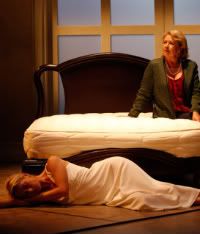
Three people are telling their stories, one that centres around a particular person, and all at separate times: Gideon, known to all but his mother as Paul, who has gone missing after detaching himself from his upper-class family and abandoning himself to the wilds of Madagascar. Noni plays his mother, Lily, waiting for Paul to arrive in Rome to meet with her for the first time after their falling-out six months earlier, unaware that he will never get off the plane from New York. Asher wallows in a silky white nightgown as Paul’s twin sister June, in the same room her mother awaited her son, lamenting the loss of her brother and unable to bear her family’s reactions. Nicholas, alas, tones down the evil to play Nathan, colleague of Paul’s father and someone who finds himself tied to the family before and after their loss, and who tells his tale long afterwards.

They are all three American; you can tell because they say “Madagascarrrrr” and not “Madagaskah”, unafraid as they are of the letter “r” at the end of words. (In Australia, it’s at the top of the terrorist threats. Look it up.) I wasn’t entirely sold on their accents, I have to say, but due to my lack of American accent nuance knowledge it’s hard to tell if it’s that because it was too much like watching old friends imitate actors after seeing them speak normally before. Lily and June are from the upper echelons of society, speaking in refined tones opposed to Nathan’s rougher Bronx voice, not helped by a confusing and violent opening scene which apparently was a dream but I took as fact until Chris pointed it out after the play.

While problems are not left only to the poor, much like last year’s play The Year of Magical Thinking, I spent much of the performance getting quietly annoyed at Lily, who can afford to escape to her Swiss chalet when the weather is nice, who takes her children on holidays overseas and who apparently suffers from the loathsome boredom that arises when there is nothing pressing to do but be upset about something. The rich are just as welcome to being upset as others, but I find myself thinking in these situations what if you couldn’t just leave? What if you couldn’t afford to follow that train of thought all over the world? And so on. That is perhaps a fault in myself and not in the play, but it’s always been the same for me: I’m not interested in the television shows where the rich lie around being rich and having affairs to spice things up, or the books where people sit in their enormous apartments and watch their sad lives reflected in their stainless-steel appliances. Of course money doesn’t buy happiness. But it buys houses and medical bills, and some people are not so lucky.

In the play’s favour, the lighting and music were utterly evocative, and I sometimes found myself completely transported to the places they described and the emotions that accompanied it. It could be haunting and beautiful at times, and when those moments came it was all I want in a play (or any form of media): the ability to be completely transported. It is always a wondrous thing.

But I can’t say I loved the play. Some of the monologues went on for so long that I got a bit distracted and started looking at the audience and playing “What Occupation Do You Have?” in my head, and then would come back to the play and hope I hadn’t missed something important. And to be honest, it ended like that: June was saying something, I got bored, imagined the man in front of me with his jumper around his shoulders as a drama teacher, then the lights went on and everyone burst into applause and I was clapping along and wondering, “Hmmm, did she just say ‘the butler did it’ or something equally important?” (Chris tells me no.) Another irritating thing—and I blame the director for this, as all three actors did it, and I don’t believe they would otherwise—was the inability of any of the actors to insert a pause for dramatic effect. When you are having a train of thought, and it gets interrupted with another line of thinking, there is a pause to indicate the change. I am the Queen Mother of Thought Trains so I know that even at my speediest changes of topic there is still the time where I have to switch, er, tracks (yes, I’m aware I am completely overdoing the train analogy here) and you can hear it. When actors onstage run sentences along together, it doesn’t strike you as much that they are speaking their thoughts aloud as fast as they can as much as they are just reading through the script too fast. It was frustratingly amateur and no sir, I don’t like it.

Despite all this, I can’t say I hated it either. It was surprisingly funny, with Noni getting all the best lines, only one of which I managed to note down through the giggles: “One of the things I didn’t realise about being opinionated is what happens when you pass that trait on.” The love she has for her children, which they occasionally cannot see and which she is occasionally quite poor at showing, is well shown through her tears. Only this time, unlike Grace, I didn’t cry along. Madagascar is an interesting play that perhaps I would have understood better with a more than limited knowledge of the Roman myths referenced the whole way through, but I won’t entreat you to see it. Go watch the drunk O-week kids create real drama at the pub instead.

Monday, November 16, 2009

when the rain stops falling

This play is, alas, our second-last for the Melbourne Theatre Company 2009 season, and we’re trying to figure out a way to get our paws on a 2010 subscription. It was also the third play out of nine that I’ve blubbered in, the other two being Grace and August Osage County.

When the Rain Stops Falling is a story of echoes. It begins in 2039, with a lonesome father finding an astonishing gift from the sky while out buying lunch to have with his estranged son. From there, it travels back and forth in time and place: from London in 1959, to the Coorong in 1988, Adelaide in 2019 (or thereabouts), and again to 2039 Alice Springs. It winds around Henry Law and his wife Elizabeth, struggling with their newborn son Gabriel in the fifties and sixties, and what impacts and echoes their life choices have on the generations that follow. The gradual reveal of who the characters are in each place we see means that I can’t really say much more here without ruining the gentle flow of the narration. I spent a lot of the play trying to figure out who was who—similarly named characters throwing me off completely—and worried I would be still confused at the end. However, by the final act, a neat circle finally closed, I had a clear picture of who was who, what was what, and of the fact that despite remembering mints I had not put any tissues in my handbag. I have read reviews for this that explain exactly who everyone is, but I personally enjoyed nutting it out myself, even if being obscure wasn’t the intent of Andrew Bovell, the writer of this (and the brilliant movie Lantana.) So, unless described otherwise, the following people are discussed using their real names so I don’t give anything away.

The actors were wonderful, from Anna Lise Phillips’ Ostrayan beauty dealing with the loss of all those closest to her, to Neil Pigot’s double act over the years as a father with much to be sorry for. Paul Blackwell, in suburban Adelaide with the ailing Kris McQuade, let out an anguished wail that started off feeling awkward and ended (you know, seconds later) with me in floods of tears over all that had led him to it. When Elizabeth Law, played by Michaela Cantwell, needs to scream but cannot, you feel it anyway. And handsome young man-about-the-stage and much-maligned son Yalin Ozucelik is quite the dish. Family matriarch Carmel Johnson, playing the older Elizabeth Law, is heartwrenching when upset, but I have since discovered she played Bubby’s eventual lover in the terrifying Bad Boy Bubby and therefore I have seen her in the nude. Awkward.

Chris found the younger Elizabeth’s English accent to be occasionally wanting, but I’m not good at picking up on such things. I suffered a little from feeling stupid about not knowing who was who, even if that was the point, and I thought some of the costumes weren’t really dated properly—the young couple in 1988 looking pretty much like a young couple now, and not one of those current retro young couples who thinks that the 80s should have a comeback when it clearly should not. And fair enough, I can’t claim to know if we’ll be wearing similar clothes in 2039, but I’m hoping fashion will be similar to the style of The Jetsons.

All in all, it was a beautiful play. It ran without interval, which I’m always pleased with, and we had fantastic seats thanks to the endlessly friendly MTC box office personnel who changed our tickets when I had to work. While I’m sorry for being unable to discuss too deeply what the play is about, I had completely forgotten the premise by the time we saw it (having originally booked it in January) and I found it to be fascinating viewing regardless, and yet another reason for us to bankrupt ourselves with a subscription. Really, I’d have preferred it to be terrible for that reason alone.

Tuesday, September 22, 2009

god of carnage

For Christmas this year we had the unexpectedly generous gift of a subscription to the Melbourne Theatre Company. They have a lower-priced version for the under 30 market, which we luckily are part of for an entire year more after this one. We’ve been to eight plays so far this year, which are convincing trying their best to tempt us into forking out the extortionist rates they make you pay once you hit your fourth decade. (I thought that, like car insurance, things got cheaper as you got older, not triple in price. No fair.)

In a French park, two boys have an argument. The result: one of them gets thwacked in the face with a stick and loses two of his teeth. The boys’ parents hold a meeting to discuss how to deal with the situation, imagining themselves as rational people who can deal with the silliness of children and work out a solution. They can’t, of course, because they’re human and humans as a species aren’t well known for their ability to fix problems with words. The whole event becomes a battleground between the couples and those within each relationship, and by the end even the painstakingly organised lounge room the conversation is held in bears the brunt of the event.

Hugo Weaving and his eyebrows starred as Alain, a lawyer whose most important announcements are usually interrupted by the ring of his mobile phone. As with other plays that star People What Are Famous For Being In Movies, the entire theatre went a bit silly every time he made a joke. I couldn’t really fault the cast—especially Alain’s wife Annette, played by Natasha Herbert, whose scene of inelegant illness was utterly convincing and wholly amusing in an immature kind of way. Pamela Rabe and Geoff Morrell round out the cast as Veronique, the injured child’s slightly batshit mother, and her more realistic husband Michel.

This play, translated from Yasmina Reza’s original, has the benefit of both being short—an hour and a half, no intermission—and the funniest play I’ve seen all year. Physical comedy and witticisms abound and I found myself quoting things like “pears!” in a posh (and awful) accent on the car trip home. It handled serious issues with occasionally too light a touch, and despite my enjoyment I could never entirely believe that the more flamboyant reactions the characters were having were realistic. However, until I am also an overprotective and French parent I can’t say for sure I wouldn’t also have a knock-down drag-out fight with my partner while guests were over. Perhaps it’s in the parenting manuals.

As with any art form that discusses classism, even only slightly, I heartily approve of this and advise you to go see it. Psst, there’s eight-dollar parking just down the other end of the road from the Arts Centre, in a warehouse. And grab some hot chips from Lord of the Fries, too, and eat them by the river. Otherwise, don’t bother going. Seriously.