Not at all the new Girl with the Dragon Tattoo like the press is desperately trying to pass it off as, Headhunters is completely different, both in plot, character, and feel—and it’s excellent fun. Thundering along at great speed and with a main character who will lose your affections at the start and then win you back, this is how crime movies should be made.
Roger Brown (Aksel Hennie, incidentally the first person convicted for doing graffiti in Norway), as he explains in a brief voiceover at the start, is 1.68m tall and compensates for his lack of stature with an oversized house and his improbably beautiful and tall wife Diana (Synnøve Macody Lund), who, like a surprisingly number of people in crime books (this is adapted from Jo Nesbø’s book of the same name) but not in reality, runs an art gallery. He’s a headhunter, a recruitment agent who knows the value of reputation. He’s good at his job and makes a pack of money, but not enough to fund the lifestyle that he and Diana lead. To compensate, and with the help of his security company cohort Ove (Eivind Sander), he also moonlights an art thief more than happy to steal from the clients he’s hiring, and whose personal information it is ridiculously easy to discover when you’re the one doing the interviewing. Despite this, Roger’s finances are precarious and his emotionless affair with brunette Lotte (Julie Ølgaard) is coming to an end when he encounters the man who could change his life: Clas Greve (Nikolaj Coster-Waldau, almost ridiculously handsome), the perfect candidate for the job Roger is hiring for, and someone who’s just inherited an original Rubens. Clas, alas, is not your everyday job hunter.
Roger is a total prong, and when everything in his life falls to shit you’re almost pleased—at first. Slowly, Roger regains your compassion and becomes a character you can get behind instead of one you want to push over, and kudos to Aksel Hennie (who has a bit of a Steve Buscemi look to him) for portraying a character arc you’re initially unwilling to follow. Part of this is the ridiculous situations it doesn’t take long for him to be in—you’ll probably want to cover your eyes for a particular hiding place he chooses, and for a fight he has with a dog—and part of it is his reactions, which don’t have you shouting at the screen “Augh! Why are you doing this?” but rather thinking: yes, that is the right thing to do. He’s a smart guy, just confused about his huge ego fighting with his lack of self-esteem. The characters that surround him are excellent too: Diana is lovely and misinterpreted, Clas ominous in his smoky expression, Ove hilarious in his introduction as he runs around his house naked shooting pop guns at a giggling Russian prostitute. Even the peripheral characters, including overweight identical twin police officers, and real-life police chiefs at a press conference, are wonderful touches that make this movie a cut above other action-type flicks.
The movie doesn’t pass the Bechdel Test—and the few women in it aren’t at all simpering, but are still being used by men in some way. Having said that, the men are all jerks. It’s also a bit gory in parts, which isn’t necessarily a criticism but something to point out if you’ve got a weak stomach for such things. (A brief pan over someone’s crushed face is followed by a solid close-up you weren’t expecting; also, the aforementioned hiding and dog scenes.) There’s a discrepancy at the end that I haven’t quite figured out, but as I went to see it alone, I don’t have anyone to set me straight.
Those are all very, very minor gripes in a movie I genuinely adored. Go see it; it’s a thrilling, entertaining crime adventure that deserves a wider release than it will probably get, and equal, if not more hype, to the Girl with the Dragon Tattoo (which, as possibly an in-joke, Diana is actually watching the Swedish version of at one point.) I give it eighteen out of twenty machine gun bullets scattered on the ground.
 David Fincher: he’s great, isn’t he? The Social Network was one of my favourite movies of recent years and he also made this little-known flick called Fight Club that you can’t mention in a sentence without everyone in the vicinity falling over themselves to sputter out their adoration of. He’s a talented director who knows how to craft addictive movies with an original edge.
So why, oh lord why, did he choose to remake Niels Arden Oplev’s Swedish film that was perfectly capable of telling the story already? Why did he waste months and years of his precious filmmaker time to give everyone a third outing of the Millennium Trilogy? 30 million people worldwide have read the books; the first film made over a hundred million smackers. This is not some obscure gem that needed a fresh facelift: it’s all tremendously modern and already available in literary and film formats. So the question is: what did Fincher hope to achieve with his version of The Girl with the Dragon Tattoo, and did he succeed? He claims that it is a completely different film from the Swedish version, but it’s not, of course. When they both work off the same source material, a dense brick of a novel with elaborate backgrounds for each character and incident, they are going to hit the same beats. Yes, it is different, because someone different directed it and the actors are different. Yes, it’s different because everyone speaks in English with Swedish accents (though they read Swedish-language newspapers.) But honestly, apart from a small change in the ending, it is the same film told the same way, and you’ll feel exactly the same by the end as you would at the end of the Swedish version. (That is: paranoid about government agencies, horrified by all men and never able to have sex again.)
It’s hard to see past that to judge the film on its own merits. Of course, it’s wonderfully cast: Rooney Mara captured the damaged (and thin) look wonderfully to be computer hacker/ward of the state Lisbeth Salander; Daniel Craig is the perfect age to be disgraced but excellent investigative journalist Mikael Blomkvist; and Christopher Plummer is expansively patriarchal as Henrik Vanger, the wealthy industrialist who inadvertently brings the two together to solve a forty-year-old crime: the loss of his beloved niece. It’s not all Agatha Christie innocence, however: you will be disturbed, by the outcome and also by many scenes disturbing in both sexual and non-sexual gore (Lisbeth’s relationship with her new guardian Bjurman—Yorick van Wageningen—is especially something you’ll want to cover your eyes for.) The growing friendship between youthful Salander and craggy Blomkvist is convincing and enjoyable to witness; the peripheral characters are portrayed just about as you’d imagine them. On a visual level, Fincher perhaps overtakes Oplev purely because where Oplev sees the place he lives and conveys it in a natural way, Fincher sees it from our non-Swedish perspective, revealing the white, icy beauty and Ikea-white angles of homes and buildings. His intro, also, is quite mind-blowing, as a soft, tender tinkly piano barrels into a tar and sweat-soaked Karen O intro as Mara and Craig sex things up in an edgy, oiled-up way along with an eagle, a snake, and some raunchy flowers. Atticus Ross and Trent Reznor score the whole flick with requisite rage and gentleness.
Lisbeth’s use of Google and Wikipedia to track someone down seems to undermine her enormous talent in the hacking field; the Swedish accents sometimes slip; I felt that despite the epic running time—nearly three hours—Lisbeth’s storyline was not given enough time; during a Eureka moment for Blomkvist he makes such a ridiculous show of taking off his glasses in mute shock it seemed like a cliché in what is otherwise a very cliché-free movie; and in frustratingly Hollywood way of thinking, female Rooney is given countless crotch shots and appears fully naked frequently while male Blomkvist (who is polyamorous and hardly a prude) reveals his chest and the barest hint of butt-crack.
Still, these facts don’t at all ruin the film. Fincher’s use of actors in their natural, often makeup-free state is commendable (and something I enjoyed about the first movie trilogy); the long running time doesn’t mean the movie drags—it’s enthralling from start to finish; Mara’s Salander, like Noomi Rapace in the Swedish version, is an absolute treat of a character, scarred from a lifetime of people screwing her over but with a raspy charm all her own: wearing a t-shirt saying “Fuck you you fucking fuck”, explaining Blomkvist’s background to the man who has hired her: “Sometimes he performs cunnilingus. Not often enough in my opinion”—she really is amazing and is the new style of heroine everyone says she is. It passes the Bechdel Test (barely) and, in Sweden, is called Men who Hate Women, so the women are smart and not underwritten.
By all means, go see it if you’re unable to see the Swedish version—it’s a well-crafted film telling a wholly interesting and grotesque family crime story. But without it showing me anything new about the story (which admittedly, I have possibly overdosed on), it is still a vaguely pointless exercise. Because of this, and my clear ragey bias about it, I’m not going to give this movie a rating. See it for yourselves and let me know what you think.
The Girl with the Dragon Tattoo is out January 12.
 So I had a completely smug moment when I went up to pay for our tickets and said, “Two adults for The Girl who Kicked the Hornets’ Nest, thanks,” and the cinema person said, “You know, you’re the only person who’s managed to say the title correctly.” Little did she know I’d sold five billion of the book, read it in a frenzy the day it came out, and attacked all customers who bought it afterwards with “I finished this yesterday/last week/a year ago! It is SO GOOD.” Anyway, while the title makes sense, especially within the context of the whole Millennium trilogy (deep breath): number one, The Girl with the Dragon Tattoo, followed by The Girl who Played with Fire, then ending on The Girl who Kicked the Hornets’ Nest, it’s still true. Long titles are difficult to remember, like the book The Guernsey Literary and Potato Peel Pie Society (aka “The Potato...Jersey...book” to customers) and A Short History of Tractors in Ukranian (“Uh, The Story of Tanks in Brazil?”). So while they’re quirky, publishers shouldn’t do it. And while we’re on the topic of things that are ridiculously long, the film The Girl who Kicked the Hornets’ Nest, at more than two and a half hours, is ridiculously long. It’s mostly worth it, but you’ll be too distracted by the need to pee to pay attention to the last half hour.
In the third and probably final title in the Millennium Trilogy—there are rumours kicking around of a fourth that is mostly written, and that late author Stieg Larsson was intending to write ten—we pick up from where The Girl who Played with Fire ended. Feisty heroine Lisbeth Salander (Noomi Rapace, now ridiculously and deservedly famous) is in the emergency room in hospital after being shot in the head and hip and shoulder, her completely vile father Zalachenko (Georgi Staykov) is down the hall in a room with a Salander-inflicted axe wound to the head, and Lisbeth’s half-brother Ronald Niedermann (Micke Spreitz)—the “blonde giant”, and someone who can’t feel pain—is on the run. Mikael Blomkvist (Michael Nyqvist), journalist at Millennium magazine and champion of Salander’s cause, is doing the very best he can to save Lisbeth from the media storm worked up by the frenzied attacks at Zalachenko’s house, and the residual hype around her from the murders she was accused of in the second movie. Now she is accused of the attempted murder of her father, as well, an accusation aided by her attempted murder of him years earlier as a twelve-year-old defending her abused mother, and supported by master bastard doctor Peter Teleborian (Anders Ahlbom). Yes, it’s all very dramatic. And when it involves politicians from the very highest parts of Swedish society, it’s about as dramatic as you can get. And it makes the ending all the more delicious.
Most of Salander’s screentime is spent with her locked up—first in a hospital room, aided by her hot and all-round fantastic doctor Anders Jonasson (Aksel Morisse); then, in a jail cell; and finally, in a courtroom, assisted by Blomkvist’s pregnant lawyer sister Annika (Annika Giannini). We also follow Blomkvist, and the rest of the Millennium team, as they try to find links between Zalachenko and parliament, despite numerous death threats and Blomkvist’s single-minded approach. Along with the police, aided by Blomkvist, and the bad guys themselves, who basically sit around shitting their pants, we also have the displeasure of watching Niedermann’s grotesque escape route, as he kidnaps and harms everyone in his path.
I have a lot of goodwill for the books, and the brilliantly cast movies. And I enjoyed The Girl who Kicked the Hornets’ Nest, and it was fabulous to see virtually everything wrapped up. You can’t help but get completely involved with Lisbeth Salander and want desperately to see her free from the horrific life she’s had to live through since she was a child. The movie has a very satisfying black-and-white way of looking at the world, where all the good people are wonderful (though Blomkvist makes some bad decisions, it is ultimately for a greater good) and all the bad people are snivelling monsters who deserve all they get.
Still, this movie was not without its flaws. The police force came across as completely incompetent—too slow-moving to defend against the lumbering Niedermann, unable to figure anything out without the help of a journo, and in one eye-bleedingly cheesy scene, driving along a pavement and almost hitting a woman wheeling a pram (a pram! Wasn’t that trope done and dusted after the bit in Speed where Sandra Bullock hits a pram and it’s full of cans?) Despite the time lapse between the start of the movie and the end—Lisbeth has brain surgery, grows her hair out, becomes stronger—Annika remains just as heavily pregnant throughout the entire film with no actual mention made of the fact that such an integral part of the team may burst into labour on the courtroom floor. If you haven’t seen the two previous movie, it’s really not worth seeing this one, as you’d spend most of it trying to remember what the hell is going on, what happened in the past, and who that middle-aged guy on screen is. Hell, I’ve read all the books and seen the movie and I still had trouble cottoning on sometimes. The courtroom aspect ends neatly but leaves you thinking, “Wait, what was the crime being discussed, and why, despite what just happened, was this the outcome?” It felt that often one little sentence was all that was needed to make a confusing aspect make sense. But they didn’t happen, and so I sometimes sat there with a perplexed look on my face dribbling my Pepsi out the side of my mouth. And seriously, I cannot state this enough: it’s too long.
I’ve mentioned this with the previous movies but it bears repeating: one of my favourite parts of these films is the casting, not just because they’re talented actors (they are), but because all the people are just so damn normal. Blomkvist is handsome—and I adore him—and has a mid-life belly and a rough-skinned face. Erika, his blonde and beautiful editor, wears the same clothes over all the movies and has wrinkles and fuzzy hair. Salander punks up for her courtroom scene in more silver jewellery than a Kmart full of teenagers, and doesn’t really make it sexy deliberately, even though she’s gorgeous. Everyone is just wonderful in their everyday way and it makes movies so much more believable when they are. Of course, they’re all speaking Swedish which just reminds you that American/Australian/British movies have a long way to come in this regard.
In Summary: Meets Expectations. A fine thriller with a dash of politics, a sprinkle of action, one and a half teaspoons of schadenfreude, and sixteen cups of length. It missed out on some parts of the books I was hoping for—the relationship between police officer Monica Figuerola and polyamorist Blomkvist, for one—but did a fairly good job of containing the important parts. May have made a better television series—ten episodes per book or something—and apparently were actually filmed as telemovies in Sweden anyway.
GIVEAWAY! Want to see this, but not sure enough to fork out full price on it? Well I have a handful of two-for-one passes for The Girl who Kicked the Hornets’ Nest valid Australia-wide, so if you’re keen, comment here about what you think the fourth book should be called, and if you’re lucky (chances are supremely high) I’ll send you one out!
 I am having trouble writing this title without changing the word “played” to “plaid”, even though I know full well that it’s a completely different word. So this is me apologising in advance for any typos.
For those not aware of the Steig Larsson juggernaut, this movie is the film adaptation of the second installment of the Millennium Trilogy, a series of books set in Sweden and concerning Lisbeth Salander (computer hacker, tough, persecuted, and all like tattooed n stuff) and Mikael Blomkvist (investigative journalist, determined, roughly handsome, defender of Lisbeth) who team up together off and on to solve crimes. Except they are much more than that, too. Lisbeth has many personal issues to sort out, and is an expert researcher with a lot of resources at her hands; Blomkvist is in a polyamorous relationship with his co-worker Erika (in the book, anyway, as this isn’t touched on in the films) and cares deeply for Salander. The crimes they solve are multi-layered, often far-reaching into Swedish politics, and involve men who hate women—the latter phrase being the original Swedish title of the first book, The Girl with The Dragon Tattoo.
The Girl who Played with Fire begins about a year after the last movie ended, with Lisbeth returning to Sweden after months of overseas travel. She is checking up on Nils Bjurmann, the guardian who abused her in the first film, but her interaction with him causes her to be accused of the murder of two aspiring journalists—who were working for Blomkvist’s magazine. Lisbeth goes into hiding and investigates why she has been set up, and Blomkvist, who doesn’t believe the allegations against her, does the same. He is unable to contact her, but she is watching him and he knows it. Separately and together, they discover that this crime goes much deeper than they expected, and will affect their closest friends and family.
This film has had mixed reviews; I even read one that gave it that nasty little dog symbol. (Especially strange, because dogs are cool, aren’t they?) I can’t understand that at all—I really enjoyed it. Because I’m a fan of the books, for me, it’s like when you want to reread a favourite book but don’t quite have the time, so you kind of skim through to the most important scenes and just read those. Watching these movies is like that. The film miss some seemingly important aspects of the book, but I do think they do a good job of condensing long books into two hours of film.
As with the first film, the strength lies in the casting and the honesty of the actors. Unlike in Hollywood, the actors don’t feel quite as plastic. Lisbeth Salander is supposed to be boyish and skinny, and Noomi Rapace is exactly that; she is hardly unattractive, but she is whippet-thin, bereft of curves, and leaves her underarms unshaven. Mikael Blomkvist is played with rugged allure by Michael Nyqvist; he is soft around the belly and his skin bears marks of acne, but he is one of the most appealing men in cinema because of it. Lena Endre is Blomkvist’s love interest, Erika Berger, and she also is as beautiful as the book says she is, while still rocking wrinkles and a curving belly. I wish more films were shot like this, with gorgeous actors that aren’t built by surgery and Botox but through talent.
Night scenes are hauntingly beautiful, shot as if in black and white with a hint of colour. While The Girl who Played with Fire misses the lovely snowbound feel of the first film, the city of Stockholm does sparkle in this one. Because I had the knowledge of the books behind me, I understood the movie well and enjoyed it very much, despite the subject matter—violence against women, political manipulation of the system to the detriment of Lisbeth—being tremendously unpleasant. It was well paced, interesting, exciting, and doesn’t hold back on the ugliness of violence and people. There is a wonderfully shot love scene between Lisbeth and her girlfriend Miriam Wu, as they make love in the dark and the elderly gentleman in the row behind me cleared his throat repeatedly. It didn’t feel gratuitous and I felt again embarrassed about American and Australian movies lagging behind in the world of film.
I do feel—and heard from Chris—that if you hadn’t read the books, it could be difficult to follow, to understand all the connections, and to get involved with some of the peripheral characters that are heavily introduced in the book but skipped over in the film. There are also some oddities in the movie: Blomkvist is unable to open an envelope by himself and demands a knife from a waitress at the cafe he is in; Millennium doesn’t seem to have any other articles on the go during the film, making the employees seem a bit lazy; there are some deaths that have very sappy signposting; people don’t call the police when they witness violence, instead taking retribution into their own hands.
Altogether it remained, for me, a touching film, filled with brutality. It shows how Blomkvist and Salander can remain friends after being lovers, and does well at recreating the main characters and their world. It’s unable to do the impossible task of getting everything right, but tries very hard and it shows.
In summary: Meets Expectations (which were high.)
 I love the fifties. Not the whole backwards, racist, sexist, everythingphobic aspect of it, of course, but purely the visuals; the way all the buildings looked, the way everyone dressed, the way all men wore hats and doffed them, leading me to use words like “doff”. If I had more motivation and money, I’d recreate my entire home and self into 1950s style, tripping along in slinky twin-sets with heels and a bouffant, and wallpapering every flat surface in the house, like the television. And whoever styled The Killer Inside Me, the 2010 adaptation of the 1952 book by Jim Thompson, did an absolutely beautiful job; everyone and everything is picture perfect and convincing, like you could drive into a West Texas town right now and find everything just as it was in the film.
And thus ends my compliments of The Killer Inside Me. This has been a controversial film due to the violence towards women; but, as has been pointed out by many, it’s not at all the most violent movie I’ve seen, towards women or anyone else. I also believe that when people clutch at their pearls and tell you, “It’s the most violent thing you’ll ever see!” you will immediately imagine something much, much worse than what will happen.
Lou Ford (a high-pitched Casey Affleck) is a small-town sheriff who wanders about the place in a big hat appeasing everyone he can. But his bland persona hides a much more unhinged personality, and when a trip to prostitute Joyce (Jessica Alba) to move her along turns into unbridled violence, then heightened passion, the viewer discovers that he is a very bad man. Despite dating local lovely Amy Stanton (Kate Hudson, surprisingly not blonde), he begins a relationship with Joyce that ends when, after a double-cross they planned on a local developer turns into a triple-cross with the joke on Joyce, he beats her mercilessly, with the movie camera there to witness it relentlessly. Thinking he has gotten away with her murder, Lou coasts through the town, not realising that people have their suspicions.
The book has been lauded and is probably very good. A film was made in 1976 and is supposed to be a bit average. This film is annoying. Now, I’ll leave a movie observing it on the surface: was it entertaining? Did I want to go to sleep? After a while I will muse on it, and Chris, who will see symbolism all over the place, will pepper me with questions until we have maybe worked out if there was some kind of deeper purpose. If a movie is both superficially and metaphorically excellent, then that’s a win for that movie. When we walked out of the cinema after seeing this, I said, “What was the point again?” and Chris said, “Well, maybe it was about...no, I don’t think so. Perhaps...no, not that either.” I just don’t understand why it was made. It was attractive, but I just didn’t care about what was happening on the screen in front of me.
We considered a few things that, having read a blurb, you might think were the point of the movie. Are we desensitised to violence? Well, seeing that many have walked out of screenings, I’d guess at no. Does it speak about the lack of emotion regarding violence towards women in ye olde ’50s? No, everyone is horrified in the film. Is it pointing out how if you’re nice enough on the surface, no one will ever suspect you? Nup, many are suspicious straight away. Are women shown as being inferior? Well, the whole film is supposed to be from Lou’s skewed perspective—he narrates it and is in almost if not every scene—and while Joyce makes an odd decision in staying with him (I’d guess she does it to save her business, not that it’s touched on) Amy is still brave, strong-willed and observant.
Perhaps the plotline would have been better suited to an episode of Law & Order: SVU, because then we’d at least have been able to see Christopher Meloni furrowing his eyebrows and Mariska Hargitay raising hers. It wasn’t nearly interesting enough to watch over an hour and a half; someone committed a crime, did his best to evade authorities, who did their best to find him. The character development between key characters was shameful; the relationship between Lou and Joyce was explained only in soundless montages, and makes no sense. He goes in, they fight verbally, he beats her, they have sex, then suddenly we flash to them laughing and joking and talking into the night and having lots and lots and lots more sex (seriously, I could barely eat my popcorn for all the bonkings and beatings in this film) but you never find out at all what they talk about, why they both declare their love for one another, or why they are in any way attracted to each other. Maybe a couple of the minutes that they spent on high-billed but blink-and-you’ll-miss-him Bill Pullman could have been spent having Lou say, “You know, I really like ice cream” and Joyce replying, “Oh my god, I totally love ice cream also!” and then we could assume that their relationship was based on iced dairy product admiration or something. They should have asked me to work on the script, obviously.
The acting is all fine. Alba is suitably depressing as Joyce, who still reaches pitifully out for Lou even as he punches her; Hudson is all cigarette-holding sass as Amy. Simon Baker doesn’t even bother changing his Mentalist accent or hairstyle to play investigator Howard Hendricks. Elias Koteas is excellent as slightly pointless insurance man Joe Rothman, and since I found out that he played Casey in the Teenage Mutant Ninja Turtles movie I totally adored on VHS when I was a kid, I’ll forgive him anything. Ned Beatty was spot on old-and-mopey as Lou’s adoring boss, Chester Conway, though remains a bit terrifying after voicing Lotso Huggin Bear in Toy Story 3. Casey Affleck, well, I’m still unsure about him. He wasn’t charming enough to carry the movie, but I’m not sure if it’s his fault, or director Michael Winterbottom’s fault, or Jim Thompson’s fault fifty-eight years ago. Or mine for seeing that instead of Step Up 3D.
In summary: Below Expectations, but I’d read the book.
 One of the lesser known problems that arose from the eruption of the unpronounceable Eyjafjallajökull volcano in Iceland earlier this year was the release delays for some books. Why they reported on the disruption of thousands of commuters in some little place called Europe instead I’ll never know. Front page news should have been: TRAGEDY! NEW SCANDINAVIAN CRIME BOOK DELAYED SLIGHTLY BY STORMS! Maybe the media was just being smart; there could have been riots.
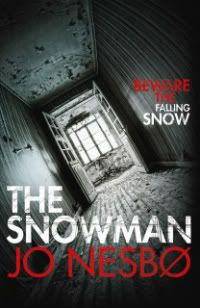
Sure, I’m kidding, but enough people were hanging on for Jo Nesbø’s latest that a not insignificant unrest could have occurred. These Nordic thrillers, they’re capturing the hearts of everyone, myself included. From Steig Larsson’s The Girl with the Dragon Tattoo and its two sequels to authors Henning Mankell, Camilla Lackberg and Jo Nesbø, the world can’t get enough of these dramatic and chilly tales. Blood dripping bright red against the snow. Bodies found frozen under ice, their faces contorted into expressions of horror. And in The Snowman, ominous snowmen built outside the homes of victims, draped in their scarves.
I loved The Snowman; this is the first book I’ve read by Nesbø and I now want desperately to read more. Inspector Harry Hole (I would be interested to know the correct pronunciation as I just read it in my Australian brain accent) is the hero of the book, a man with a drinking problem and a troubled past yet beyond the cliché that appears as and into reality. He has been put on the case of what could possibly be Norway’s first serial killer, someone who abducts women and then kills them in spectacularly bloodthirsty fashion. What these women have in common—if, in fact, they do—is what Hole aims to find out, along with who the killer is, and why Harry is beginning to feel he’s being followed.
He juggles his case along with his other problems: the cynicism of the men in charge who don’t particularly like him; his ex-girlfriend, the affable Rakel; Oleg, Rakel’s son, who by mutual agreement still hangs out with Harry; a new co-worker, the smart and tough Katrine Bratt who surprises at every turn. The character depth is wonderful, with involving snippets from just about everyone, even those just passing through, so that everyone feels beautifully fleshed out and you feel utterly invested in the story. The Snowman is full of red herrings and surprises, and just enough blood and gore to make it a thrilling crime novel without causing you throw up the two-minute noodles you ate for lunch.
It does suffer from a very twee and annoying literary quirk that I can’t say for sure is Nesbø or the translator’s work: it will repeat the last line of a section as the first sentence of the new section.
...He had come all the way back here and slaughtered a chicken. But why? A kind of voodoo ritual? A sudden inspirations? Rubbish, this killing machine stuck to the plan, followed the pattern.
There was a reason.
Why?
‘Why?’ Katrine asked.
Why? I also ask. This is amusing in small doses, but happens so often it become very forced and tiring, especially when the rest of the writing is just heavenly. The Snowman is the kind of book that reminds me why I adore crime—because I love to be surprised, I love to give little gasps of shock when I find out who the killer is, or what the connection is. I love it when they are set in a place I am unlikely to go and that is very cold and striking and where the women are less likely to be assessed on their dress because everyone is wearing heavy overcoats and mittens and their breath comes out in fog when they speak. And so on. I’ve never actually been to the snow so there is a chance I’ve romanticised it in my mind.
Apart from two loose ends that I found a bit frustrating, one of which may be saved for the sequel (and oh how I am waiting for the sequel, The Leopard, to get released here), The Snowman manages to be a book I seem to spend a lot of time complaining about but that I enjoyed so much it has revitalised an entire genre for me. If any more volcanoes erupt and spoil my reading fun, I’ll be right there with my “JUST SAY NO TO EYJAFJALLAJÖKULL” placard.
 Australia is renowned Australia-wide for being an absolutely fantastic country for churning out movies set in suburbia that are about how awful and mundane life is and how violent it can be to live in even the most innocuous of places. Australian film is made almost entirely of grit; light-hearted movies like Bran Nue Dae are few and far between. As a rule, I stay away from gritty films, because they just don’t float my boat. But Animal Kingdom had received such outstanding reviews from the press and from friends that I decided it was time to launch myself back into the dirty reality of living in Melbourne, where the underbelly of crime is interesting enough that they made a television show about it and then banned it from being shown here. Plus, I do want to support Australian cinema, because one day they’ll make the film adaptation of my Great Australian Novel, right?
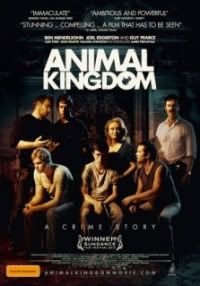
Animal Kingdom is the tale of a criminal family—a film based loosely on the Walsh Street killings, immortalised in book form by Tom Noble (who cameos in the film as a warden) and translated for the screen by David Michod, who also directed and can barely walk now for all the plaudits loaded upon him. Joshua “J” Cody is a teenager who has just lost his mother, and with no one else to turn to, calls his estranged grandmother for help. Smurf, as she is known, takes him in, and thus he is brought into their criminal lifestyle, where violence and drugs are the norm and armed robbery is how they make their income. The cops are watching their homes and everyone is nervous. Throw in a new young member of the family and, frankly, it can’t go well.
This is a good movie, no doubt. It has an all-star cast, with Jacki Weaver as Smurf, Ben Mendelsohn as J’s uncle Pope, an Edgerton as family pal Baz, Guy Pearce as policeman Leckie, and newcomer James Frecheville as Jay. The plot is real and interesting, the locations excitingly, well, local (note: may apply to myself and my nearby readers only) and the script tight. Despite the subject matter, it is never gory or overtly sexual just for the sake of it. But after hearing the words “amazing” and “incredible” used to describe it, I don’t think it could live up to how fantastic it was going to be in my head.
The problem was investment. Not the financial kind—especially as I had a couple of movie vouchers lying around to get me in—but the character kind. With virtually everyone in the film criminals, including some of the police force, I just didn’t care if everyone died. J’s family were all terrible people who killed and stole and were mean to women. J himself kept a blank face devoid of all charm. To be honest, apart from J’s girlfriend’s gloriously normal family, the only person who wasn’t a giant tool of some kind was Guy Pearce’s Leckie, and he had such a bad moustache that I couldn’t muster up the energy to feel for him either. Which is fine—not everyone needs to be charming to be deserving of life—but it meant that tension was lacking, unlike Harry Brown, where you were desperate for Michael Caine’s Harry and Emily Mortimer’s police officer to survive, and every moment with them in danger was spent on the edge of your seat. It was, however, a brilliant portrait of criminal families, and Jacki Weaver’s Smurf is possibly the most reprehensible of them all: a woman who will not dirty her hands with criminal acts but who shamelessly adores her sons and will do anything in her power to keep them happy, manipulating whoever she can to do so.
There are no down-home comfort moments, no times of levity to understand why the family unit is a bearable one. When I was in high school, I went to a friend’s house once to find an unnerving situation: his mother sitting at the dining room table, chopping the marijuana they grew in their backyard into a little bowl, while her sons let out their anger with violence against the walls or the people around them. It was an awkward, bizarre and faintly dangerous situation to me, and while movies can never compare to reality, I felt little of the same anxiousness watching Animal Kingdom that I did that day.
Animal Kingdom is a worthwhile watch, but I didn’t shake with fear or cry, and I bawl in pretty much anything, including ads for Domestic Blitz or similar help-related television shows when the family looks thrilled about whatever’s happened. It doesn’t take much to set me off into emotional turmoil, and I felt strangely distanced from the whole movie. Still, if you love Underbelly, or hearing someone say the phrase “Bridge Road, Richmond” so you can yell at the screen, “I totally go there for coffee sometimes!” then Animal Kingdom is the film for you.
 The world is thrilled by a big disaster. See the unpronouncable Icelandic volcano Eyjafjallajökull, spurting out ash and stranding travellers all over Europe. And a pandemic—well, everyone gets into a frenzy about those, like last year’s swine flu, which threatened to take on Spanish flu proportions but essentially had a lesser fatality rate (though any fatality rate is terrible) than the normal flu. Before that, the panic was avian flu. But what would have happened in a world where avian flu was actually an international disaster? The comic Chew is here to tell you.
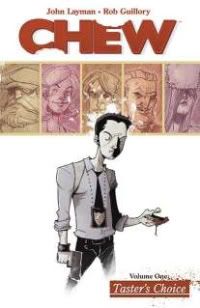
23 million Americans have died of bird flu. Chicken is, predictably, banned, but there is a flourishing black market for it. Detective Tony Chu is on the case, staking out such organisations with his partner. But Chu isn’t just your everyday cop (who is in the world of comics?) but is, in fact, Cibopathic. What is that? you ask, scrambling for your medical dictionary. Well, you won’t find it in there, so put it down and get back to reading this. Cibopaths can get impressions from what they eat on the history of where their food came from. Eating an apple will tell Cibopaths where the orchard was that it grew from and what pesticides were used. Eating a steak is accompanied by the unpleasant knowledge of how said steak got on the plate. The only food that Chu doesn’t react to is beets. And if anything will make me personally feel empathy for a character, it’s the knowledge they can only eat beetroot. Nightmarish stuff.
When a stakeout of an underground chicken restaurant turns into a much more dramatic discovery, Chu’s talent is discovered by higher powers: the Food and Drug Agency. He is recruited by the FDA as an agent with the special crimes division, and finds out he’s not the only Cibopath in the team. Also able to eat and detect is Mason Savoy, the size of a house, ridiculously tough, and, with his particular distinguished talking style whilst causing mayhem, aching to be played in my imaginary movie version by Vinnie Jones in a fatsuit. The team is rounded out by Mike Applebee, in charge of both men and a raging jerk. And together, they fight crime. And how do they do that? Well, to get a sense of their final moments (and earlier), occasionally they snack on bits of dead or dying people. Also a dog, at one point. It’s not pleasant.
It’s a novel way of crimefighting and will put you off your dinner if you’re thinking of eating anything with a possibly turbulent past. (I was eating popcorn while I read it and tried not to imagine that the kernels were in the saucepan crying out as I gleefully caused them to turn inside out.) The entire comic is great fun, the story arc for this volume, Taster’s Choice, involving yakuza, Arctic telescope stations, dismembered fingers, Russian girls in their underpants with machine guns, betrayal, possible aliens and even a little bit of love. Serious when need be, Guillory’s drawing style is angular, full of expression, and makes every scene exciting and—my favourite part—clear. In other comics, so much can be going on in a page that I spend far too long figuring out and even then being a bit confused, but this manages to have a sufficient amount of action and still be absolutely understandable. Action’s not entirely what this comic is about, however, with our Tony just trying to figure out what he’s doing in this new world, dominated with people cynical of the bird flu and out to tell the world no matter what the cost. And why he’s suddenly chomping down on the cremated remains of a Senator.
There to capture Tony’s heart is the lovely Amelia Mintz, who also has a word you’ll want to look up (but don’t bother): she’s a Saboscrivner. She can write about food so vividly that those who hear or read her words can taste the food she’s talking about just as clearly as if they were eating it. And for someone who can’t eat anything without collapsing into angst, she’s the woman of his dreams. Trouble is, he’s been sent by Applebee to do something about her, after she took to writing about less than pleasant restaurants and dragged the city’s population there with her.
It’s wonderfully rendered, with Rob Guillory’s excellent illustration perfectly matching John Layman’s rollicking storytelling. (I should be commended here for my overuse of the double-l in that last sentence.) The colour is sharp, the people of all shapes and sizes, the line between caricature and realism made blurry. It’s as enjoyable to look at as it is to read. As long as you have a relatively strong stomach for some gore.
This has been sitting for far too long on my shelf untouched by me, and while I’m partly angry at myself for waiting to get into something that’s this entertaining, I’m pleased that Volume Two, International Flavor, has just been released, collecting issues #6 to #10. I’m going to get my grubby paws on a copy as soon as I can.

 Not at all the new Girl with the Dragon Tattoo like the press is desperately trying to pass it off as, Headhunters is completely different, both in plot, character, and feel—and it’s excellent fun. Thundering along at great speed and with a main character who will lose your affections at the start and then win you back, this is how crime movies should be made.