Man, it's been so long since I last posted a review here that the entire dashboard has changed and I am confused. What's with these new buttons? What is this thing you call "Publish"? I'm pretty sure when I last posted the option was "Chisel into stone". Anyway, with my beloved on school holidays we have manipulated many of our relations into babysitting for us and seen quite a few movies ("quite a few" in the way that parents of young children see nothing new unless they illegally download it and then watch it over three days over the periods where said kids are not throwing cornflakes on the floor or finding glasses of water to knock over.)
47 Ronin has received many terrible reviews. On Metacritic, its score was 29 (out of 100, for those sensible people who don't care about review sites that aren't, obviously, this amazing one right here.) I assumed it was going to be so awful that I would spend most of it composing mean tweets in my head, should I ever see it. And then I scored some free tickets, which meant that I could see it, with no guilt. Score!
Keanu Reeves plays Kai, a "half-breed" found almost dead in a river as a youth and brought up by the compassionate Lord Asano (Min Tanaka), though all around him treat him badly apart from Asano's daughter, Mika (Ko Shibasaki). The town they live in is visited by the Shogun, who is accompanied by a rival lord, the constantly smarmy Lord Kira (Tadanobu Asano). Kira has dire plans for the town, however, along with the magical, nameless shapeshifter played with absolute alarming creepiness by Rinko Kikuchi, whom I will love forever after being in Pacific Rim. After manipulating the event and causing Lord Asano to commit seppuku to restore his now-bad name, the town's army, left as ronin--masterless samurai--decide to fight for Asano's honour, despite the quest meaning certain death.
About halfway through I leaned over and whispered to Chris, "What is everyone talking about? This is a perfectly serviceable movie!" At the end, I cried. (Don't read the Wikipedia entry on the true story of the forty-seven ronin, it is spoiler central.) This is a movie that had a good pace, knew how long to make the action scenes without giving the viewer fight fatigue, was populated by a large amount of handsome male actors with long hair (swoon), and never once made me look impatiently at my watch. The acting was all marvellous--Keanu wooden as per usual but it works as a stoic samurai-type--and it even passed the Bechdel test, with both Rinko Kikuchi's witch and Ko Shibasaki's Mika princess tough as nails.
Of course it has flaws: it's a Japanese myth made by Hollywood, with Reeves as a half-breed when there was no such person in the original story. It's frustrating, because Hollywood is so obsessed with white people saving the day in every nation, and Reeves' closest tie with Asia is being one-quarter Chinese-Hawaiian (Hawaii having a large Japanese influence, however.) At least the rest of the cast were Japanese and not from a variety of unrelated Asian countries *cough*Crouching Tiger*cough*; also, Asano's 2IC, Oishi (Hiroyuki Sanada, my boyfriend from Sunshine) is just as much the hero, and mostly more useful, than Kai. The one ronin who is more big-boned than the rest supplies comic relief through his weight alone, which also feels out of place. The Japanese witchcraft doesn't add much to the tale, so could be done without; one frighteningly large silver samurai is mysterious right until it is unmysteriously dispatched but without an explanation for its origins. Also, that all-over-tattoo dude from the posters has like one line and ten seconds of screen time, would it have killed advertisers to put Sanada or Shibasaki on it? Jeez.
But kudos to the filmmakers for staying fairly close to the bones of the original story, for totally surpassing my low expectations, and for the most un-Hollywood ending I've seen in a long time. I give this 47 out of 70 Ronin.
Showing posts with label movies. Show all posts
Friday, January 24, 2014
Saturday, November 10, 2012
bachelorette
Movies like Bachelorette, The Hangover and Bridesmaids make me feel like getting married is a complete lapse of judgement that will end with you in some kind of physical or emotional pain on what is touted as the best day of your life. I also am beginning to think that I have a very rare thing in my life: friends who are not assholes. Is it really that hard not to be an asshole? Bachelorette says: apparently it is very hard.
Becky (Rebel Wilson) tells her dear friend Regan (Kirsten Dunst) that she is engaged to her high school sweetheart, Dale (Hayes MacArthur). Despite this piece of apparent good news, Regan calls their mutual friends Katie (Isla Fisher) and Gena (Lizzy Kaplan, who also starred in a previous mean girl movie called Mean Girls) to immediately anguish over the fact her boyfriend hasn’t proposed to her (because in Hollywood, relationships aren’t real unless you’re married), and why does Becky deserve a decent husband anyway?
Then the movie fast forwards to the day before the wedding. Regan, as maid of honour, has declared herself in charge of the wedding and is cruel to the help. Katie assists by bringing a vast amount of cocaine. Gena is pouting because her ex Clyde (Adam Scott) will be there and she has Unfinished Angst about him. Together, the girls ruin Becky’s bachelorette party with an obnoxious stripper, get told by Becky to grow up, and proceed to Become Mature People by laughing about how they can fit two people in Becky’s wedding dress, which they then tear. Can they fix it in time to not ruin Becky’s wedding? Will they encounter handsome men? Will they all die at the end in a fiery explosion? WE CAN ONLY HOPE SO.
Bachelorette fails because the cast is so vehemently unlikeable. Regan does nothing but shout, and when she whines about not getting proposed to, you assume it’s because she’s a monster. Katie is painted as the ditz and really is so ridiculously stupid, which she exacerbates by being almost constantly high, that she is entirely unrelatable. Gena is the one I think the audience is supposed to bond with, and harbours a fairly grim secret with Clyde which adds some romantic tension in a sea of pricks (see: Dale’s friend Trevor, played with jerky abandon by James Franco) and needs to move on with her life and perhaps not be so horrible. But lord, you just don’t care about what happens to them. You wish for them to succeed because Becky seems like a nice person who suffered through high school and who clearly isn’t great at picking acquaintances, but otherwise, just...sigh. Many of the characters (Regan, Katie to an extent, most of the men) don’t get enough backstory to connect with the viewer, and some of the lessons—like, bulimia saves lives!—will make you shake your head.
There are some great lines, Adam Scott is totally a babe who does one of the best wedding speeches you’ll ever hear, it passes the Bechdel Test easily and I’m super pleased Rebel Wilson is getting famous. Also, she kills with the line: “People think I’m too fat for Dale.” Regan’s response is good, but Becky is right. Her friends are horrible. That is the only lesson to take away from this.
I give it three out of six bridesmaids. And even those three bridesmaids are wearing dresses that they will never wear again.
Becky (Rebel Wilson) tells her dear friend Regan (Kirsten Dunst) that she is engaged to her high school sweetheart, Dale (Hayes MacArthur). Despite this piece of apparent good news, Regan calls their mutual friends Katie (Isla Fisher) and Gena (Lizzy Kaplan, who also starred in a previous mean girl movie called Mean Girls) to immediately anguish over the fact her boyfriend hasn’t proposed to her (because in Hollywood, relationships aren’t real unless you’re married), and why does Becky deserve a decent husband anyway?
Then the movie fast forwards to the day before the wedding. Regan, as maid of honour, has declared herself in charge of the wedding and is cruel to the help. Katie assists by bringing a vast amount of cocaine. Gena is pouting because her ex Clyde (Adam Scott) will be there and she has Unfinished Angst about him. Together, the girls ruin Becky’s bachelorette party with an obnoxious stripper, get told by Becky to grow up, and proceed to Become Mature People by laughing about how they can fit two people in Becky’s wedding dress, which they then tear. Can they fix it in time to not ruin Becky’s wedding? Will they encounter handsome men? Will they all die at the end in a fiery explosion? WE CAN ONLY HOPE SO.
Bachelorette fails because the cast is so vehemently unlikeable. Regan does nothing but shout, and when she whines about not getting proposed to, you assume it’s because she’s a monster. Katie is painted as the ditz and really is so ridiculously stupid, which she exacerbates by being almost constantly high, that she is entirely unrelatable. Gena is the one I think the audience is supposed to bond with, and harbours a fairly grim secret with Clyde which adds some romantic tension in a sea of pricks (see: Dale’s friend Trevor, played with jerky abandon by James Franco) and needs to move on with her life and perhaps not be so horrible. But lord, you just don’t care about what happens to them. You wish for them to succeed because Becky seems like a nice person who suffered through high school and who clearly isn’t great at picking acquaintances, but otherwise, just...sigh. Many of the characters (Regan, Katie to an extent, most of the men) don’t get enough backstory to connect with the viewer, and some of the lessons—like, bulimia saves lives!—will make you shake your head.
There are some great lines, Adam Scott is totally a babe who does one of the best wedding speeches you’ll ever hear, it passes the Bechdel Test easily and I’m super pleased Rebel Wilson is getting famous. Also, she kills with the line: “People think I’m too fat for Dale.” Regan’s response is good, but Becky is right. Her friends are horrible. That is the only lesson to take away from this.
I give it three out of six bridesmaids. And even those three bridesmaids are wearing dresses that they will never wear again.
Saturday, September 22, 2012
ruby sparks
In a plotline that feeds into the fantasies of 90% of people who work in cafes, an author defeats writer’s block by writing about a woman he dreams of, who then comes to life and is able to be controlled by said author’s typing. I mean, this guy—Calvin, nearing thirty, played by Paul Dano—had already written a bestseller at age 19, and lives off his writing. This is more unrealistic than bringing a girl to life with your mind, but is strangely not the topic of the movie.
Calvin is moping about, friendless, dateless, and not writing but being harassed about it, when he dreams of a girl and they have a nice conversation without any usual weird dream things like it being in your old bedroom but actually on Mars or anything. Inspired by that and his therapist Dr Rosenthal (Elliot Gould), he writes about her, and thus Ruby Sparks (Zoe Kazan, also the writer and one of the producers) springs to life one morning as Calvin runs about panicking about being late. Reacting perfectly to the presence of a strange woman in his house by hiding from her and freaking out, it takes a while for him to comprehend that she is real, really real and wonderful and fun and just the girl for him. Which is grand, until their relationship hits a few minor speed bumps and Calvin, in a panic, gets back onto his typewriter and changes her course.
What are the ethics of controlling someone, even when they’re not entirely real? What about if you think it’s for their own good, to make them happy? What would you do in the same situation? (We discussed it while we were watching: write them a huge trust fund and a bright red convertible Cadillac.) What is behind Calvin’s need for control over those in his life? Ruby Sparks is thrown around as a lightweight comedy but has a lot of depth and seriousness; you won’t always be laughing, and everyone is not perfect. While it outright discusses (without the name) Manic Pixie Dream Girls and how they are not practical as human beings, it raises other questions, for me anyway: why are men compelled to write women with sexually turbulent pasts? Did it not pass the Bechdel Test on purpose to make a point about women being idealised?
Well now that serious contemplation is out of the way, I will say that it’s a great movie: the acting is sincere, the characters bounce off each other well—Calvin’s much more normal brother Harry (Chris Messina) is a good straight logical man without coming across as boring because of it; Annette Bening and Antonio Banderas (sigh) as Calvin’s mother and stepfather are an interesting look into Calvin’s psyche; Calvin’s dog Scotty is suitably fuzzy—and make it a believable situation in a believable world. When Calvin tries to alter Ruby’s personality and finds things inevitable screw up, it makes for both humorous and slightly-to-very depressing situations. It’s an interesting idea and it’s been done well. As a bookseller, one of my favourite things about it was that the book covers in the movie were actually great instead of the crap they usually put out in films—mostly, the author’s name IN VERY BIG LETTERS in case you weren’t sure the book they were signing was their own. If these books turned up in my store, I would buy them. Kudos to their art department then, and to their set designers for Calvin’s stepfather’s forest-like house, which is the most divine place you’d ever want to live in armed with lots of bug spray.
Ruby Sparks is quirky and delightful while avoiding cliché and never straying into comedy for the sake of it. You could do a lot worse than this film next time you’re out and about. I give it four out of five houses with swimming pools.
Calvin is moping about, friendless, dateless, and not writing but being harassed about it, when he dreams of a girl and they have a nice conversation without any usual weird dream things like it being in your old bedroom but actually on Mars or anything. Inspired by that and his therapist Dr Rosenthal (Elliot Gould), he writes about her, and thus Ruby Sparks (Zoe Kazan, also the writer and one of the producers) springs to life one morning as Calvin runs about panicking about being late. Reacting perfectly to the presence of a strange woman in his house by hiding from her and freaking out, it takes a while for him to comprehend that she is real, really real and wonderful and fun and just the girl for him. Which is grand, until their relationship hits a few minor speed bumps and Calvin, in a panic, gets back onto his typewriter and changes her course.
What are the ethics of controlling someone, even when they’re not entirely real? What about if you think it’s for their own good, to make them happy? What would you do in the same situation? (We discussed it while we were watching: write them a huge trust fund and a bright red convertible Cadillac.) What is behind Calvin’s need for control over those in his life? Ruby Sparks is thrown around as a lightweight comedy but has a lot of depth and seriousness; you won’t always be laughing, and everyone is not perfect. While it outright discusses (without the name) Manic Pixie Dream Girls and how they are not practical as human beings, it raises other questions, for me anyway: why are men compelled to write women with sexually turbulent pasts? Did it not pass the Bechdel Test on purpose to make a point about women being idealised?
Well now that serious contemplation is out of the way, I will say that it’s a great movie: the acting is sincere, the characters bounce off each other well—Calvin’s much more normal brother Harry (Chris Messina) is a good straight logical man without coming across as boring because of it; Annette Bening and Antonio Banderas (sigh) as Calvin’s mother and stepfather are an interesting look into Calvin’s psyche; Calvin’s dog Scotty is suitably fuzzy—and make it a believable situation in a believable world. When Calvin tries to alter Ruby’s personality and finds things inevitable screw up, it makes for both humorous and slightly-to-very depressing situations. It’s an interesting idea and it’s been done well. As a bookseller, one of my favourite things about it was that the book covers in the movie were actually great instead of the crap they usually put out in films—mostly, the author’s name IN VERY BIG LETTERS in case you weren’t sure the book they were signing was their own. If these books turned up in my store, I would buy them. Kudos to their art department then, and to their set designers for Calvin’s stepfather’s forest-like house, which is the most divine place you’d ever want to live in armed with lots of bug spray.
Ruby Sparks is quirky and delightful while avoiding cliché and never straying into comedy for the sake of it. You could do a lot worse than this film next time you’re out and about. I give it four out of five houses with swimming pools.
Monday, September 17, 2012
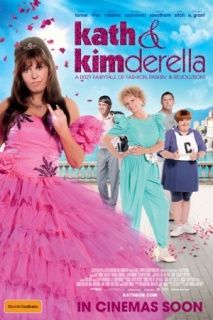
kath & kimderella
Have you heard of the sandwich way of criticism? It’s when you need to say something bad about someone who you’re trying to encourage, or who you like, or who will roll up their manuscript/screenplay/comic and beat you about the head with it if you are mean. (I am this person.) You sandwich the bad criticism between good criticism.
Like, for instance, Kath & Kimderella. I enjoyed the first season of Kath & Kim (I bought it on VHS, in case you were curious about how long ago it started). Kath & Kimderella is possibly the worst movie to ever grace the big screen. But Woodley was very funny.
See? A nice gentle criticism sandwich.
Kath (Jane Turner) and Kim (Gina Riley) are both angsting about the missing sparkle (or “vajazzle”, as Kath would and does say) in their relationships when plot encouragement occurs for them as Kath wins a competition at her local chemist for a trip to the Spanish outpost of Pampilloma, located in the south of Italy. Upon their arrival they discover that the whole place has gone bankrupt and their hotel has shut down, but after a tour of the local castle the king (Rob Sitch with luscious hair) misinterprets their knockoff label clothes as the real thing, assumes they’re rich and attempts to seduce Kath for her apparent wealth. His son, hiding his features behind a mask, falls for Kim after seeing her with a t-shirt that says PRINCESS on it in sparkles. Hijinks ensue. Sigh.
The central conceit isn’t really a problem—give me enough jokes and any plot is fine. But crucially, Kath & Kimderella is not funny. It’s not funny when Kath, Kim and Sharon (Magda Szubanski, along for the ride) go outlet shopping and the girls run around sped up like a Benny Hill skit. The same sped-up schtick is also not funny when Kath uses what she thinks is the castle’s gym but is in fact their dungeon (LOL HAHA except that it is actually totally a gym). It’s not funny when Kath and King Javier go for a ride on their Vespa against some green screen so obvious that it could almost be a joke, but just looks bizarrely cheap against the rest of the movie’s actually decent backdrops. It’s not funny when the plot stagnates halfway through, and it’s not funny that all the twists are completely obvious from the moment the characters appear on the screen.
It’s also confusing when the poor men, left at home to watch telly in their Snuggies, decide to go fight the royals for their women. Kath’s husband Kel (Glenn Robbins) commits an act on an airplane that would surely get him banished from all flights forever, but then turns up mysteriously in Europe five minutes later to save the day. And, even more mysteriously, arrives before Kim’s own husband Brett (Peter Rowsthorn), who was on either the same flight or an earlier one. Uh, spoiler alert. Also, Gina Riley looks amazing and while I certainly can’t rock a midriff top, I’m a bit over the whole “ugh, look at her in an outfit that’s too small lulz” thing. Wear what you want and get over it.
Oh hey, It wasn’t entirely awful. Kim’s cutting little digs were occasionally funny, and the cinema popcorn was nice, and the bit where the king and Kath address a crowd and Frank Woodley signs for the hearing impaired made me shake with laughter. This hasn’t made me dislike Turner and Riley, whom I admire greatly for making me laugh numerous times over the years, but I really did not enjoy this. Though I did just see a review on IMDb by summerblink that stated “To everyone who didn't find it amusing - there's so much of Australian culture you do understand. If you call yourself an Aussie, you should be ashamed.” And I’m glad people like it, honestly, but here I am in shame, saying I give it 9 out of 86 minutes.
Like, for instance, Kath & Kimderella. I enjoyed the first season of Kath & Kim (I bought it on VHS, in case you were curious about how long ago it started). Kath & Kimderella is possibly the worst movie to ever grace the big screen. But Woodley was very funny.
See? A nice gentle criticism sandwich.
Kath (Jane Turner) and Kim (Gina Riley) are both angsting about the missing sparkle (or “vajazzle”, as Kath would and does say) in their relationships when plot encouragement occurs for them as Kath wins a competition at her local chemist for a trip to the Spanish outpost of Pampilloma, located in the south of Italy. Upon their arrival they discover that the whole place has gone bankrupt and their hotel has shut down, but after a tour of the local castle the king (Rob Sitch with luscious hair) misinterprets their knockoff label clothes as the real thing, assumes they’re rich and attempts to seduce Kath for her apparent wealth. His son, hiding his features behind a mask, falls for Kim after seeing her with a t-shirt that says PRINCESS on it in sparkles. Hijinks ensue. Sigh.
The central conceit isn’t really a problem—give me enough jokes and any plot is fine. But crucially, Kath & Kimderella is not funny. It’s not funny when Kath, Kim and Sharon (Magda Szubanski, along for the ride) go outlet shopping and the girls run around sped up like a Benny Hill skit. The same sped-up schtick is also not funny when Kath uses what she thinks is the castle’s gym but is in fact their dungeon (LOL HAHA except that it is actually totally a gym). It’s not funny when Kath and King Javier go for a ride on their Vespa against some green screen so obvious that it could almost be a joke, but just looks bizarrely cheap against the rest of the movie’s actually decent backdrops. It’s not funny when the plot stagnates halfway through, and it’s not funny that all the twists are completely obvious from the moment the characters appear on the screen.
It’s also confusing when the poor men, left at home to watch telly in their Snuggies, decide to go fight the royals for their women. Kath’s husband Kel (Glenn Robbins) commits an act on an airplane that would surely get him banished from all flights forever, but then turns up mysteriously in Europe five minutes later to save the day. And, even more mysteriously, arrives before Kim’s own husband Brett (Peter Rowsthorn), who was on either the same flight or an earlier one. Uh, spoiler alert. Also, Gina Riley looks amazing and while I certainly can’t rock a midriff top, I’m a bit over the whole “ugh, look at her in an outfit that’s too small lulz” thing. Wear what you want and get over it.
Oh hey, It wasn’t entirely awful. Kim’s cutting little digs were occasionally funny, and the cinema popcorn was nice, and the bit where the king and Kath address a crowd and Frank Woodley signs for the hearing impaired made me shake with laughter. This hasn’t made me dislike Turner and Riley, whom I admire greatly for making me laugh numerous times over the years, but I really did not enjoy this. Though I did just see a review on IMDb by summerblink that stated “To everyone who didn't find it amusing - there's so much of Australian culture you do understand. If you call yourself an Aussie, you should be ashamed.” And I’m glad people like it, honestly, but here I am in shame, saying I give it 9 out of 86 minutes.
Tuesday, June 26, 2012
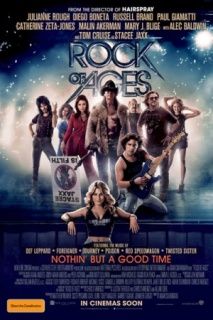
rock of ages
It was my thirtieth birthday last Wednesday, and I was determined to take myself and the kidlet out and do A Thing during the day instead of sitting around incessantly shaking a stuffed robot at her and singing songs about Masterchef contestants. Unfortunately, the only option was the terrible-looking Rock of Ages (I’ve already done 1987 once, and that was enough.) But after a scare where we thought the babes in arms movie option was instead Adam Sandler laugh-an-hour fest That’s My Boy, suddenly it seemed like a perfectly serviceable film, and, thanks to a lovely new mother-type friend who also jumped at the chance to go to the flicks during daytime hours, off we went to see it with our best perms and midriff-baring band t-shirts. (Haha I’m kidding, my stomach looks like I was in the last Freddy Kreuger movie.)
Peachy blonde bubble of enthusiasm Sherrie (Julianne Hough) arrives in Hollywood from the town of Dreamsquasher USA and within minutes is mugged then saved by mop of curly hair Drew (Diego Boneta), an employee of the famed Bourbon Room who also kindly nabs her a job there. Both are musicians, and the Bourbon Room is a haven for rock music lovers after giving Stacee Jaxx (Tom Cruise, channelling Axl Rose et al) his big break. But the Room is in trouble, with owner Dennis Dupree (Alec Baldwin, greying) and his cohort Lonny (Russell Brand as the only person who didn’t need a wig) running out of cash and fame. In the meantime, Mayor Whitmore’s wife Patricia (Catherine Zeta-Jones, underused) is on a mission to destroy rock music because sex, Stacee is going through a career crisis, and Drew and Sherrie’s fledging relationship is threatened by Drew’s shot at fame. And all this is conveyed through songs you probably know the words to.
While the music generally grated on me, it was a pretty entertaining film, relentless in its mashed-up tunes and enthusiastic actors. Tom Cruise is a good choice as Stacee, who is a tool, so you don’t have to force yourself to get behind him. He’s all excess, big-haired groupies and dragon-head codpieces, swanning about in a grotesque manner that will make you squirm and laugh and squirm. The singers are all passable to great, with Sherrie and Drew smiley endearing kids you want to see live happily ever after. The highlight, however, is the surprisingly touching relationship between Dennis and Lonny, two meathead looking dudes harbouring a lot of secret Feelings. The lowlight, though, is the other two hours of the movie.
Rock of Ages is terrible. They should have just done a live covers concert and be done with it, because the plot is so thin on the ground I’m not sure why they bothered. One or two lines of dialogue are in between each song and are so earnest and ridiculous that you’ll sigh and wish for the next dose of Bon Jovi. There are decade errors like the hipster-style underpants worn by Malin Ackerman’s Rolling Stone journalist Constance Sack, who also suffers from a painful dose of cliché when she turns up in glasses and a hairclip and is only attractive, apparently, after she loses both. Patricia’s plan to demolish rock is never a threat, not even for a moment, and everyone seems to know it, making Zeta-Jones a pointless addition who also has the most redundant song and dance routine in a rendition of Pat Benatar’s “Hit Me With Your Best Shot” that looks like it’s been choreographed by someone who never read the screenplay to see what was going on. (Lucky them.) Sherrie, down and out after leaving the Bourbon Room, stalks angrily out of a job at a diner when someone slaps her on the ass, only to go directly into a waitressing job at a strip club and then be told by boss Justice (Mary J Blige, talented but another unnecessary part) that the only way to get respect is to become a pole dancer. (Obviously pole dancers and everyone in the sex industry deserve respect, but deserving more than a waitress is a bizarre concept and has no relation to the rest of the movie anyway. I was tuning out completely by this point.) I also dislike the way the movie mocks the late-eighties angular-primary-colours pop that was blooming on the radio—anyone who makes fun of another’s musical taste is a jerk. As Stacee Jaxx’s agent, Paul Gill (Paul Giamatti) is such a complete idiot that I assumed he deliberately wanted to be broke and despised. You know what, I actually have a lot of rage for this movie, I think I have to stop before I set my keyboard on fire.
An adequate movie that you’ll enjoy more if you’re a fan of cock rock. If you’re not, watch it with a sarcastic friend for much more fun. I give it 500 out of 1987 years.
Peachy blonde bubble of enthusiasm Sherrie (Julianne Hough) arrives in Hollywood from the town of Dreamsquasher USA and within minutes is mugged then saved by mop of curly hair Drew (Diego Boneta), an employee of the famed Bourbon Room who also kindly nabs her a job there. Both are musicians, and the Bourbon Room is a haven for rock music lovers after giving Stacee Jaxx (Tom Cruise, channelling Axl Rose et al) his big break. But the Room is in trouble, with owner Dennis Dupree (Alec Baldwin, greying) and his cohort Lonny (Russell Brand as the only person who didn’t need a wig) running out of cash and fame. In the meantime, Mayor Whitmore’s wife Patricia (Catherine Zeta-Jones, underused) is on a mission to destroy rock music because sex, Stacee is going through a career crisis, and Drew and Sherrie’s fledging relationship is threatened by Drew’s shot at fame. And all this is conveyed through songs you probably know the words to.
While the music generally grated on me, it was a pretty entertaining film, relentless in its mashed-up tunes and enthusiastic actors. Tom Cruise is a good choice as Stacee, who is a tool, so you don’t have to force yourself to get behind him. He’s all excess, big-haired groupies and dragon-head codpieces, swanning about in a grotesque manner that will make you squirm and laugh and squirm. The singers are all passable to great, with Sherrie and Drew smiley endearing kids you want to see live happily ever after. The highlight, however, is the surprisingly touching relationship between Dennis and Lonny, two meathead looking dudes harbouring a lot of secret Feelings. The lowlight, though, is the other two hours of the movie.
Rock of Ages is terrible. They should have just done a live covers concert and be done with it, because the plot is so thin on the ground I’m not sure why they bothered. One or two lines of dialogue are in between each song and are so earnest and ridiculous that you’ll sigh and wish for the next dose of Bon Jovi. There are decade errors like the hipster-style underpants worn by Malin Ackerman’s Rolling Stone journalist Constance Sack, who also suffers from a painful dose of cliché when she turns up in glasses and a hairclip and is only attractive, apparently, after she loses both. Patricia’s plan to demolish rock is never a threat, not even for a moment, and everyone seems to know it, making Zeta-Jones a pointless addition who also has the most redundant song and dance routine in a rendition of Pat Benatar’s “Hit Me With Your Best Shot” that looks like it’s been choreographed by someone who never read the screenplay to see what was going on. (Lucky them.) Sherrie, down and out after leaving the Bourbon Room, stalks angrily out of a job at a diner when someone slaps her on the ass, only to go directly into a waitressing job at a strip club and then be told by boss Justice (Mary J Blige, talented but another unnecessary part) that the only way to get respect is to become a pole dancer. (Obviously pole dancers and everyone in the sex industry deserve respect, but deserving more than a waitress is a bizarre concept and has no relation to the rest of the movie anyway. I was tuning out completely by this point.) I also dislike the way the movie mocks the late-eighties angular-primary-colours pop that was blooming on the radio—anyone who makes fun of another’s musical taste is a jerk. As Stacee Jaxx’s agent, Paul Gill (Paul Giamatti) is such a complete idiot that I assumed he deliberately wanted to be broke and despised. You know what, I actually have a lot of rage for this movie, I think I have to stop before I set my keyboard on fire.
An adequate movie that you’ll enjoy more if you’re a fan of cock rock. If you’re not, watch it with a sarcastic friend for much more fun. I give it 500 out of 1987 years.
Monday, June 11, 2012
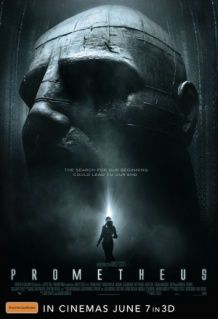
prometheus
One of the cinemas at Hoyts Victoria Gardens has this perfect little oasis called the Crying Room. Maybe nine seats, soundproof walls and glass, tinny sound piped in through speakers, and the opportunity to take any small children you may have to see a film where someone’s helmet is melted onto their face. Yes, I am an amazing mother.
Prometheus is a prequel of sorts to the Alien franchise, started by Ridley Scott and continued by numerous directors in varying levels of excellence and shambles detouring into the Predator universe. Seemingly deciding there was no way forward to pursue, Ridley jumped back into his unicorn-leather director’s chair and helmed a movie set before it all. Drs Shaw (Noomi Rapace) and Holloway (Devil’s Logan Marshall-Green) discover the world’s oldest cave drawings—edgy sketches by the skinny-loinclothed hipsters of 40,000 years ago—and one more piece of a puzzle they’d been collecting. Artworks from diverse cultures and times all had one thing in common: a constellation unable to be seen by the naked eye. Shaw believes she will find her maker in this place, and with a rocket full of shipmates (including a robot, a bureaucrat, some comic relief and a stack of dispensable people you won’t miss when they get splattered), funded by the Weyland Corporation they head off on the two-year journey to this planet. Will they find happiness, peace, and a flowery sunny utopia? Seems likely.
Prometheus hasn’t been receiving the most favourable of reviews, and I can’t say I adored it either. There weren’t any moments of surprise in the film. Spoiler alert: they don’t find happiness, peace, and a flowery sunny utopia. They find dark caverns and goo and aliens so like sexual organs you won’t be able to do any bonking for days. (The penis-worm with the vagina-mouth is a good example noted by my friend Brett.) People have secret agendas on the mission but the agendas of the aliens themselves are never fully explained. Apparently Mr Scott wanted to leave a lot of loose ends to keep people interested in Prometheus 2: The Flubber Returns, but by the end I just assumed he’d done what I do frequently and interrupted his own story with a tangent and interrupted that and so on until he’d forgotten what he was originally talking about. Don’t worry, Ripley, it happens to the best of us. I don’t get paid tens of million dollars to do it though. While I’m on the whiny paragraph, I was thrown by the ship Prometheus itself: it has technology that far surpasses the 8-bit technology on Alien’s mining ship—I mean, my car has more advanced technology than the Nostromo—so even taking into account the fact that the Nostromo isn’t a luxury vessel it seems likely that anything that can make it into space will have a better font. But that’s not a huge problem—it’s not early-80s-Ridley’s fault that technology became amazing, and the audience would hardly believe shitty tech on a ship when our phones alone have Google Earth on them. I was also annoyed by the characters’ lack of emotions—their expressions when discovering alien lands were about as enthusiastic as when you discover a two-dollar coin in your car when you need to pay for parking. You know, pretty pleased, but nothing you’d talk about when you got home to your spouse. Their motivations were confusing at times, with crew member Millburn (a timid Rafe Spall) freaking out at the sight of a long-dead corpse then suddenly not being concerned about reaching out to the aforementioned penis-worm (and calling it “beautiful”, I mean, ew), and the ship’s captain Janek (Idris Elba) not at all worried about leaving Millburn and tattooed redhead Fifield (an unfriendly Sean Harris) in a corpse-ridden hellhole overnight even when the storm keeping them apart only lasted long enough for an (excellent) action scene. The only character whose emotions seemed right was Weyland’s representative Vickers (Charlize Theron, stony), though I guessed her role on the ship right from the start. Most frustrating of all, a particular character undergoes some dramatic stomach surgery, limps around for a bit, then is suddenly sprinting about and flinging themselves onto ledges. I don’t care how advanced medical surgery is in eighty years...just no.
On the upside, though, I was never bored, and the effects of the ship and the aliens and space itself were marvellous (and I saw it in 2D, for the record). There are numerous scenes of dramatic tension that had me clutching at arm rests and people’s hands. The stomach surgery I discussed above was so suspenseful that I was almost climbing the soundproof walls to get to the other end of the scene. All the bad reviews in the world weren’t enough to stop me from seeing this, and the many reviews that list what I’ve discussed above, and probably some smarter or more subtle flaws as well (apparently Holloway yells “Noomi!” instead of “Ellie!” during a particularly sandy part of the movie), shouldn’t be enough to stop you either. It’s not terrible, it’s just that the errors were numerous and obvious. Just about anyone who’s seen this will feel compelled to see the sequel to figure out what the hell’s going on—me included—so it can’t be that bad. Go in with low expectations and you might be pleasantly surprised.
I give it forty out of a hundred jars of black primordial goo.
Prometheus is a prequel of sorts to the Alien franchise, started by Ridley Scott and continued by numerous directors in varying levels of excellence and shambles detouring into the Predator universe. Seemingly deciding there was no way forward to pursue, Ridley jumped back into his unicorn-leather director’s chair and helmed a movie set before it all. Drs Shaw (Noomi Rapace) and Holloway (Devil’s Logan Marshall-Green) discover the world’s oldest cave drawings—edgy sketches by the skinny-loinclothed hipsters of 40,000 years ago—and one more piece of a puzzle they’d been collecting. Artworks from diverse cultures and times all had one thing in common: a constellation unable to be seen by the naked eye. Shaw believes she will find her maker in this place, and with a rocket full of shipmates (including a robot, a bureaucrat, some comic relief and a stack of dispensable people you won’t miss when they get splattered), funded by the Weyland Corporation they head off on the two-year journey to this planet. Will they find happiness, peace, and a flowery sunny utopia? Seems likely.
Prometheus hasn’t been receiving the most favourable of reviews, and I can’t say I adored it either. There weren’t any moments of surprise in the film. Spoiler alert: they don’t find happiness, peace, and a flowery sunny utopia. They find dark caverns and goo and aliens so like sexual organs you won’t be able to do any bonking for days. (The penis-worm with the vagina-mouth is a good example noted by my friend Brett.) People have secret agendas on the mission but the agendas of the aliens themselves are never fully explained. Apparently Mr Scott wanted to leave a lot of loose ends to keep people interested in Prometheus 2: The Flubber Returns, but by the end I just assumed he’d done what I do frequently and interrupted his own story with a tangent and interrupted that and so on until he’d forgotten what he was originally talking about. Don’t worry, Ripley, it happens to the best of us. I don’t get paid tens of million dollars to do it though. While I’m on the whiny paragraph, I was thrown by the ship Prometheus itself: it has technology that far surpasses the 8-bit technology on Alien’s mining ship—I mean, my car has more advanced technology than the Nostromo—so even taking into account the fact that the Nostromo isn’t a luxury vessel it seems likely that anything that can make it into space will have a better font. But that’s not a huge problem—it’s not early-80s-Ridley’s fault that technology became amazing, and the audience would hardly believe shitty tech on a ship when our phones alone have Google Earth on them. I was also annoyed by the characters’ lack of emotions—their expressions when discovering alien lands were about as enthusiastic as when you discover a two-dollar coin in your car when you need to pay for parking. You know, pretty pleased, but nothing you’d talk about when you got home to your spouse. Their motivations were confusing at times, with crew member Millburn (a timid Rafe Spall) freaking out at the sight of a long-dead corpse then suddenly not being concerned about reaching out to the aforementioned penis-worm (and calling it “beautiful”, I mean, ew), and the ship’s captain Janek (Idris Elba) not at all worried about leaving Millburn and tattooed redhead Fifield (an unfriendly Sean Harris) in a corpse-ridden hellhole overnight even when the storm keeping them apart only lasted long enough for an (excellent) action scene. The only character whose emotions seemed right was Weyland’s representative Vickers (Charlize Theron, stony), though I guessed her role on the ship right from the start. Most frustrating of all, a particular character undergoes some dramatic stomach surgery, limps around for a bit, then is suddenly sprinting about and flinging themselves onto ledges. I don’t care how advanced medical surgery is in eighty years...just no.
On the upside, though, I was never bored, and the effects of the ship and the aliens and space itself were marvellous (and I saw it in 2D, for the record). There are numerous scenes of dramatic tension that had me clutching at arm rests and people’s hands. The stomach surgery I discussed above was so suspenseful that I was almost climbing the soundproof walls to get to the other end of the scene. All the bad reviews in the world weren’t enough to stop me from seeing this, and the many reviews that list what I’ve discussed above, and probably some smarter or more subtle flaws as well (apparently Holloway yells “Noomi!” instead of “Ellie!” during a particularly sandy part of the movie), shouldn’t be enough to stop you either. It’s not terrible, it’s just that the errors were numerous and obvious. Just about anyone who’s seen this will feel compelled to see the sequel to figure out what the hell’s going on—me included—so it can’t be that bad. Go in with low expectations and you might be pleasantly surprised.
I give it forty out of a hundred jars of black primordial goo.
Friday, April 27, 2012
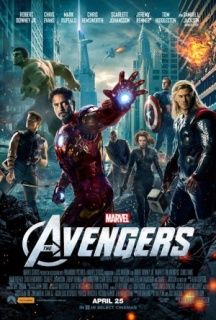
the avengers
Since Captain America came out last year and Chris Evans’ upper-arm circumference became a bigger number than his paycheque, I—along with a good chunk of the population—have been nigh on frantic for the release of The Avengers. We knew it was going to star all of our favourite Avengers from previous Marvel-funded flicks—1940s transplant Captain America (Evans), metal-suited “billionaire genius playboy philanthropist” Iron Man (Robert Downey Jr), Russian spy Black Widow (Scarlett Johansson), Norse god Thor (Our Chris Hemsworth), candidate for anger management Hulk (previously Edward “Jerkface” Norton, now played by Mark “Unshaven Face” Ruffalo) and a new-to-this-series arrow sharpshooter Hawkeye (Jeremy Renner). We knew the bad guy was going to be Loki (Tom Hiddleston), a god with a big stick and hair that flicks up at the ends. (How I wish I knew his secret.) We knew Nick Fury (Samuel L Jackson) would bring them all together into a great big tasty Avengerrific pie. But would it live up to the hype felt by full- and quasi-nerds everywhere?
When Loki, brother of the more Earth-friendly Thor, arrives on our planet, he leaves a trail of destruction and borrows a few good guys on his path to global domination. When the person you’re fighting is as powerful as Loki, you need to band together the best of the best—the superheroes that have been defending our beautiful world (read: North America). But when they’re all together, it’s a clash of egos and personalities—will they band together to defeat a god, or will their group fracture and disperse the power they have as a team?
If that sounds trite, it’s because it is. Yes, I’m aware that in some circles (aka mine) anything but adoration for this movie is controversial. I’ve already been threatened with death, or maybe a sulk, I forget which. It has caused discord even in my own relationship, which will hopefully survive this conflict like it survived the great Sultanas: Yes Or No debate of 2004. But while it was perfectly serviceable, well-acted and fun, it wasn’t as good as it should have been. Much of this comes down to having a plotline that has been done countless times before. The heroes bouncing off each other is part of the fun, and the infighting isn’t even a problem—of course they’re all going to grate on each other. (Have you met Thor? He’s an asshole.) When they all start getting suspicious of each other and of Nick Fury, it’s ridiculous, especially when someone even points out in the film that Loki will try and prise them apart. While they can get to the group’s split (not really a spoiler, come on) in an interesting way, it’s just not a fresh concept. Yes, superheroes aren’t “fresh”, they’re comic characters that have been around for decades. It doesn’t matter. We’re sick of seeing these things happen. Get a new plot.
Despite director Joss Whedon’s habit of making women kickass characters, the film doesn’t pass the Bechdel Test. There are three major female characters: Black Widow, Pepper Potts (Gwyneth Paltrow), and S.H.I.E.L.D. Agent Maria Hill (Cobie Smulders, recently seen 400 times this week as Robyn from How I Met Your Mother). They never talk to each other, though they are all very cool. Black Widow, while having the best introductory scene, is also the only character to break down after a confrontation. Seeing the female hero shaking in a corner, while everyone else just picks themselves up and gets over it, was a disappointment, especially after she’d flipped that idea in an earlier scene with Loki. It’s corny—Bruce Banner falls on a “contents under pressure” sign at one point—and the effects are pretty average, with a lot of blur. Because I am tragic, I saw it in 3D, which might explain some of the wonky FX, but if you’re going to market a movie like Avengers as a 3D movie, do it properly—this is one of the first movies I wish I’d seen in 2D instead. Even though the Hulk was utterly entertaining, is he able to hold a conversation while Hulky or not? Because he was coherent in convenient moments, but not others. Whedon didn’t bother avoiding that frustrating, easy-out trope where an enemy—numerous and flying—vanishes for just long enough for an important conversation to happen. There are also some continuity errors (can I just hit my past self about the head for forgetting to take a notebook, I am clearly out of practise), including the frequent amount of times that Tony Stark can be seen swanning about without his chest glowing even though it had been just a minute earlier. These are all things I could get over separately if the movie’s excellence had otherwise blinded me to them, but sadly (and I’m genuinely sad, I wanted so desperately to love this) it just didn’t.
To the movie’s credit, the characters are all staunchly excellent and the casting blissful—Ruffalo is a brilliant Banner, and made all Banner/Hulk scenes my favourite, even though I’d assumed I’d be squealing every time Cap opened his mouth. (Actually, he was kind of sulky.) The fight scenes were a knockout, and there are a few one-liners and comedic tussles that kept me smiling. Working with a great cast and acclaimed director meant it was never going to be a terrible film, but it should have been a brilliant one. The characters shared a mostly equal amount of screen time, though it could have been retitled Iron Man 3 in a pinch. Hawkeye, being the only entirely new addition to the movie franchise, suffered from lack of a backstory, but time constraints—the movie is already nearly two and a half hours long—make it understandable.
I give The Avengers three and a half out of six superheroes. How do you get half a superhero? Well, Bruce Banner, but not the Hulk.
When Loki, brother of the more Earth-friendly Thor, arrives on our planet, he leaves a trail of destruction and borrows a few good guys on his path to global domination. When the person you’re fighting is as powerful as Loki, you need to band together the best of the best—the superheroes that have been defending our beautiful world (read: North America). But when they’re all together, it’s a clash of egos and personalities—will they band together to defeat a god, or will their group fracture and disperse the power they have as a team?
If that sounds trite, it’s because it is. Yes, I’m aware that in some circles (aka mine) anything but adoration for this movie is controversial. I’ve already been threatened with death, or maybe a sulk, I forget which. It has caused discord even in my own relationship, which will hopefully survive this conflict like it survived the great Sultanas: Yes Or No debate of 2004. But while it was perfectly serviceable, well-acted and fun, it wasn’t as good as it should have been. Much of this comes down to having a plotline that has been done countless times before. The heroes bouncing off each other is part of the fun, and the infighting isn’t even a problem—of course they’re all going to grate on each other. (Have you met Thor? He’s an asshole.) When they all start getting suspicious of each other and of Nick Fury, it’s ridiculous, especially when someone even points out in the film that Loki will try and prise them apart. While they can get to the group’s split (not really a spoiler, come on) in an interesting way, it’s just not a fresh concept. Yes, superheroes aren’t “fresh”, they’re comic characters that have been around for decades. It doesn’t matter. We’re sick of seeing these things happen. Get a new plot.
Despite director Joss Whedon’s habit of making women kickass characters, the film doesn’t pass the Bechdel Test. There are three major female characters: Black Widow, Pepper Potts (Gwyneth Paltrow), and S.H.I.E.L.D. Agent Maria Hill (Cobie Smulders, recently seen 400 times this week as Robyn from How I Met Your Mother). They never talk to each other, though they are all very cool. Black Widow, while having the best introductory scene, is also the only character to break down after a confrontation. Seeing the female hero shaking in a corner, while everyone else just picks themselves up and gets over it, was a disappointment, especially after she’d flipped that idea in an earlier scene with Loki. It’s corny—Bruce Banner falls on a “contents under pressure” sign at one point—and the effects are pretty average, with a lot of blur. Because I am tragic, I saw it in 3D, which might explain some of the wonky FX, but if you’re going to market a movie like Avengers as a 3D movie, do it properly—this is one of the first movies I wish I’d seen in 2D instead. Even though the Hulk was utterly entertaining, is he able to hold a conversation while Hulky or not? Because he was coherent in convenient moments, but not others. Whedon didn’t bother avoiding that frustrating, easy-out trope where an enemy—numerous and flying—vanishes for just long enough for an important conversation to happen. There are also some continuity errors (can I just hit my past self about the head for forgetting to take a notebook, I am clearly out of practise), including the frequent amount of times that Tony Stark can be seen swanning about without his chest glowing even though it had been just a minute earlier. These are all things I could get over separately if the movie’s excellence had otherwise blinded me to them, but sadly (and I’m genuinely sad, I wanted so desperately to love this) it just didn’t.
To the movie’s credit, the characters are all staunchly excellent and the casting blissful—Ruffalo is a brilliant Banner, and made all Banner/Hulk scenes my favourite, even though I’d assumed I’d be squealing every time Cap opened his mouth. (Actually, he was kind of sulky.) The fight scenes were a knockout, and there are a few one-liners and comedic tussles that kept me smiling. Working with a great cast and acclaimed director meant it was never going to be a terrible film, but it should have been a brilliant one. The characters shared a mostly equal amount of screen time, though it could have been retitled Iron Man 3 in a pinch. Hawkeye, being the only entirely new addition to the movie franchise, suffered from lack of a backstory, but time constraints—the movie is already nearly two and a half hours long—make it understandable.
I give The Avengers three and a half out of six superheroes. How do you get half a superhero? Well, Bruce Banner, but not the Hulk.
Monday, February 27, 2012
headhunters
Roger Brown (Aksel Hennie, incidentally the first person convicted for doing graffiti in Norway), as he explains in a brief voiceover at the start, is 1.68m tall and compensates for his lack of stature with an oversized house and his improbably beautiful and tall wife Diana (Synnøve Macody Lund), who, like a surprisingly number of people in crime books (this is adapted from Jo Nesbø’s book of the same name) but not in reality, runs an art gallery. He’s a headhunter, a recruitment agent who knows the value of reputation. He’s good at his job and makes a pack of money, but not enough to fund the lifestyle that he and Diana lead. To compensate, and with the help of his security company cohort Ove (Eivind Sander), he also moonlights an art thief more than happy to steal from the clients he’s hiring, and whose personal information it is ridiculously easy to discover when you’re the one doing the interviewing. Despite this, Roger’s finances are precarious and his emotionless affair with brunette Lotte (Julie Ølgaard) is coming to an end when he encounters the man who could change his life: Clas Greve (Nikolaj Coster-Waldau, almost ridiculously handsome), the perfect candidate for the job Roger is hiring for, and someone who’s just inherited an original Rubens. Clas, alas, is not your everyday job hunter.
Roger is a total prong, and when everything in his life falls to shit you’re almost pleased—at first. Slowly, Roger regains your compassion and becomes a character you can get behind instead of one you want to push over, and kudos to Aksel Hennie (who has a bit of a Steve Buscemi look to him) for portraying a character arc you’re initially unwilling to follow. Part of this is the ridiculous situations it doesn’t take long for him to be in—you’ll probably want to cover your eyes for a particular hiding place he chooses, and for a fight he has with a dog—and part of it is his reactions, which don’t have you shouting at the screen “Augh! Why are you doing this?” but rather thinking: yes, that is the right thing to do. He’s a smart guy, just confused about his huge ego fighting with his lack of self-esteem. The characters that surround him are excellent too: Diana is lovely and misinterpreted, Clas ominous in his smoky expression, Ove hilarious in his introduction as he runs around his house naked shooting pop guns at a giggling Russian prostitute. Even the peripheral characters, including overweight identical twin police officers, and real-life police chiefs at a press conference, are wonderful touches that make this movie a cut above other action-type flicks.
The movie doesn’t pass the Bechdel Test—and the few women in it aren’t at all simpering, but are still being used by men in some way. Having said that, the men are all jerks. It’s also a bit gory in parts, which isn’t necessarily a criticism but something to point out if you’ve got a weak stomach for such things. (A brief pan over someone’s crushed face is followed by a solid close-up you weren’t expecting; also, the aforementioned hiding and dog scenes.) There’s a discrepancy at the end that I haven’t quite figured out, but as I went to see it alone, I don’t have anyone to set me straight.
Those are all very, very minor gripes in a movie I genuinely adored. Go see it; it’s a thrilling, entertaining crime adventure that deserves a wider release than it will probably get, and equal, if not more hype, to the Girl with the Dragon Tattoo (which, as possibly an in-joke, Diana is actually watching the Swedish version of at one point.) I give it eighteen out of twenty machine gun bullets scattered on the ground.
Friday, February 3, 2012
chronicle
Chronicle opens with high school senior Andrew (Dane DeHaan, appropriately sulky and gawky) setting up his new video camera to record his life: his physically abusive, alcoholic father; his dying mother, strapped to machines in her bed; his school life, where bullies torment him mercilessly and the only person who gives him any time is his philosophical-stoner cousin, Matt (Alex Russell). Andrew doesn’t do himself any favours by bringing a video camera to school and creeping everyone out—in fact, he’s generally unlikeable, but wholly sympathetic regardless—but it comes in handy when, at a warehouse party, he’s summoned by Matt and the school’s gosh-darn endearing Mr Popularity Steve (Michael B Jordan) to a strange hole in the ground. They go underground, the camera gets fuzzy, things are weird, then bam: they are back in the sunlight and suddenly the three of them have developed telekinetic powers. All right! Awesome! This could never go wrong!
The movie succeeds because the three do exactly what you (well, I) would do if you had telekinetic powers. There’s a nod to the Lego video game franchise as they build things with their mind; they skim rocks over rivers; they use a leaf blower to blow up the skirts of the pretty girls. (Hey, I didn’t say they were mature about it.) They start small as they learn to control their powers, and the three develop a close bond—but it doesn’t take long before a harmless prank gets dangerously close to a fatality and the three lay down some ground rules, including the most important: don’t use the powers when you’re angry. However, teenagers do angry really well, and when things go wrong, it happens on an epic scale.
The movie centres around Andrew, as the one with the camera, but all three characters feel convincing: they dress and act like normal people, are occasionally jerks and frequently humane. Matt’s squirm-worthy attempts to prove to a girl that he’s, like, cool, but, like, above being like popular and stuff are painfully endearing; Steve’s determination to be a good politician see him take on Andrew as a challenge, where they use their powers to gain him popularity in the most wholesome way possible. Even Andrew’s jerk of a father has some depth: you hate him, but you have some understanding of him. This, all told in what is essentially a found-footage film (though both Chris and I had thought of the phrase “lost-footage”, as the movie uses footage from cameras that are destroyed, CCTV footage, people’s iPads and so on) is very impressive; it even dodges the problem of Andrew never being on camera when he gets the idea to control it with his mind so it is always looking at the scene from a short distance. The special effects are faultless, which makes the movie’s many tricks—small or large—great fun. The boys never break from character, and Chronicle tracks in an hour and a half the path to villainy that George Lucas barely achieved in the first (second?) three Star Wars movies.
Chronicle doesn’t pass the Bechdel Test—there are women, but they never talk to each other—and you do occasionally want to take Andrew by the ear and get him to the counsellor’s office for a thorough discussion about emotional control and dealing with turmoil at home (and finding somewhere new to live—or a way to get his father in jail.) But on the whole, Chronicle is a surprisingly excellent film that doesn’t bother too much with the why of getting superpowers (because really, who cares?) as much as what kind of person you are, and how you deal with them when you have them.
I give it four out of five car rides to school.
Monday, January 16, 2012
the skin i live in
I wouldn’t dare spoiler anything for you, but be assured the horror of the story—and you will be horrified—has little to do with the new, resilient skin that Robert is experimenting with and more to do with the horrendous acts people commit. If you aren’t in a position to deal with sexual assault on film, stay far away from this one. Not only are the scenes convincingly awful, as the experience must be, but the confusion surrounding them can make for an uncomfortable viewing. I’m loathe to say more and ruin the movie, which held countless surprises, but there you have it. It touches on a few sex/gender issues as well, which Pedro Almodovar has done in the past. Having a director out there game to try some new stuff is great, but I guess I feel a little out of my depth in commenting too much on it.
So, onto things I know! I know I generally love Antonio but found him completely alarming in this film; I know that the acting was amazing from everyone. Almodovar is adept at getting nuances out of actors who get offered Western roles that aren’t quite as meaty (Penelope Cruz, for example, is excellent in Volver but more popular in the fourth Pirates of the Caribbean movie, where everyone is required to be melodramatic) so seeing Banderas in a role where he wasn’t likeable was hard—because usually he’s so lovely in them—but also impressive. The choppy narrative style was an interesting route to take and, luckily, fell on the side of compelling instead of annoying (though I probably annoyed everyone around me by whispering my confusion at Chris every five minutes.) It was a very narrowly landscaped film—we get a feel for Ledgard’s home but not the environment around it, and only a few other settings, which means it doesn’t feel particularly Spanish (apart from the fact that it’s in Spanish and subtitled) and instead feels appropriately claustrophobic.
It’s a confronting, engaging, revenge-driven flick filled with relationships you’re continually unsure of. Who do you hate? Where does the right of revenge end? Why do people ask rhetorical questions anyway? Well, perhaps I’ll stop and just rate it something high like eight out of ten tiger stripes.
As requested by the lovely Afsana
Monday, January 9, 2012
hugo
The world of young boy Hugo (Asa Butterfield) himself is not so lovely. It’s 1931, and, orphaned after the death of his clockmaker father (Jude Law) in a museum fire and sent to live with his alcoholic uncle, his life goes from quiet contentment to ruination. Unable to go to school, running the station’s clocks is his only job, but one he must do perfectly in case anyone notices that as the movie begins, he is now alone, his uncle having abandoned him. Apart from the clocks, Hugo spends his time tending to a broken automaton his father found in a museum, trying to find parts for it—or to steal them from the station’s toymaker, Papa Georges (Ben Kingsley) out of view of the orphan-catching Station Inspector (Sacha Baron Cohen). After an altercation with Georges that sees him lose his father’s notebook, a precious memento that also holds the clues to fixing the writing-robot that is his father’s only legacy, he thinks all is doomed. But wait! Because it’s an adventure story (and a self-referential one at that), an effervescent girl named Isabelle (Chloe Grace Moretz, adorable) is waiting in the wings to befriend him, even though her guardian is Georges himself. And between them, they may just hold the not entirely metaphorical key to everyone’s angst—Hugo’s emotional and mechanical problems, and the secret her godfather has been keeping for years.
Hugo is a love letter to cinema itself: not only in its visuals, but in the subject matter and in the characters themselves. Hugo’s father adored cinema and took his son to films, whereas Georges has never let Isabelle see a movie in her life. There is a glorious line to make all movie-lovers sigh, as Hugo tells Isabelle about the first time his father had seen a movie: “He said it was like seeing his dreams in the middle of the day.” The history of film is touched on as well, as the first one shown—a train pulling into a station—causes the entire audience to shriek and run as the train barrels towards the camera. Connected to it all is cinematic genius Georges Melies, whom you might remember from a particularly referenced and adored film scene where the moon cops a rocket to the eye. Any movie about movies is one that floats my boat, and this is lovingly rendered in every way, where the recreations of hundred-year-old special effects still have the power to amaze, and the loss of film can cause the loss of much more personally.
Quirky French touches abound, as the station’s other occupants—flower-seller Lisette (Emily Mortimer), the object of the Station Inspector’s awkward affections; cafe owner Madame Emile (Frances de la Tour, one of three Harry Potter actors in the film—she played the French giantess); and newspaperman Monsieur Frick (Richard Griffiths, second Potter-person, Uncle Vernon) dance around each other and create a lightness and sweetness that the movie’s occasionally sad moments need. Moretz is a delight as an enthusiastic counterpart to Butterfield’s quiet grimness, and Cohen does a wonderful job making the initially dastardly Inspector a sympathetic character (it does take a while to warm to the man, though. What kind of jerk throws orphans in a cage?)
However I couldn’t really bond with Hugo himself, a character with a genuinely sorrowful backstory but who in Butterfield was unable to sell me on any of his emotions or the reasoning behind some of his actions. Sadly, this made him one of the least interesting characters in the movie for me. Papa Georges’ backstory, while interesting and visually entrancing, is not quite enough payoff for the build-up surrounding it—so I enjoyed the movie but still left the theatre feeling slightly unfulfilled. I do recall feeling the same way when I read the book as well: that I was hoping for a dramatic reveal and was underwhelmed. Characters frequently did the frustrating trope where they don’t explain their actions, choosing silence over logical discussion and making the movie stretch out into devastation when it could have been remedied by a nice chat over a cup of tea.
But it’s still a fun film, and kudos to director Martin Scorsese for doing to 3D what the mechanically brilliant young Hugo does to a mechanical mouse—injecting it with something new and wonderful. I give it eight out of twelve o’clock.
In Australia, Hugo is released January 12.
Monday, January 2, 2012
the girl with the dragon tattoo
So why, oh lord why, did he choose to remake Niels Arden Oplev’s Swedish film that was perfectly capable of telling the story already? Why did he waste months and years of his precious filmmaker time to give everyone a third outing of the Millennium Trilogy? 30 million people worldwide have read the books; the first film made over a hundred million smackers. This is not some obscure gem that needed a fresh facelift: it’s all tremendously modern and already available in literary and film formats. So the question is: what did Fincher hope to achieve with his version of The Girl with the Dragon Tattoo, and did he succeed? He claims that it is a completely different film from the Swedish version, but it’s not, of course. When they both work off the same source material, a dense brick of a novel with elaborate backgrounds for each character and incident, they are going to hit the same beats. Yes, it is different, because someone different directed it and the actors are different. Yes, it’s different because everyone speaks in English with Swedish accents (though they read Swedish-language newspapers.) But honestly, apart from a small change in the ending, it is the same film told the same way, and you’ll feel exactly the same by the end as you would at the end of the Swedish version. (That is: paranoid about government agencies, horrified by all men and never able to have sex again.)
It’s hard to see past that to judge the film on its own merits. Of course, it’s wonderfully cast: Rooney Mara captured the damaged (and thin) look wonderfully to be computer hacker/ward of the state Lisbeth Salander; Daniel Craig is the perfect age to be disgraced but excellent investigative journalist Mikael Blomkvist; and Christopher Plummer is expansively patriarchal as Henrik Vanger, the wealthy industrialist who inadvertently brings the two together to solve a forty-year-old crime: the loss of his beloved niece. It’s not all Agatha Christie innocence, however: you will be disturbed, by the outcome and also by many scenes disturbing in both sexual and non-sexual gore (Lisbeth’s relationship with her new guardian Bjurman—Yorick van Wageningen—is especially something you’ll want to cover your eyes for.) The growing friendship between youthful Salander and craggy Blomkvist is convincing and enjoyable to witness; the peripheral characters are portrayed just about as you’d imagine them. On a visual level, Fincher perhaps overtakes Oplev purely because where Oplev sees the place he lives and conveys it in a natural way, Fincher sees it from our non-Swedish perspective, revealing the white, icy beauty and Ikea-white angles of homes and buildings. His intro, also, is quite mind-blowing, as a soft, tender tinkly piano barrels into a tar and sweat-soaked Karen O intro as Mara and Craig sex things up in an edgy, oiled-up way along with an eagle, a snake, and some raunchy flowers. Atticus Ross and Trent Reznor score the whole flick with requisite rage and gentleness.
Lisbeth’s use of Google and Wikipedia to track someone down seems to undermine her enormous talent in the hacking field; the Swedish accents sometimes slip; I felt that despite the epic running time—nearly three hours—Lisbeth’s storyline was not given enough time; during a Eureka moment for Blomkvist he makes such a ridiculous show of taking off his glasses in mute shock it seemed like a cliché in what is otherwise a very cliché-free movie; and in frustratingly Hollywood way of thinking, female Rooney is given countless crotch shots and appears fully naked frequently while male Blomkvist (who is polyamorous and hardly a prude) reveals his chest and the barest hint of butt-crack.
Still, these facts don’t at all ruin the film. Fincher’s use of actors in their natural, often makeup-free state is commendable (and something I enjoyed about the first movie trilogy); the long running time doesn’t mean the movie drags—it’s enthralling from start to finish; Mara’s Salander, like Noomi Rapace in the Swedish version, is an absolute treat of a character, scarred from a lifetime of people screwing her over but with a raspy charm all her own: wearing a t-shirt saying “Fuck you you fucking fuck”, explaining Blomkvist’s background to the man who has hired her: “Sometimes he performs cunnilingus. Not often enough in my opinion”—she really is amazing and is the new style of heroine everyone says she is. It passes the Bechdel Test (barely) and, in Sweden, is called Men who Hate Women, so the women are smart and not underwritten.
By all means, go see it if you’re unable to see the Swedish version—it’s a well-crafted film telling a wholly interesting and grotesque family crime story. But without it showing me anything new about the story (which admittedly, I have possibly overdosed on), it is still a vaguely pointless exercise. Because of this, and my clear ragey bias about it, I’m not going to give this movie a rating. See it for yourselves and let me know what you think.
The Girl with the Dragon Tattoo is out January 12.
Monday, December 5, 2011
attack the block
But then you end up following these kids through their incompetent attempts to defeat the sudden influx of aliens and, dammit, after a while you don’t want them to die after all. Led by moodily attractive teenager Moses (John Boyega), the gang come across as quite threatening to begin with until you realise that actually they are all pretty incompetent because they are, well, yoof. It’s Guy Fawkes Night, and they were out to create havoc and striving to be part of the gang led by the block’s main criminal mastermind, Hi-Hatz (Jumayn Hunter). Just as they finally strike it lucky enough to actually be on their path to, well, jail, more aliens rain down on them and everything changes, seeing the gang on the wrong side of everyone, from the police to Hi-Hatz to an irate Sam.
Having kids be the protagonists for a horror/sci-fi movie is pretty interesting, especially when director Joe Cornish chooses to be open about the facts that not all accidental alien-hunters are going to be as skilled as the team from Predators. These are kids who don’t have guns or fighting skills, but instead heed the call to arms with baseball bats, firecrackers, kitchen knives and false bravado. When shit gets real and they finally twig that they’re out of their depth, they can’t call for help because they’ve all run out of mobile phone credit; when they speed down staircases on their pushbikes they inevitably crash into the ground because they are not bicycle parkour enthusiasts. Despite the fact that the majority live quite standard home lives, getting told off by their mothers or told to keep out of trouble by their nannas, they’re all too desperately rough to turn to the grown-ups when being chased by deadly critters. And that’s the other thing, with them being kids: even though the movie is kind of funny, it’s not a balls-out comedy which makes it all the more surprising when you realise that not all of the teenagers are going to live out the film.
The film briefly touches on the state of British youth, when Moses speculates that the aliens have been sent by the Feds to kill the African-British because “we’re not killing each other fast enough”. It’s a nice try, but the fact that the kids, apart from Moses himself, seem to have fairly happy upbringings and some kind of self-awareness of what they’re getting into, means the movie doesn’t go far enough down that path, and you’re not even sure if any of the gang have learned a lesson by the end of it.
Nice touches are the aliens themselves: neon-fanged black holes of colour with no depth, like an orang-utan shagged a yeti in a dark cupboard using a glow-in-the-dark condom with a hole in it. The idea that colour shading would be different on a different hadn’t occurred to me and I thought it was really interesting, to be honest; it makes them shadowy and creepy even when they’re in a brightly-lit flat. It isn’t laugh-a-minute funny (which, as it’s from the writer of Hot Fuzz and stars Nick Frost, I was expecting), but it’s pretty amusing and the dialogue between the kids (who are also great actors) can be pretty hilarious at times. The two nine-year-old boys looking up to the gang are probably the comedy relief, flinging around tough phrases in high-pitched voices. It passes the Bechdel Test and the women in it—Sam, an elderly neighbour, and the girls the gang are all interested in—are pretty kick-ass, either physically or verbally.
Nick Frost’s high billing probably has to do with his star power more than his subdued role as a stoner in the only “safe house” in the building, though he and befringed try-hard Brewis (Luke Treadaway) smoke their way through some fairly funny moments. It was a fun movie that somehow missed a vital point with me, though I can’t think exactly what; I’d recommend it happily, even though it wasn’t quite cranked up all the way on either the funny, poignant, sci-fi or horror dials.
I give Attack the Block seven out of ten rows of glowing teeth. Because rows of teeth are SCARY.
Sunday, November 20, 2011
the first grader
The story of Maruge’s taken-from-real-life trials, from the past to the film’s present, are in turns uplifting and devastating, the whole film perfectly pitched for the M rating it has in Australia but far too heartbreaking and reality-based for me to really try and be funny about. The children, singing, getting up to shenanigans and being generally adorable, lighten the tone, as does Maruge himself, who is clearly a man of hope. This is further strengthened when the viewer is pulled into his past, an unfathomable place of violence and horror where your toes and your children will be taken without a thought. Witnessing these scenes is nothing short of horrible and I was openly weeping in the theatre during them. You probably will too, and you’ll know what I’m talking about when it happens. The movie tugs at heartstrings in small ways and large, from moments as dramatic as the spilling of blood or as poignant as watching Maruge’s desperate plight to get into the school in the first place—told he can’t be there without the proper uniform, he uses part of his meagre savings to buy pants and turns them into shorts himself, then turns up in black shoes, long striped socks, shorts, a shirt and a blue jumper. His spirit is what buoys the film; his, and his teacher’s. Jane Obinchu (Naomie Harris) is determined to see him get taught despite the risks both professional and physical she brings upon herself by doing so.
There are moments of obvious exposition at the start, with Maruge remembering his wife and children as he moves about his home, and Jane on the porch with her husband as he tries to convince her to live in Nairobi with him and make babies while she tells him clearly that she wants to help the school. Despite radio announcements about Maruge’s schooling and journalists from the likes of the BBC shoving microphones in his face, you never really get a feel for the scope of Maruge’s influence locally or worldwide on a personal level. Rumours start about people being angry but it’s unconvincing; none of the parents ever come up to the school and give any valid reason why, and one permanently sour-looking father does a lot of glaring and is dangerously proactive about it, then fades into the background instantly afterwards. These aren’t huge gripes, however; you know me, I can’t like anything without pointing at some things and barking, “But if I was director, that would be different! Also there would be smell-o-vision and more Danny Trejo.”
Something as moving and hopeful as The First Grader needs to be seen to be believed, and you should see it. There are virtually no white people, and, thank the movie gods, none who come to save the day; it passes the Bechdel Test; Litondo’s acting is so expressive that he can make you want to cry just by staring into the distance; the enthusiasm of the kids for learning is infectious; the history lesson unforgettable; the message one we can all stand by: Learn. And don’t be an asshole. (I’m paraphrasing.)
I give it seven out of the ten tissues you’ll have to take with you.
Labels:
african,
based on a true story,
british,
drama,
movies
Monday, November 7, 2011
don't be afraid of the dark
The central character of Don’t Be Afraid of the Dark’s all-round excellent cast is headed up by Bailee Madison as Sally, a young girl shipped from her mother’s possibly-over-medicating arms to her architect father Alex (Guy Pearce, not quirky for once), who is working on restoring an enormous mansion in Rhode Island. She’s instantly miserable, especially when she realises that her mother got rid of her indefinitely rather than briefly and that Alex’s girlfriend Kim (Katie Holmes, mostly dressed in sacks) is going to be sticking around. Just when living in a gigantic, beautiful mansion with two people who love you and a maid who makes apple pie seems like it couldn’t get any worse, the family uncover a basement hidden under the house, and unleash a tribe of stabby little gremlin-type monsters who love to feast on people. Well, specifically, people-bones. But will anyone believe a kid with a history of hardcore sulking? I mean, what would you believe if your clothes were found cut up: that it was your angry stepdaughter, or monsters that eat teeth?
Don’t Be Afraid of the Dark is getting some pretty bad press but it’s not really a terrible movie. Like virtually all recent horror flicks, it has a lot of flaws, but you could do worse than seeing this at the movies one night when you’re bored. The set design is amazing, the house’s landscape beautiful (with touches of Pan’s Labyrinth, thanks to the obvious touches from producer Guillermo del Toro) but unfortunately under-utilised. The actors, mostly Australian, are top-notch (and include, peripherally, Garry McDonald, apparently finally broken by his Mother & Son matriarch; Nicholas Bell as a greying therapist; Jack Thompson as the cranky but wise gardener), including Madison, who is an absolute treasure, delivering glares like a seasoned child-of-a-divorce but who ultimately just wants to be loved. (Aw.) A grotesque opening prologue delivers some serious cover-your-eyes squick straight away, and, as with all these types of films, it is endlessly frustrating yet understandable when people—especially adults—won’t believe you when you tell them there’s monsters out to get you. And these monsters are pretty damn icky, perfectly rendered special effects-wise with not a moment when they don’t seem physically there. They are revealed early and come out in dim enough light to be seen pretty clearly; they hold up in the light but as with many monster-flicks lose something in the reveal. The ending, as well, is a shock when you are hoping for the happy-la-la ending of many teen-aimed horror films. One thing absolutely worth mentioning is that it passes the Bechdel Test repeatedly, with women talking a lot about a variety of things, and that I was unexpectedly thrilled to see that when the family got around in a car, Kim did all the driving and Alex sat in the passenger seat.
On the downside, the tension isn’t directed all that well; you’ll be nervous, but not scared. The creatures can take on a grown, ragey man but when confronted with a sobbing nine-year-old swipe at her without making contact just long enough for her to be saved. When people fall, it’s always right on their head so they get knocked out. (Why is this? Do they not know that if they stay unconscious more than a few seconds it usually means some serious brain damage? Pretty much everyone gets tripped/falls and bonks their head instead of breaking their outstretched arm like a normal person.) Not enough is made of Sally’s mental state; she turns up to the house on Adderall and a comment is made on her past, but instead of making this an interesting discussion about child mental illness they brush it away, assume the medication isn’t necessary and even after a violent incident, suspicion doesn’t fall on her (or anyone, even when the particular incident is clearly not self-inflicted. It’s actually really frustrating.) Kim comes across as pretty selfish at the start, which makes her hard to relate to; also, she and Alex have inappropriate conversations that Sally overhears at more than one different moment, the repetition of which which cheapens Sally’s initial hurt through the amazing power of cliché. Important moments become plot holes—why does Sally not point out the twitching critter arm to a crowd after she victoriously squashes one? Why do critters that like to eat children’s teeth NOT ONCE get referred to as Tooth Fairies? And to top it off, the survivors’ underwhelming reaction to the horrific ending left me full of a rage I dare not elaborate upon, because, well, spoilers.
It’s not excellent but not appalling, well produced and quite a pretty film. I wouldn’t take anyone younger than, say, twelve to see it, but it might really hit the mark for a youthful audience. Don’t avoid it, and don’t be afraid of it. I give it eleven out of twenty baby teeth.
Sunday, October 30, 2011
in time
It’s an interesting concept ruined once you try to think about it longer than thirty seconds. It’s an allegory for the power money has over people: after all, if you can’t afford shelter, food, or medical care, what hope do you have? And in this current economic climate, it’s true that few people hold most of the money just because they’re horrible examples of humanity. And it’s a pretty fun movie on a very base level, with a man hell-bent on revenge, a beautiful young woman who can’t help but be attracted to a man from the wrong side of the tracks with superior morals, an oily bad guy, some horrible thieves with cultured accents and a (time)cop who just wants to uphold the law, no matter who’s breaking it. But ultimately, it fails, because:
1) They never explain why society evolved like it did. I’m happy to take leaps of faith, but you have to give me something.
2) There are so many corny time/money jokes, it’s like someone as cheesy as me wrote the damn thing.
3) Why does everyone stop aging at 25?
4) Who would agree to have their child implanted with an under-the-skin digital clock that has a timer?
5) Cillian Murphy, while awesome, cannot pass as twenty-five.
6) Why does a civilisation advanced enough to be able to pass time through skin contact not have any other technological advances apart from a CCTV system that conveniently follows no one but important characters?
7) Why does everyone drive 70s-noir muscle cars like they’re in Mad Max?
8) Honestly, it is just really, really impossible to ever believe that a society would turn out this way, even being as pessimistic as I can muster.
9) You only ever see one evil fat cat in Kartheiser’s Philippe—does no one actually rule this world, or the countries, or the timezones? Is no one actually in charge?
10) And seriously, why the hell is everyone in this world skinny? This just makes no sense at all.
11) The future doesn’t pass the Bechdel Test.
12) How does it all WORK??
On the upside, there’s some good casting (Alex Pettyfer and Vincent Kartheiser are stand-outs), it trundles along nicely, and the Robin Hood aspect of Will and Sylvia’s criminal spree is something you can really get behind. It really has to be said that having everyone’s timers on the verge of running out half every second scene makes for some seriously intense viewing: anyone can die, at any time.
In Time isn’t the worst thing you could spend your afternoon watching, but if you really want something juicy this week, go see Drive.
I give it twelve out of twenty-five years.
Friday, October 21, 2011
the thing
For those who have seen The Original The Thing, you’ll know it starts with two Norwegians in a helicopter chasing a dog at the South Pole, and the subsequent shitstorm that follows, because aliens. The New The Thing tells the story of how things got to that point, and luckily, it’s not really a spoiler to know the beginning of The Original The Thing.
The Norwegian base camp at the South Pole has made a discovery: there is an alien structure beneath the ice, one dated from a very, very long time ago. And alongside this structure, something else is found: the inhabitant. It’s the most important discovery in science, and the Norwegians need to assemble a team to make sure everything goes according to plan. [insert scoff here].
The worry of creating a subtitled Norwegian blockbuster is neatly sidestepped by hauling in a bunch of Americans to help solve the problem, and then making everyone speak English about 80% of the time. It’s corny, but better than hiring A-list actors to pretend to be a certain culture and then failing miserably (I’m looking at you, Scottish lead of 300.) Norwegian scientist Dr Sander Halvorson (Ulrich Thomsen) brings his research assistant, Adam Goodman (Eric Christian Olsen, one of my favourite people: he played both Vaughn in Community and Austin “Jakey Jakey about to make a big...mistakey” in Not Another Teen Movie) who then suggests his friend, palaeontologist Kate Lloyd (Mary Elizabeth Winstead, who will forever be known to me as Ramona from Scott Pilgrim). Helicoptered over to the South Pole by able pilot Sam (Joel Edgerton), tensions arise early between sensible Kate and Sander, who is making rash decisions out of excitement. Her cautiousness is proved right when the alien, brought in a block of ice to their base, thaws out and instead of sitting down for a cup of tea and a chat about interplanetary politics, goes on a murderous, stabby, regenerative rampage—because it’s a creature who can take on the form and nature of those it imbibes.
It’s the are-they-aren’t-they tensions that make these movies so fun: who has become The Thing and is hiding it behind their poker face, and how can the others figure it out? Scenes in The Original The Thing involved an excellent tense moment when blood was tested, and because that scene is so grand I’m pleased they didn’t recreate it, and instead went for a punchier version, opined by Kate, whose know-how and level-headedness almost instantly sees her grab control of the situation. This upsets some—namely Sander, who clearly has issues—and mutiny is afoot, like they don’t already have enough damn problems.
The New The Thing is a good prequel to The Original The Thing because it could have easily been terrible—many, including myself, adore John Carpenter’s version and were hesitant to like anything new. But it’s got a cracking pace, good effects, hair-chewing tension, and a woman with a flamethrower. It also passes the Bechdel Test, admirable considering there wasn’t a single female in The Original The Thing. Kate is the Ripley of this piece, taking charge and rightly so and saving cowering menfolk from getting dead. It’s quite inspiring.
Alas, there really isn’t enough character development in this—to have enough characters to be able to (not really a spoiler) kill a bunch of them off, you’ve got to care somewhat for everyone, which you do, at the expense of caring particularly hard for anyone. There’s a hint of a romance between Kate and Sam, and some clear friendship lines that, when broken, make you sad, but that’s about all they give you. There aren’t any of the mindblowing set monster pieces from The Original The Thing—walking head, anyone?—but it more than adequately steps up to the monster plate with some pretty gross stuff. Otherwise, my only real issues were a pixelated spaceship drive that does not at all look like it’s there, and the 1980s costuming that is basically nonexistent—not a mullet or a teased fringe in sight, and Adam dresses about the same as a 1980s scientist as he does a 2011 hippy, though with, sadly, less nipples showing.
I give it five out of eight disgusting stumpy limbs.
Friday, October 7, 2011
real steel
It’s 2020 and robot fighting has superseded human boxing (hooray! I knew the future would be good for something), and Charlie Kenton (Hugh Jackman, unexpectedly jerky) is a total asshole who wrangles said robots for a living. He isn’t actually that good at it, and owes money to boxing promoters all over America, and is on the run from yet another one—the film’s cowboy-hatted villain Ricky (Kevin Durand, slimy)—when he gets a life-altering piece of news: his ex-girlfriend is dead, and their son Max (Dakota Goyo, awesome), who he abandoned years before, is now is his care. While trawling for robot parts, Max—after a heartstopping accident—finds an retro (read: 2014-era) sparring bot named Atom in the mud and digs it out with his bare hands, and is then determined to put him in the ring and show his dad that he has the nous to win. Will Charlie be able to stop being an asshole long enough to turn his life around? Will he stop ruining the lives of those who care for him, including old pal and robot mechanic/boxing gym owner Bailey (Evangeline Lilly, wise and hot)? It seems obvious, but actually Charlie is such a horrible person for the first half of the film that you really doubt it, and don’t even want him to get custody over Max’s rich aunt Debra (Hope Davis).
The movie is basically a kids’ fantasy: robots, fighting, a dad who takes you on the road to grungy underground fights, lots of money, hamburgers for dinner. So when I went in thinking it was a typical blockbuster, it did seem a little cheesy in parts, until Chris whispered, “This is basically a kids’ movie.” And it’s true. Like the equally fun Super 8, it’s the story of the kid’s troubles almost more than the adult’s—it’s devastating as Max tries desperately to forge an emotional bond with the robot that he is lacking in his own life—and follows a plotline where the kid is pretty much smarter and more savvy than all the adults at just about anything, including building a championship-quality robot out of dumpster parts. Real Steel, however, succeeds because of these childlike touches rather than in spite of them, and means you’re much more willing to dismiss plot holes and strange moments (why are more people not using these old robots if they are so damn excellent? Why does literally no one else ever turn up at Bailey’s gym? Also, isn’t it totally creepy when Charlie sneaks into Bailey’s bedroom at night? etc etc), because kids don’t always care about such stuff, and maybe adults shouldn’t either. At the risk of sounding like a prude, it’s actually nice to see a film where someone drives 1200 miles just for a kiss, women can be smart instead of nude and where blood is actually a very rare sight. It means you could take your twelve-year-old nephew as well as your eighty-year-old grandpa and everyone would have fun, though the word “shit” is said maybe three times if that’s something you’re concerned about.
The acting is top-notch—Jackman is a truly horrible person but still appealing because he’s basically the world’s favourite person; Dakota Goyo is someone you may literally cheer for (I sure as hell did) and Evangeline Lilly is a bit weepy, as women typically are in movies (but as a habitual weeper I can totally relate—I mean, I cried in a hospital ad showing before the movie today), but is also tough and smart. The special effects are great, the robots utterly convincing in the presence of the humans; the sets are huge and fun—glitzy arenas, jungle-based underground fights populated by future-punks (still wearing Ramones t-shirts), rodeo-style Texas fights with a bull. The last of those was the only thing I can really say I didn’t enjoy—of course the bull was CGI in most parts (assuming bulls aren’t good at dealing with green-screen acting) but pitting an animal against a hunk of metal still made me uncomfortable and it was horrible when it got thrown around. (Vague spoiler: the bull wins that fight, but still.) The dance scene where Atom shadows Max’s moves should suck but is actually quite hilarious. The robotic rival/final boss Zeus is huge, terrifying and smashes lesser robots instantly, all while being commanded by enigmatic maker Tak Mashido (Karl Yune, moody) and icy owner Farra Lemkova (Olga Fonda, tight ponytailed). It doesn’t pass the Bechdel Test, but the movie’s full of women who are perfectly capable of doing their own thing, even including a bunch of little girls at the start who give Charlie attitude when he richly deserves it.
Top effort to director Shawn Levy for making me care about robots without actually giving them any personality. It probably has to do with Atom representing all of the Kanters’ hopes and dreams, and all behind a sad little stitched-together mesh face and in a future that looks pretty much exactly the same as right now. I don’t want them to make a sequel, but if they do, I’d see it. I give Real Steel four out of five punches in the nuts.
Tuesday, September 27, 2011
crazy, stupid, love
Crazy, Stupid, Advertising is actually a pretty fun movie; there are a lot of laughs, and some really touching moments too. The set pieces make this film what it is: the gentle, sexy humour of Jacob and Hannah’s first “date”; the flat-out hilarious slapstick scene when all our characters finally meet; a quietly poignant moment when Cal, secretly weeding his family’s backyard at night, sees Emily fake a phone call to him just to talk. Add to that the glorious cast, all who ping off each other wonderfully, and who include Hannah’s equally-sassy best friend Liz (Liza Lapera); Cal’s rival for Emily’s affections, David Lindhagen (Kevin Bacon) Cal and Emily’s lovelorn teenage son Robbie (Jonah Bobo), who can’t hide his adoration for his gangly babysitter Jess (Analeigh Tipton), while she is nurturing love for Cal himself. It’s basically an ingredient list for a recipe that can’t go wrong, like toasted cheese sandwiches. Comforting, funny, and a good night spent at the flicks, it doesn’t have the perfect Hollywood cookie-cutter ending but definitely won’t leave you wanting to impale yourself with a Coke straw.
It’s debatable due to forgetfulness whether it passes the Bechdel Test (Chris claims there was a tickle fight between Jess and Robbie’s younger sister Molly where they didn’t talk about boys, and also an initial scene between Hannah and Liz which possibly began discussing jobs before it derailed into boy-talk, but I don’t remember for sure—and even so, that’s pitiful if I have to dredge memories to clarify) and there is a scene that tries to be cute in the movie’s graudation finale that would be actually a bit halp-call-the-police if the genders were reversed; also, women just seem like objects waiting for Ryan Gosling to hit on them (which, let’s face it, is mostly true) and then vanish from the movie, never to get emotionally involved again. Also, what does Jacob do for a living? Why did Cal and Emily even break up if they’re going to spend the rest of the movie staring wistfully after each other? (It’s the movies, haven’t these people heard of therapy?) But hey, dramedies are rarely perfect and if you feel like love is possible at the end they’ve pretty much done their job, and I’m still happy to give Crazy, Stupid, Advertising the following rating: three and a half out of five pairs of jeans not bought at The Gap. (Chris, surprising everyone, gave it five out of five putts at a mini golf course.)
Monday, September 5, 2011
final destination 5
As per the other movies in the series, Final Destination 5 starts with a set piece in which all the major characters are killed off swiftly and bloodily—in this, our main characters are on a bus on the way to a work retreat, when the suspension bridge they are crossing collapses. As they escape the bus, they meet their ends in a variety of ways you wouldn’t even know were possible. Then it turns out the collapse isn’t real at all, just a vision of our main character Sam (Nicholas D’Agosto), who then manages to flee the bus before the bridge actually collapses and saves a bunch of his co-workers in the process. As is to be expected, the invisible hand of Death isn’t happy that this pack of one-note characters didn’t die as planned, and picks them off one by one thereafter in tense and theatrical ways.
3D is used to such effect in this movie I feel like it should only be used in schlocky horror films from now on. Intestines fly at the screen; blood coats the camera; bones stick out through skin right in your face. It’s glorious. The very first death in the film, as the camera follows a body as it falls towards the water but then encounters an unexpected obstruction, was so violent and bloodthirsty and surprising that the entire cinema audience fell apart with shock and glee, thereby setting the tone for the movie. The outlandish premise is enough to have you enjoy the film without ever thinking it’s real enough to get upset about. And the way all the deaths are set up—with the camera panning over every dangerous device in the room, which it turns out, is basically everything—makes for such exquisite tension as to what is actually going to cause the upcoming carnage that I occasionally had to close my eyes and pretend I was somewhere else so my heart didn’t burst out of my chest or I didn’t go into spontaneous early labour.
It doesn’t take itself too seriously, but luckily, the cast themselves do. Played by a bunch of up-and-comers who frequently look a lot like someone more famous, they are given all of their development time at the start of the film as they meet up to get on the bus for their trip. Sam (D’Agosto, looking like a sibling of Andrew Garfield) is a friendly office worker who really wants to be a chef; his girlfriend Molly (Emma Bell, from the excellent creepy movie Frozen) has reconsidered their relationship; Peter (Miles Fisher and quite possibly the love child of Christian Bale and Tom Cruise) is the high-flying crisply-suited hard-worker; his girlfriend Candice (Ellen Wroe, with a cutesy Ginnifer Goodwin vibe) is the peaches-and-cream gymnast with a slightly nasty personality; Olivia (Jacqueline MacInnes Wood, a blend of Megan Fox raunch and Jennifer Keyte primness) is the punk-rocker quick with a curse word and struggling with her eyesight; Nathan (Arlen Escarpeta, familiar from bit-parts on countless television shows) is the recently-promoted man trying to prove his worth to the factory workers who don’t like change; Isaac (PJ Byrne, similarly snivelly in Horrible Bosses) is the self-absorbed stalker-type creepy enough to be the one guy you actively hope dies; and their boss, Dennis (perfectly-balding David Koechner, from just about everything, most recently Paul) is satisfyingly passive-aggressive and full of his own self-importance. Rounding out the cast is the deep talking wise man coroner Bludworth (Tony Todd, who played the man-of-my-teenage-nightmares Candyman) and the policeman on the case Jim Block (Law and Order stalwart Courtney B Vance).
The two-dimensional aspect of the characters is a flaw in the film, but barely a concern in the scheme of such fun, especially when you consider the extra dimension they are otherwise seen in. The only real problem I had was that when characters started to die, the first people on the scene, called by police or our heroes themselves, seemed to be our friends the co-workers—what, no parents, no siblings, just call the office and get everyone to come over? The lack of the other people was unrealistic, but adding them would probably have detracted from the lightness of the film and made you feel emotional towards the families when really you didn’t have the time or inclination to actually care.
Happily, Final Destination 5 ends with not quite a twist, but a surprise for sure—especially when you consider the others don’t finish with anything like that at all. It’s an ultimately thrilling finale that makes you reflect on the whole film differently, but probably not enough to have to suffer through the death of Candice again (by far the one that scarred me the most) to see if it’s actually obvious and we just completely missed it.
I give Final Destination 5 four out of five poles through the head.
Subscribe to:
Posts (Atom)