Kenya, 2004: the government has just announced that school is now free for everyone, and kids everywhere launch themselves at high speed—I’m not even joking—at the nearest classroom. Woefully undersupplied and with only 50 desks for the 200 kids there, one particular school is doing it tough. And one more student is determined to attend: 84-year-old Kimani N’gan’ga Maruge (Oliver Litondo), survivor of a brutal uprising fifty years earlier, desperate to get the education he never did, and learn to read so he can understand an important letter he has received in the mail.
The story of Maruge’s taken-from-real-life trials, from the past to the film’s present, are in turns uplifting and devastating, the whole film perfectly pitched for the M rating it has in Australia but far too heartbreaking and reality-based for me to really try and be funny about. The children, singing, getting up to shenanigans and being generally adorable, lighten the tone, as does Maruge himself, who is clearly a man of hope. This is further strengthened when the viewer is pulled into his past, an unfathomable place of violence and horror where your toes and your children will be taken without a thought. Witnessing these scenes is nothing short of horrible and I was openly weeping in the theatre during them. You probably will too, and you’ll know what I’m talking about when it happens. The movie tugs at heartstrings in small ways and large, from moments as dramatic as the spilling of blood or as poignant as watching Maruge’s desperate plight to get into the school in the first place—told he can’t be there without the proper uniform, he uses part of his meagre savings to buy pants and turns them into shorts himself, then turns up in black shoes, long striped socks, shorts, a shirt and a blue jumper. His spirit is what buoys the film; his, and his teacher’s. Jane Obinchu (Naomie Harris) is determined to see him get taught despite the risks both professional and physical she brings upon herself by doing so.
There are moments of obvious exposition at the start, with Maruge remembering his wife and children as he moves about his home, and Jane on the porch with her husband as he tries to convince her to live in Nairobi with him and make babies while she tells him clearly that she wants to help the school. Despite radio announcements about Maruge’s schooling and journalists from the likes of the BBC shoving microphones in his face, you never really get a feel for the scope of Maruge’s influence locally or worldwide on a personal level. Rumours start about people being angry but it’s unconvincing; none of the parents ever come up to the school and give any valid reason why, and one permanently sour-looking father does a lot of glaring and is dangerously proactive about it, then fades into the background instantly afterwards. These aren’t huge gripes, however; you know me, I can’t like anything without pointing at some things and barking, “But if I was director, that would be different! Also there would be smell-o-vision and more Danny Trejo.”
Something as moving and hopeful as The First Grader needs to be seen to be believed, and you should see it. There are virtually no white people, and, thank the movie gods, none who come to save the day; it passes the Bechdel Test; Litondo’s acting is so expressive that he can make you want to cry just by staring into the distance; the enthusiasm of the kids for learning is infectious; the history lesson unforgettable; the message one we can all stand by: Learn. And don’t be an asshole. (I’m paraphrasing.)
I give it seven out of the ten tissues you’ll have to take with you.
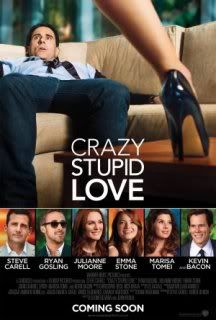
 I’m going to rename this Crazy, Stupid, Advertising because pitching a preview screening as a “Girls Night In” event—offering free drinks upon arrival and giving you a goodie bag at the end filled with such gender-neutral awesomeness as Libra pads—was a huge mistake. Even the title is pretty ridiculous, because make no mistake: this flick is about the guys, namely middle-aged schlub Cal (Steve Carrell), who’s just been asked for a divorce by his bored wife Emily (Julianne Moore), and serial smoocher Jacob (Ryan Gosling), who picks up more women than he picks up peanuts at the bar both men now frequent. When Jacob sees Cal muttering to himself in (gasp, apparently) New Balance trainers, he takes it upon himself to give Cal a makeover and turn his life around. But does Cal want to shag attractive women like Kate (Marisa Tomei, slightly batshit as per usual), or does he want his old life back? Is Jacob really happy in his life as a man bedding attractive women on a regular basis? Will it take the movie’s other sassy redhead, Hannah (Emma Stone), to make him see the horror that is his life as a rich man who is also charming and accompanied by a sensual bass track and a camera that wants to have sex with him every time he’s on screen?
Crazy, Stupid, Advertising is actually a pretty fun movie; there are a lot of laughs, and some really touching moments too. The set pieces make this film what it is: the gentle, sexy humour of Jacob and Hannah’s first “date”; the flat-out hilarious slapstick scene when all our characters finally meet; a quietly poignant moment when Cal, secretly weeding his family’s backyard at night, sees Emily fake a phone call to him just to talk. Add to that the glorious cast, all who ping off each other wonderfully, and who include Hannah’s equally-sassy best friend Liz (Liza Lapera); Cal’s rival for Emily’s affections, David Lindhagen (Kevin Bacon) Cal and Emily’s lovelorn teenage son Robbie (Jonah Bobo), who can’t hide his adoration for his gangly babysitter Jess (Analeigh Tipton), while she is nurturing love for Cal himself. It’s basically an ingredient list for a recipe that can’t go wrong, like toasted cheese sandwiches. Comforting, funny, and a good night spent at the flicks, it doesn’t have the perfect Hollywood cookie-cutter ending but definitely won’t leave you wanting to impale yourself with a Coke straw.
It’s debatable due to forgetfulness whether it passes the Bechdel Test (Chris claims there was a tickle fight between Jess and Robbie’s younger sister Molly where they didn’t talk about boys, and also an initial scene between Hannah and Liz which possibly began discussing jobs before it derailed into boy-talk, but I don’t remember for sure—and even so, that’s pitiful if I have to dredge memories to clarify) and there is a scene that tries to be cute in the movie’s graudation finale that would be actually a bit halp-call-the-police if the genders were reversed; also, women just seem like objects waiting for Ryan Gosling to hit on them (which, let’s face it, is mostly true) and then vanish from the movie, never to get emotionally involved again. Also, what does Jacob do for a living? Why did Cal and Emily even break up if they’re going to spend the rest of the movie staring wistfully after each other? (It’s the movies, haven’t these people heard of therapy?) But hey, dramedies are rarely perfect and if you feel like love is possible at the end they’ve pretty much done their job, and I’m still happy to give Crazy, Stupid, Advertising the following rating: three and a half out of five pairs of jeans not bought at The Gap. (Chris, surprising everyone, gave it five out of five putts at a mini golf course.)
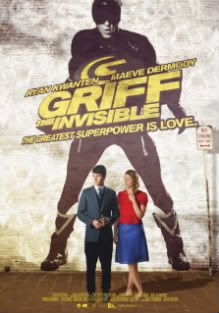
 Forever in my mind as Vinnie the hapless husband from the halcyon days of high school when my mother and I obsessively watched Home and Away after dinner, Ryan Kwanten has done what only a handful of ex-H&A-types have and is now gleefully in the middle of an awesome local and international career. And you can see why—in Griff the Invisible as the titular Griff, he is so far removed from the world of Jason Stackhouse both literally—Griff is an Australian film—and emotionally, as he doesn’t exude the confident ridiculousness of Jason but instead is so put upon and quirky you just want to give him a hug. Or an AFI. Maybe both.
In the dark of night, when crime is creeping up on unsuspecting civilians, the person to save them is Griff: clad in a yellow-and-black suit, strong and brave, he will defend the citizens of his town the best he can. With an amazing security system and cameras all over his neighbourhood, he knows where to go and when to help. But when daytime rolls around, he struggles in normal society. Bullied at work by the mean-spirited Tony, he stammers and blushes his way through social interactions and only slight loosens up around his own brother, Tim. It’s Tim himself who first reveals, holding up a poster of a poorly-drawn representation of the costumed Griff that are plastered around the neighbourhood saying DO YOU KNOW THIS MAN?, that this is not new, and that Griff has been in trouble for this before. And before long, you are left questioning: is he a superhero? Does he have superpowers and a line straight to the unnamed commissioner?
There are a lot of everyday-superhero movies out at the moment, from the recentish Kick-Ass to the very recent Rainn Wilson vehicle Super, and it has become such a genre of its own that I couldn’t even convince my spouse to see it with me, so bored was he of the idea. But the limited scope of Griff—you never go out of the neighbourhoods he works and lives in—means it becomes much more personal and involving, less about action and fight sequences and more about the mental state of its main characters. Along with the painfully shy Griff, there is Melody (Maeve Dermody), Tim’s new love interest and a scientist who believes she should be able to walk through walls. And while it’s Tim who finds Melody at a Chinese takeaway restaurant, it’s she and Griff together, realising almost instantly that they have found a kindred spirit in each other, that make the film so wonderful: they are cuteness personified, laden with quirk and attractive without the overly made-up perfection of Hollywood movies. Despite the superhero plotline, it’s a movie that smacks of familiarity, and can I just say, it is so nice to see an Australian movie that’s not about a) bogans, b) death, or c) bogans dying. There are suitably Australian turns of phrase but with none of the cultural cringe that movies like Sanctum make you suffer from. (The phrase “yum yum chook’s bum” is uttered, but it’s contextually appropriate and kind of funny.) It’s the kind of Australian film you wouldn’t be embarrassed sending to your overseas pals on DVD if not for those pesky regions.
It’s a gorgeous-looking film, with the reveals of Griff’s surroundings over time heartbreaking and simplistic. The camera loves the beautiful Melody, and it’s well-shot even within the confines of the limited areas and spaces used. The soundtrack is good enough to make me go to work and whine that we don’t have it in yet, and the sound design also zippy. The film, however, does drag on a bit, despite its short running time, and goes through so much happy! sad! together! apart! that you’re a bit done with it by the end. There’s also a couple of fun things, like Griff’s fights with steampunkers in alleys, and Melody’s habitual clumsiness, that happen at the start and then vanish towards the end, leaving you feel cheated of the things that made you feel so warm towards it in the first place. But really, it’s the characters that make Griff the Invisible so great, with Tony someone you’d really like to see blasted into space by a cannon (spoiler: this doesn’t happen), Tim someone well-meaning but ultimately painful to talk to (“Anyhooo, we better goooo,” he will say awkwardly), Melody’s concerned but adoring parents (Heather Mitchell and the always utterly utterly fabulous Marshall Napier), and Griff and Melody themselves, superheroes, super weird and a couple to be held in high esteem by outsiders everywhere.
In Summary: Meets Expectations. I couldn’t say it’s the greatest movie of our time, but it is absolutely a sweet little movie to spend an afternoon watching, and then you could go out afterwards and take Melody’s advice: protest a protest, or Google Google. Or go punch a bad guy in the street. Whatever floats your boat.
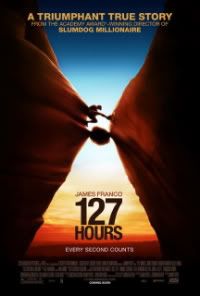
 One thing that is always the kicker when it comes to seeing a movie based on a true story is that often I know how it ends. No one went into Titanic expecting to see the plucky engineers turning the boat in time, missing the iceberg and changing the movie into The Love Boat; no one thought Gallipoli was going to be a gentle travel narrative. So going into 127 Hours, I knew exactly what happened to Aron Ralston during his climbing accident in Utah. If you’ve been paying attention to the movie’s publicity, you’ll know that the film’s based on Ralston’s autobiography, so you know he survives. Because I work in a bookstore, and I can’t ever refrain from flicking through pictures in autobiographies (it’s my protip on the shortest way to understand the entire plot if I get asked questions by customers), I know how it happened. So did Danny Boyle sustain my interest in an entire movie set around one guy stuck between a rock and a hard place (I’m not being corny, that’s the name of the book) and with an ending I knew clearly? We all know I love to answer my own questions, so here: Oh My, Yes.
127 Hours is amazing. I can’t recommend it enough. I also can’t stress enough how much you shouldn’t bring your small children to see this, like the family I saw with a stack of kids so little they needed booster seats—not only is the fourth word of the opening song “fuck”, but there are some scenes so visceral that there are warning signs all over the movie theatre alerting viewers to the danger of seizures. Okay, so maybe I’m a prude, but it’s rated MA15+, so The Man agrees with me.
Aron Ralston is a happy-go-lucky outdoorsman, in his element when thrashing around America’s expansive countryside. One Friday night he drives to Utah’s rocky desert, sleeps in his car, then wakes up fresh and peppy to make his way to Blue John Canyon. On his way he encounters two lost and conveniently pretty girls, and he sets them back on their path, but not before taking them on a nifty little side tour, revealing his ultimate desire to be an outback guide. They part ways, the girls inviting him to a party of theirs locatable by the giant inflatable Scooby Doo, and Aron continues bouncing around the place. Then, while making his way down a crevasse, a solid-looking rock falls and Aron tumbles along with it. When Aron and the rock come to rest, his arm is lodged firmly between the canyon wall and the rock itself.
Movies about people trapped in small spaces have to work hard to keep you from getting bored, and of all directors, the ever-inventive Danny Boyle is absolutely the one to nail the genre. While all moments spent in the enclosed space with the camera lodged in Aron’s face are still compelling, he does give the viewer the relief of flashbacks and elaborate hallucinations, but they are not so extended they remove you from the ultimate claustrophobia of being stuck to a stone. The beauty of his surroundings are lost on neither us nor Aron himself, angling his foot out to catch the fifteen minutes of sunshine he gets a day, or setting his clock by the raven that flies ahead in the morning. He’s in his element, but has made a fatal error: no one knows where he was going, or when he was intending to return. So if the movie has a moral, it’s that. Leave a note, kids. Or take up a low-impact sport like Extreme Toastmaking.
The movie opens with loud intense music, and a three-way splitscreen that takes you between sports, cheering crowds, and the energetic Aron planning his trip to the canyon. The splitscreen continues as Aron bikes his way through the rocky terrain—even spectacularly crashing, the kind of fall that would send me into a whimpering mess and unable to walk for weeks but just makes Aron laugh heartily at his clumsiness and get right back on—and adds to the kind of on-edge hyper-realistic tone of the film. The scenes of Aron taking his new lady friends to a gorgeous blue pool you can get to only by a dangerous and concealed plunge into nothing is breathtaking, and the atmosphere until Aron is trapped absolutely makes the viewer understand the allure of his lifestyle, even for someone like me whose outdoor activities mostly comprise of running only late at night when no one can point and laugh.
Watching Aron use all of his knowledge to survive and try to escape is enlightening—from making an outfit out of rope during the cold nights, conserving his pee to drink later (and you really believe it, too, and feel a bit ill watching it), and attempting to set up a pulley system to get the rock off. As his physical and mental functions start to fail, we see him exhausted, and hallucinating the inflatable Scooby Doo in the recesses of the cavern. (And you will be legitimately spooked, too.) More heartbreaking is Aron’s realisation that he put himself in this position, alienating those that love him—family (including his sister, played by Lizzy Caplan), friends, and lovers (including Harry Potter’s Clemence Poesy as the beautiful wispy partner he pushed away)—causing no one to know he would be gone. His determination to start again eventually drives him to commit the act he is known for—and if you’ve never seen Aron Ralston and know nothing of the story, skip this next paragraph, okay?
So you’re all wondering about the arm scene, aren’t you? Of course you are, you creepazoids. You’ll know the seizure moment when it arrives—more in the form of noise that compounds the tension—and while it doesn’t take the full amount of time it took Ralston himself, it still doesn’t feel like it holds back. Ralston filmed the process at the time, and let Boyle and Franco watch it (apparently his mother did too, and undoubtedly wished she hadn’t), and it does feel real, look gruesome, and make everyone in the cinema cover their eyes and squirm and squeal. Don’t be ashamed. Everyone else is doing it too.
But all of that means that the Sigur Ros-fuelled final moments of the film had me literally clutching my heart and weeping. I’ve never clutched my heart in a movie before, so that was a new thing for me, and a bit embarrassing and histrionic. But I did it, and you might do it too.
In summary: Exceeds Expectations, almost to the point of the ridiculous. It is an incredible film. The only thing that was underplayed was how much pain Franco was in—sure, he looked anguished at the start as he stares at his trapped arm, the wall above flecked with chunks of skin and blood, but then he seems to take a deep breath and never look in pain again. Even if he’d just said at one point, “Well, this hurts a bit, but what can you do?” I would have felt better. But that’s what happens when Danny Boyle doesn’t get me to read over the script.
 It’s a very little known disease in the medical community, but it is a true fact that I am allergic to spoilers. When I come in contact with one, I break out into ALL CAPS RAGE. So please know that I will not ruin the ending of Catfish for you, because despite the fact it’s hardly Sixth-Sense-twist-worthy, the world at large has done such a marvellous job of shutting up about it I wouldn’t dare say anything in case my allergy is contagious via words. (Laugh all you like, I saw Pontypool and know that it can happen.)
Catfish is a little-known documentary that is referred to by news outlets who like zippy headlines as “the other facebook movie”. The Social Network was better, but with Fincher attached and a budget of $40 million, it had a lot more to support it than Catfish did. Made by New Yorkian directors Ariel (Rel) Schulman and Henry Joost and their hand-held cameras, they detect a potentially exciting story when Rel’s photographer brother Yaniv (Nev) strikes up an unusual friendship. When a picture of Nev’s makes it into a newspaper an eight-year-old art prodigy from rural Michigan named Abby paints it and mails her work to Nev, with the blessing of her family. Over time, Nev sends more pictures to Abby, who paints them; Nev, via facebook, becomes friends with her long-haired mother, Angela; Angela’s husband Vince; and their other children, including the unfairly attractive nineteen-year-old Megan Faccio. As the months roll by, Nev and Megan’s relationship turns into something much more intimate and steamy than expected (as revealed in a hilarious scene when Nev, fitted out with his retainer, reads out the text messages the two sent to each other; by the end, when heaving bosoms are involved, he is hiding under the doona in embarrassment.) After the three boys take a trip across the country for work, they decide to spring a visit on Abby and her family to see if they are who they say they are.
There has been debate over whether this documentary is real or not, citing the fact that there was too much perfect timing of the cameras picking up the dramatic scenes. With Joost and the Schulmans hotly declaring otherwise (I may be using “hotly” in this context to imply that they are actually all pretty hot, but you decide whether I’m that shallow) we will never know, but in my totally professional opinion, I think it is real. I loved the movie, so this next part is hard to explain, but I feel that if the movie was a fake they would have made it more interesting—a few more explosions, or what have you—as it is, the movie is wonderful, but also realistic in its lack of drama. I do feel that the boys themselves, prior to or after their visit, may have reshot some scenes of their own to perhaps summarise a month’s worth of excitement into one five-minute take, or to make themselves look sensitive, or to seem cool. Some scenes seemed a little forced, but then, maybe the awkwardness of being in front of camera at all caused that. I don’t have a camera following me around on a daily basis (shocking, I know) so I couldn’t really tell you.
It is an amazingly crafted, edgy film. The handheld camera work is grainy but not shoddy, and gives the movie an intimate and involved feel. A second, better camera is used for some scenes—often Henry and Rel have a camera each and film each other—but the movie’s zany excellence resides in the use of the magic that is the internets. Characters are introduced and named by hovering a mouse over a photograph, revealing a little box with their name, a gesture that those of you who have encountered facebook know well. House shots are stills from Google Street View; locations are pinpointed by a satellite zoom on Google Maps; one great driving scene is accompanied by frame after frame of Street View looking down the road. It seems like an awkward flip book but is an amazing little montage of footage, and a good reveal of how the internet can seemingly hide nothing.
In summary: Exceeds Expectations. Look, I’m not sure why the twist is such a big secret, but I did get a little thrill of nervousness as the three men roll up the driveway towards Megan’s farm, not knowing what was going to happen. Catfish touches on some sensitive issues, and there is a lot I haven’t been able to discuss because I don’t want to ruin anything. Shoot me a comment if you’ve seen it—we can chat about scandalous spoilers in the comments, right? That way no one will be surprised by the news that Abby and her family are all catfish. (I AM JOKING.)
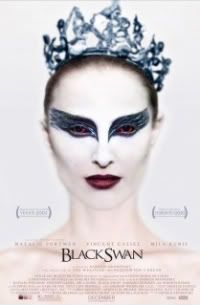
 Ballet is generally known to those stupid in the ways of dance (see: your faithful reviewer) as something quite lovely and delicate. Black Swan turns ballet into something much more ominous and terrifying than I ever expected, a feat achieved by both Natalie Portman’s dancing (and her long-shot stunt double) and the film itself: the sound design and camera work when she is dancing as Swan Lake’s black swan is amazing, and everything people say dance can be. However, you’ll still never convince me to go to the ballet, classical music still makes me snore, and I found Black Swan a bit boring in parts. So, I have no culture. At least I have movies like Machete to keep me warm at night.
Nina (Natalie Portman) is a ballet dancer with a narrow view of the world: unless she is forced outside by events out of her control, she only spends time with the prestigious dance company she works for, headed by the demanding and frankly creepy Thomas Leroy (Vincent Cassel); and in her little-girl room with her mother (Barbara Hershey), who gave up her ballet career to give birth to Nina and who now lives vicariously through her daughter. With the involuntary retirement of principal ballerina Beth (Winona Ryder), Nina is given the opportunity to dance the lead in the little-known production Swan Lake by some dude called Tchaikovsky. Threatening her newfound fortune is newcomer Lily (Mila Kunis), whose charm and talent unbalance Nina’s already delicate sense of self-worth. Much like the critically acclaimed and read, watch, listen-criticised Inception, Black Swan plays with what is real and what isn’t, and at the end you may still be unsure.
The acting is wonderful; Portman is heartbreaking as the unstable Nina, her anguish at the world clear on her face and her almost constantly distress-shaped eyebrows. Hershey is alarming as her mother, someone so dedicated to her daughter’s career she clings to her in a wholly unhealthy manner. Mila Kunis is lovely and affable as Lily, the uptight Nina’s antithesis, a woman game enough—and racy enough—to be the seductive black swan that Nina struggles to play properly, so dedicated is she to her confined and virginal white swan lifestyle. (You can tell Lily is the naughty to Nina’s nice because Lily has tattoos and wears black eyeliner, and Nina is surrounded by an excess of pink. And good girls don’t get tattoos, as movies have taught me and I, along with tens of millions of other good people, have studiously ignored.)
Shot in an interesting, intimate style, the smooth lines of the dancers compete with the disjointed, handheld camera movements. Many of Nina’s scenes as she moves from one place to another are shot from behind her head, like you are in some kind of Black Swan video game with the over-the-shoulder view switched on. (If it was a game, I would totally play it and kick Leroy square in the nuts with a flying ballet leap. It would be awesome.) Scenes are often shot through mirrors, playing with perspective and with Nina’s image of herself. It is a beautifully constructed movie, scored perfectly and delicately, and I can’t find any fault with the editing between Natalie Portman as Nina and her double, who only danced in the long shots. (Portman has danced in the past and has kept her dancer’s physique, as can be seen in all its bruised and ribbed glory in the short film before The Darjeeling Limited.)
Ostensibly a movie about the psychological pressures placed on those at the top of their game—and where it shares minor similarities with director Darren Aronofsky’s recentish The Wrestler—it could be a movie made about any competitive activity. Stick Portman in a tennis outfit instead, or maybe as a professional runner, and the movie could follow a similar track. Ballet’s obsession with beauty plays a not insignificant part, though it’s tricky to tell in movies because everyone in them is beautiful anyway and you almost forget how lovely people look when everyone who surrounds them is also beautiful. (Maybe this is an insight into the movie industry as well? Probably.) Visions of Nina throwing up, or smiling as the costume designer tells her “you’ve lost weight!” play into the beauty aspect, as does the predictably sleazy Leroy, happy to seduce and reduce Nina to her sexuality and creating some truly uncomfortable scenes. In that, Cassel is probably a fabulous actor, because I hated him.
The general dislike I had for everyone was part of why, despite all this, I didn’t enjoy the movie as much as I had hoped. Nina is absolutely a sympathetic character, made destructive by her environment: driven by her desperate mother to perfection and by her teacher into becoming someone she is not for the sake of a part. But she is so uptight and ill-humoured that I didn’t actually like her. By the end of the film I didn’t like a single person in it, and ballet came across as an exhausting, depressing, misogynistic vocation that can ruin your body and your brain just so some rich people can pay to see people give themselves lifelong physical ailments by jumping about on their toes. So yes, that wasn’t particularly unexpected, then.
As I’ve said in this blog before, unlikeable characters don’t necessarily make or break a film*, but my indifference towards her did not help when teamed with the other issues I had. Also like Inception, I sometimes found it boring, checking the time or shifting in my seat and looking pointedly around hoping to catch the eye of someone else bored. (I didn’t. And some people applauded at the end of the film. So you may love this.) I couldn’t tell you which scenes bored me; I just know that I was waiting for something and it was taking too long. I also found myself unsurprised by the events that unfolded. It wasn’t actually predictable in that I could tell which scenes were coming, but with every dramatic moment I never really felt shocked by what happened, bar one scene in Beth’s hospital room that almost produced a squeal. Aronofsky did create amazing tension, building up every character to the point where they could break, or break Nina, but some scenes that the sound design indicated were supposed to make me start in shock just had no effect at all, like a B-grade horror movie that has monsters jumping out of closets every time you need to get your coat.
Well, this is getting long, and there’s more I’d love to whine about, but I should shut up and summarise: Below Expectations. I love Aronofsky, I think Natalie Portman is great if you pretend she never smooched Anakin Skywalker, and I wanted to like a movie about ballet so I could seem like totally smart and stuff. But I didn’t like it, not really. It didn’t amaze or astound, and while Aronofsky was honest about the lack of glamour in ballet—as the bleak grey bricks in the studio can attest—I just don’t like it. The fact that Ms Portman is now engaged and pregnant to co-star and choreographer Benjamin Millepied made me feel a little better though—I love a good romance (even in a movie that’s not about one), and I love that his name sounds like millipede. Because I’m not cultured. But I’m okay with that.
*Neither does my dislike of the sport involved; I also hate wrestling, but I thought The Wrestler was a great movie.
 If you take anything away from the following review, please take these two things: 1) Go see Blue Valentine, seriously, and b) take at least one full box of tissues, so you aren’t left snivelling into the sleeve of your cardigan like some people who cannot be named due to legal embarrassment. My one comforting thought was that I wasn’t the only one in the cinema crying and sniffing; it came from all directions, like they’d put pollen in the air vents. I asked Chris afterwards if he cried and he said no, but that he did get emotional. That’s okay, I do more than enough weeping for the both of us, so much so that I should really start bringing Gatorade to relationship movies to replenish my tears so I have enough spare for watching ads for said movie later on.
Like the hit-and-miss (500) Days of Summer, Blue Valentine charts the love of two people, bouncing back and forth from the giddy early days to the later dissolution of the relationship. Unlike (500) Days of Summer, which still had Hollywood shine and was too finely-tuned and glitzy to be honest, Blue Valentine feels so unmistakably real that by the end of the film you are so emotionally invested in now-humourless Cindy (Michelle Williams) and now-drunk Dean (Ryan Gosling) that it feels as raw as watching the breakup of your two best friends.
Set over two days in the present and sparked by the family labrador going missing, Cindy, Dean and five-year-old daughter Frankie bicker and hug and work and live in a world that seems immediately fractious. In an attempt to bring them together while Frankie is having a sleepover at her grandfather’s, Dean books the pair into a love hotel’s future-themed room and there, despite the humour in the room—no windows, rotating bed—the damage to their bond becomes clear. Smoothly revisiting key moments in the early months of their relationship that tie in visually or topically with the present, the trajectory of their life together may be doomed, but as youth they are filled with such hope and excitement it is nothing but heartbreaking.
The cinematic technique of a scattered version of events can often be a pain in the ass to watch, a cheap trick used to make the film seem more Totally Deep and Stuff than it actually is. Blue Valentine shoots down detractors of the technique (possibly just me, however), and will reveal over time how awkward arguments make complete sense, or how a justified reaction becomes too harsh. By the end, the viewer has a whole new perspective on everyone’s actions. Every scene is important, but never feels forced or contrived. At the end of it all, while both Cindy and Dean both act in ways that you may not agree with, neither are horrible people, but rather, just people.
The script hit so close to home in so many scenes that it was impossible not to feel like my life and fears had been catalogued and filmed. The arguments they have spring from the kind of petty comments that I’m liable to make when I’m tired or cranky; their reactions to each other so true to how I get when I’m pissy. (Not a lot, but I’ve just been through Christmas in a Retail Management Capacity so I have possibly been a bit tetchy in high-stakes situations like Oh God the Peanut Butter Has Run Out, or Why Did You Wash Those Jeans I Wanted to Wear Them, You Are the Worst Boyfriend in the History of Forever.) It didn’t make me second-guess my own relationship, as we’ve been together for more than a decade and we don’t suffer from the same ailments—actually none, really, apart from fighting about movies—but the moments of tired resignation or rejected affection in Blue Valentine are maginified versions of moments that every relationship suffers through. Moments of tenderness and love made me cry just as hard as the painful scenes of their fights and one particularly devastating and convincing scene in a hospital that will probably lead to me giving Michelle Williams a sympathetic hug in the street should I ever see her.
In Summary: Exceeds expectations completely. An almost perfect movie, but I’d advise against it if you’re feeling down. It’s not all depression and sadness, and I didn’t leave the movie cursing our fickle emotions, but it’s a fairly melancholy tale of how love can just end. If worried, remember that Williams and Gosling co-produced, so they must be pals in reality, right? Right.
(And in case anyone is wondering, the Tom Waits song Blue Valentine is not in the soundtrack, which is written by the incredible Grizzly Bear.)
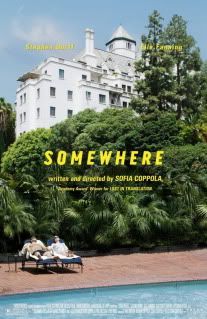
 Somewhere out there, there are celebrities and CEOs and other famous, bored people who go see Sofia Coppola’s new movie and think to themselves, oh, OH, thank the lord someone has finally made a movie about how hard it is to be ridiculously wealthy. I’m not saying that being rich will buy you happiness—poor mental health transcends class, undoubtedly—but if you want me to watch a film about the sorrows of being able to fly anywhere, bonk anyone, and have everyone love you, then you better make it interesting. And Sofia, while you look like a nice person and I loved The Virgin Suicides and adored Lost in Translation (and as you are an ex-partner of Quentin Tarantino I will forever hold you in high esteem), I found Somewhere to be self-indulgent and dull. Sorry.
In LA’s Chateau Marmont, hotel to the famous and the place to do stupid things that end up on TMZ, famous actor Johnny Marco (Stephen Dorff) is holed up waiting for the upcoming media junket for his new action flick and recuperating after a staircase-induced arm injury. He also drives a luxury sports car, as the five-minute opening sequence of him circling a racetrack in it will attest. In other news, his daughter Cleo (Elle Fanning) comes to stay for an indefinite period of time, dropped off by her mother. During this there is lots of brooding, no real talking for the first fifteen minutes, and no actual, long proper conversation for the entire length of the film, which is about an hour and a half, maybe less. So, the fact it’s short is a plus. Another point in the movie’s favour are the actors themselves—Stephen Dorff is quite likeable, Elle Fanning is great as Cleo, and the only other actor in it for any period of time, Jackass alumni Chris Pontius and his luxurious hair, is perfectly agreeable as Johnny’s best friend. Coppola herself turns up in a party scene, in case we hadn’t already thought that the life of a kid following her famous dad around hotels had any kind of autobiographical elements.
The movie is a series of vignettes about Marco’s existence over a few weeks, each scene carefully thought out and executed to perfection. We see him watch two awkward pole-dancing shows in his room (and in case you were worried it was too subtle, he falls asleep during the first one); look morose at his own party; sunbathe with his daughter; receive anonymous text messages calling him names; order room-service gelato with Cleo in an Italian hotel room; do a lot of driving; and have sex with everyone who makes eye contact with him. There is a startling dearth of speaking, and much like those scenes in Family Guy when Peter trips over and hisses over his hurt knee for five straight minutes, each moment is stretched out as long as is possible, then for, say, four minutes more. Thus poignancy turns tedious, and we physically feel the pain and torment of life as a star. It’ll make you want to donate to an ennui-based charity.
The juxtaposition of scenes seems important and telling, like when one of the pole-dancing scenes is followed by an uncomfortable viewing of eleven-year-old Cleo’s ice-skating routine. Hers is not a raunchy routine, nor is it perfect, and it gains the attention of Johnny like the dancers could not, but seeing her skimpy, glittery costume so soon after other skimpy, sexualised costumes is most definitely disconcerting. I don’t quite know what the message was. Dancing and metal props don’t mix?
Johnny and Cleo’s relationship doesn’t seem to be the point, as it follows a straight, drama-free trajectory. Johnny’s interactions with everyone are fairly mundane or friendly, his affairs only temporarily distracting. His hedonistic tendencies are on show, but still do not make him an unappealing character, meaning he lacks any real depth. When he calls one of his lovers to ask for company and she says no, he cries in despair, but with none of his past on display or many of his emotions or motivations revealed, I just couldn’t understand or care.
An enjoyable moment with a masseuse and affable characters, along with fine acting, lifts the movie out of the bin and possibly above the horror that was Tron: Legacy. The soundtrack has been much lauded but went largely unnoticed by me—which is not necessarily a bad thing, however, especially as I can’t stand Phoenix, who had a hand in it. It looks gritty and indie, and raw and true. But I still looked at my watch a lot, and wished Johnny would brush his hair just once, honestly.
In summary: Below Expectations. I feel she was striving for beauty and emotion, and instead got beauty and nothing else underneath, like when you’re walking through the Basement at Myer and think you see some well-dressed dude sitting down until you come to the devastating realisation that it’s a stragetically placed mannequin and will probably not appreciate your well-thought-out pickup line. And nothing will ever pull you out of a movie more than seeing the boom appear at the top of the screen not once, but twice. For shame. I’m shaking my head at my laptop now in pointed despair, Sofia.
 In a world as familiar as the suburbs and as alien as a sci-fi movie, seventeen-year-old Ree Dolly is put in a terrible position. As the caretaker of her younger siblings now that her mother has lapsed into a speechless depression, she finds out that if her absent father does not turn up for his court date in a week, she will lose the family’s house and land—which he put up for bond. Trouble is, she doesn’t know where her crack-dealing pappy is, and the frightening inhabitants of her rural Missouri town take any requests for information as a personal threat. But with the wellbeing of her beloved family at stake, Ree is prepared to face whoever and whatever she needs to help them. While Ree’s younger brother and sister adore her and are good kids, they’re too young to look after themselves, and Ree has very few people to turn to. Teardrop—her missing father’s brother—is a scary, violent man, haggard and brutal, and aware of the code of honour within the society they live in. Her friend Gail is stuck at home with a baby and her unwilling, angry-looking spouse, unable to offer Ree the help she needs in her search. As a determined Ree asks questions of everyone within her realm of knowledge, the bleak landscape and the community do their best to stop her.
Chris pondered aloud if the camera could have caught a flash of green grass or clear skies if only it had moved a bit either way; as it was, Winter’s Bone’s cinematography catches a place that is universally grim. Everything is cold, and worn, and old, and the world I am familiar with—happiness, smiles, friendliness—seems so impossible to get to that it is hard to believe cushy American movies are filmed on the same continent (and that my dear friend Lilli was in the same state recently having a total blast.) The gardens and houses show a world where perhaps in the past life was brighter: toys may have been new, machinery free of rust, houses freshly built. Drugs have choked the town, with its inhabitants mostly made up of crystal meth dealers and users, leaving everyone drawn and with the alarming look of someone high, or waiting for the next high. So chilling are the cast that Teardrop, constantly snorting from his little baggie, terrified me until I IMDb’d him in the car on the way home and realised he was actually John Hawkes, recently the cause of my adoration as the will-they-won’t-they father in Miranda July’s excellent Me and You and Everyone We Know. It was such a brilliant turn and I was so completely fooled that it reminded me just how plain talented actors can be. Jennifer Lawrence, as the savvy Ree, is also amazing, stopping at nothing—no matter what the threat—to save her family.
The movie manages to put a few interesting twists into the characters, turning two cinematically-hated tropes, including an army recruiter, into basically the kindest people in the film. As Ree hopes to join the army, asking when the promised $40,000 would arrive, the recruitment officer tells her gently that it wouldn’t be for a few months, and that she really needs to rethink joining the army if money is her sole motivation, and that caring for her family is a much more important job. Their heartfelt discussion is, frankly, shattering, as it was the only time I had thought: join the army! Get some money! This really is your only choice! Instead of: run away! Army bad!
Winter’s Bone is probably going to take over the Oscars, and it should. It really is a marvellous film: knock-you-down devastating, depressing and pearl-clutching, with a lake scene so viscerally horrible near the end that will have you wanting to hug Jennifer Lawrence should you ever see her in the street shopping for groceries. There is, in Ree and her siblings and the home of her father’s lover, little sparks of hope that make the movie beautiful through its cheerless exterior. In this, it shares similarities with John Hillcoat’s The Road, though Winter’s Bone conveyed a world that Hillcoat (well, Cormac McCarthy) needed an apocalypse to create. Why so dramatic, when there is such horror in the world we already have?
In summary: Above Expectations. This is a tremendous film, never tedious, and with characters you feel are desperately real and whose determination you cheer (or whose downfall you secretly wish for.) The only fault, for me, was the addition of a tree-felling dream sequence. I don’t believe a good dream sequence has even been filmed (or written.) Feel free to shoot me if you wish. (And hush, Alice in Wonderland is not counted.)

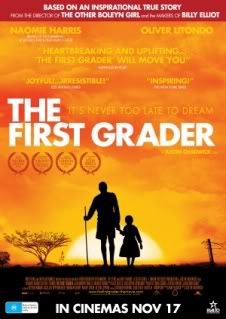 Kenya, 2004: the government has just announced that school is now free for everyone, and kids everywhere launch themselves at high speed—I’m not even joking—at the nearest classroom. Woefully undersupplied and with only 50 desks for the 200 kids there, one particular school is doing it tough. And one more student is determined to attend: 84-year-old Kimani N’gan’ga Maruge (Oliver Litondo), survivor of a brutal uprising fifty years earlier, desperate to get the education he never did, and learn to read so he can understand an important letter he has received in the mail.