Showing posts with label action. Show all posts

Saturday, July 30, 2011

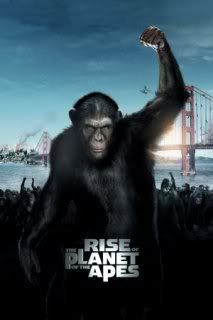
rise of the planet of the apes

While I was stoked to get invited to an advance screening of the new Apes movie, and was jumping around like a kid at the zoo waiting to see it this afternoon, we really have to get past the most pointed flaw in this movie, don’t we? I mean, seriously, repetition doesn’t have a place in the titles of well-crafted big-budget movies. Using “of the” twice in one title is overkill. I understand it gets to the point—everyone knows exactly where this movie is going—but really, they couldn’t spare a few thousand dollars of the budget to get a bunch of eight-year-olds to think up a cooler simian title? It could have been called something like MONKEYS ARE EXCELLENT or AN ACTION MOVIE WITH AN AWESOME LACK OF KISSING SCENES or APES R BETTER THAN BEN 10 ARE NOT ARE TOO or something equally lengthy that doesn’t become boring halfway through saying it.

Beyond the title, which I should probably shut up about, is a well-crafted movie that—like all prequels—has an ending you know is coming as long as you know there’s a movie out there called Planet of the Apes. Still despite you knowing the Titanic is going to sink it remains a relentlessly tense and thrilling action movie. Young neurologist Will (James Franco) is desperate to find a cure for the Alzheimer’s that his father Charles (John Lithgow) suffers from, and has a breakthrough with the drugs he is working on at the lab. One mistake leads to all the chimps that have been experimented on to be put down, bar one tiny baby chimp Will takes home and names Caesar (Andy Serkis with some help from the SFX team). Caesar, after inheriting his mother’s altered genes from the powerful drug, grows big and smart, until he becomes too damn big and smart for his own good and is banished to an animal sanctuary, where he finally has a meet and greet with some other simians.

This movie is a four-star ape movie and a two-and-a-half-star human movie, making it meet somewhere in the middle and be average-to-good. The ape scenes, especially when Caesar winds up in the animal sanctuary to be tormented by Dodge (an aptly-named and stereotyped Tom Felton, aka Harry Potter’s Malfoy), are fantastic in scope: with the limits of no dialogue, director Rupert Wyatt still makes you understand the dynamics of the relationships. While the humans also have their emotions—Will’s care and distress for his father is honest but necessarily short—his blossoming relationship with zoo doctor Caroline (Freida Pinto) has very little drama and his arguments with boss Steven Jacobs (David Oyelowo) over the development of the drug are fairly superficial.

Apes is Serkis’s—or Caesar’s—movie, and he glows every time he is on-screen. I did feel that he was often accompanied by dramatic music that wasn’t always necessary but left me in a state of heightened anxiety. Not knowing his own strength, or that he is different from the humans he is desperate to play with, he is frequently in danger or putting others in danger and I was so tense that I often let out little shrieks and spend half the movie with my hand over my mouth like a perfect little emotive audience member. This strain did mean that the payoff—namely a certain scene with a recognisable phrase and the perfect response—was downright exhilarating, to the point where the audience let out cheers and applause and even I joined in, though I usually think that’s a bit corny. It was sweet release, and changed the tone of the movie to the point of no return.

From an animal rights perspective, it’s a painful and depressing movie to watch. The reactions of virtually all the humans to the conditions of the apes is disappointing and there is never a moment where they fall to their knees moaning “Why did we treat such beautiful animals like this?” While Will is painted as the humanoid hero, he still keeps Caesar in his own home for his own selfish reasons, and never bats an eye at the other apes who are locked in sterile glass cages at his workplace. It makes for a strange juxtaposition when the animal sanctuary, where Dodge actively harms the animals, still seem much more fun, because at least Caesar is able to make some new pals and jump around on a tree, and none are experimented on.

Altogether, it makes for a frustrating though understandable viewpoint where you’re not sure who to root for. The humans mostly seem like a pack of selfish brats, except for the sadly declining Charles, and Caroline, who does not have much to say until she says of Charles’s illness, “Some things aren’t meant to be changed”, though I doubt many people in the audience feel that the cure for Alzheimer’s is worthless. But it’s also tricky to be on the side of the apes and their monkey associates, who are strong, kind of scary and a touch violent even despite Caesar’s best efforts to reign them in, and, well, become fascist slave-drivers. By the end, all you can definitively hope for is that the car park won’t be too full on the way out.

The effects are fantastic but not perfect—a few scenes are flawed, but I could count them on one hand, and that’s not bad for a movie where humans and special effects are interacting so frequently. It of course helped that the apes were played by people (it also made me feel better as a super-vegetarian to know no animals were harmed in the making of this movie), which meant they were physically present—the flaws were mostly in fully-digitised scenes, but aren’t noticeable unless you’re horribly critical like I am and trying to disassociate from such an ultimately depressing movie.

It is hard to remove my own strong emotions about animal care from the movie itself, and the fact that no human wanted to campaign for general increased ape care left me feeling a bit cold towards them. It means that my opinion of the film is clouded by this, and if I was a better reviewer I would cast them aside and be a erased blackboard of emotions. But it’s a grim movie. Apes’ very infrequent moments of humour are so vastly spaced that it almost seemed redundant to have them; more generally humorous but actually quite devastating is the idea of Will’s poor neighbour being the unluckiest man in the world.

I do sound critical of what is really a very good blockbuster movie with all the right elements—cracking pace, heart-attack-worthy action, some mindless city destruction, a hilarious orang-utan. The material ultimately made it hard for me to enjoy because I spent so much time being sad. There are some cheesy plot-points, like death scenes at the most coincidentally poignant of times (and one character surviving a fiery blast long enough to sigh, unsinged, and die in someone’s arms); there are red herring moments never explored; the above mindless destruction is a tad unwarranted and the human damage goes unmentioned. But with the scenes at the animal sanctuary so amazing, it almost doesn’t matter.

Go see The Rise of The Etc and let me know what you think. I am especially interested to hear if anyone else agrees it’s the prequel not only to Planet of the Apes but also to 12 Monkeys, depending on what mood you’re in for a movie marathon that day. Also, while there’s no curse words and limited blood, I spent so much of the movie clutching at Chris’s hand that I still wouldn’t recommend it for kids, unless you want them to have monkey-based nightmares for eternity. And hey, if you’re that type of parent, more power to you.

Today
’s arbitrary score: two out of three bananas.

Friday, June 17, 2011

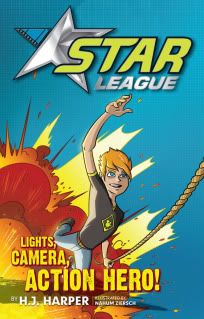
h j harper, star league #1 lights, camera, action

There’s something about initials in kids books. When I was a kidlet, all the best books were by people hiding behind initials – along with Point Horror writers Caroline B Cooney and D E Athkins, R L Stine is of course a good example, and I was so in love with him and his initialled compatriots that for a while all of my (numerous and terrible) stories were mostly me thinking up dramatic titles, writing the name F E Hardy in bold, then running immediately out of ideas. The trend continues with the Zac Power books, written by H I Larry, a pen name for a variety of excellent authors who have contributed to the series. H J Harper is no pseudonym, but an actual (and quite lovely) person named Holly, and her new Star League series starts as much fun.

Book one opens with movie star Jay Casey heroically stopping some bank robbers in a commercial for the drink Fizz Force. As the filming wraps up, we learn more about Jay: he does his own stunts, swinging down from the ceiling and kicking a burglar’s legs out from underneath him; he’s kind, showing concern for the actors he’s just beaten up; and he’s a lonely kid, orphaned and with only his uncle/agent Jefferson as a friend. Then Jay finds out he’s up for an audition with the famous director Ben Beaumont—but it’s not an audition for a movie, but to join a new bunch of kids with the ability to save the world. There’s robot S.A.M., animancer Leigh, zombie Roger (full name Roger Romero, which is why I love Holly right there), werewolf Connor and ninja Asuka, and the first book shows the team meeting for the first time, and thrown right in the deep end with a dramatic kidnapping as the evil and awesomely named Professor Pestilence tries to use Jay
’s fame to his advantage.

I like early reader chapter books because I can knock them out in a short period of time and feel like a Successful Bookseller. It’s also great when I like them and then have some proper advice to offer those who want to buy a book for the eightish-plusish market. (Younger kids will probably like having it read to them and older kids, like for example twenty-nine-year-old ones, might also like to snare themselves a copy.)

Having male, female and androgynous-robot characters means that all types of kids can see that anyone can be powerful and courageous, and makes the series good for kids who think reading about the opposite sex is gross/smelly/weird/boring or the parents that assume their kids think that way. Though to be honest, in many ways the children’s book industry mops the floor with adult books, sexism-wise, because there are female spies and agents and adventurers all over the place in the kids section but not as much in the adult fiction section. Hopefully kids who grow up reading books like Star League: Lights, Camera, Action Hero will end up writing books like Star League: Equal Pay, Equal Badassness. Or perhaps they’ll think of better titles. Probably.

Lights, Camera, Action Hero is fun, adventurous, a bit different, and manages to tackle the serious issues of being ostracised and feeling lonely while throwing in terrifying evil professors, killbots (my favourite kind of bot!) and jokes. Basically, it’s all you could want in a kid
s adventure book, with the added bonus of originality and warmth. Nahum Ziersch’s manga-ish illustrations are excellent, energetic, edgy and other e-words too: it makes for a good-looking read to go with the clear but not patronising language. And if you/your kid/your grandma likes it, there’s five more books in the series. You know what, you should probably just go buy them all at once.

Tuesday, June 14, 2011

super 8

While I can only remember spending my school summer holidays watching Spaceballs on repeat and eating peanut butter out of the jar, in Super 8 a bunch of clearly more motivated kids decide to spend their summer holidays shooting a zombie movie. Among them is Joe Lamb (an excellent Joel Courtney), in charge of makeup effects, who lost his mother in an industrial accident four months earlier. He and his father’s relationship has suffered heavily, most heartbreakingly displayed in a moment when dad Jackson (Kyle Chandler) sells him on the idea of spending summer at a baseball camp by saying “it’s best for both of us”. Before the idea takes hold, the group of friends sneak out late one night to film a midnight scene by a train line. Accompanying them is the only person with access to a car—Alice Dainard (Elle Fanning), whose first scene is amazingly snippy but who Joe is besotted with regardless. As they start filming, a train comes along in the background, and all hell breaks loose.

The train crash scene was incredible. I love a good smashy disaster spectacle on film—only pretend ones, though—and this blows most other such scenes out of the water. Carriages go flying, debris everywhere, fireballs—you name it, it happens. And it keeps happening. It takes your ability to believe in the physics of a crash and stretches it as thin as possible. It is one of the most entertaining ten minutes I’ve ever had in cinema, and though the movie had been fine up until that point, that was when the audience gasped at each other in shock and I blustered about it happily in my seat. In the aftermath of the crash, the story proper is set up: something mysterious and alive was in one of those carriages, and the Spielberg/Abrams camp is happy to scare the pants off you from here on in.

As the town deals with the crash and the subsequent drama of both the army’s arrival and the fallout from the accident, Joe and his friends have their own problems—jealousy, grief, blossoming friendship and the need of movie director Charles (Riley Griffiths, shouty and excellent) to finish the film. Shit gets real pretty quickly, and our characters are in actual danger, making it a tense and gripping film that has typical Spielberg humour to lighten the mood. And I don’t begrudge him that for a second; it’s bloodier and the kids swear like troopers, but otherwise, it’s got a real Goonies feel to it; fun, scary, everything a kid could want—though I’d be hesitant recommending it to anyone under the age of twelve or so.

The acting is perfect, and the kids—some of who have never acted in film before—will make you weep for them and laugh with them. The film-within-a-film’s lead actor Martin (Gabriel Basso) barfs at any level of distress; explosion effects master Carey (Ryan Lee) is a slightly alarming little pyromaniac; Preston (Zach Mills) designs sets and is a terrible extra. You’ll love them all—apart from Alice’s guilt-ridden father Louis (Ron Eldard), none of the humans are really a grey area as far as how you want them to see out the movie. The army is made up of jerks. The townspeople are good. And with a mysterious creature on the loose, someone’s going to get attacked.

The scares were so neatly placed that I never expected them; one particular bus scene had me so surprised that I knocked Chris’s Pepsi over in my terrified flail. One guy behind me screamed in an earlier moment of shock. With these moments of alarm coupled with jokey characters and a pace that never stops being affecting in some way, Super 8 is almost a perfect movie.

It isn’t, though: the creature itself is a grey area emotionally and has a frustrating ending; Alice’s dad Louis seems to have more backstory with Joe’s family than is properly exposed; a particularly magnetic (this is a terrible pun) scene at the end is laboured and pointless; a joke about a kid listening to this new thing called a “Walkman” is forced and elicited nothing but groans from the audience. But no movie is flawless, and it was such a fantastic movie overall that a few people even applauded as the credits rolled. And you should, of course, stay for the credits.

Super 8 is a wonderful, instant-classic type movie; it gives me hope for J J Abrams (because let’s face it, Cloverfield was pretty average) and reminded me why Steven Spielberg is the kind of guy who you want to hug and thank for making childhood seem much more fun than it actually is. For the first time in a long time, I am contemplating seeing a movie at the cinema twice. This time I’ll make sure we take drinks that have screw-top lids so no one needs to find themselves covered in ice just because I can’t control my arms.

Friday, April 29, 2011

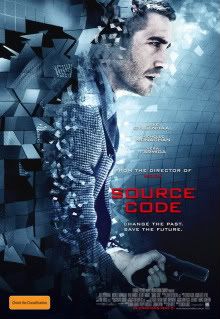
source code

So if you’ve noticed a lack of shouting from me on your Google Reader feed lately, it’s because I’ve been away – to Vancouver, Yellowknife (it’s in Northern Canada, far enough that I got to see the Northern Lights), New York City and Toronto. It was a blast, and yes, I’d love to be on holiday for eternity, but I’m pretty happy with my life (and that includes you, faithful reader) so I’m just as stoked to be home. And you’ll be pleased to know that I didn’t forget my sworn oath to bleat about movies to the sighing masses, and I watched some movies on the plane (Yes Man: perfectly adequate and Zooey Deschanel is a doll; Gulliver’s Travels: funnier than expected though seriously Jack Black is always so reprehensible, am I right?; The Tourist: not actually the worst movie ever, but I picked the twist and Johnny Depp looks like he has a tiny little face next to Angelina) and I even went to see a flick in NYC. Before I go on about the film, let me say that the cinematic experience itself was a bit of a surprise: while I could still have the popcorn there (alert: buttered popcorn never has actual butter) the floor sloped up, not down, which was a bit distracting, and the aisle was in the middle instead of along the sides, which meant instead of sitting in the middle of the row, aka the whole POINT, I had to sit TWO CHAIRS TO THE SIDE. I know, I know. America, right? Totally backwards.

Source Code is the newest movie directed by Duncan Jones, the genius behind mind-bend Moon. In it, Colter Stevens (Jake Gyllenhaal, apparently pronounced Jill-en-hall for those who, like me, are perpetually worried about saying it wrong) wakes up on a train to find a beautiful girl named Christina (Michelle Monaghan) having a conversation with him that he doesn’t understand. After stumbling about, angry and confused, the train explodes and he wakes up again—this time strapped in a chamber and understandably freaking out. He is a military pilot, trying to figure out what happened to the crew he last remembers flying with, but Goodwin (Vera Farmiga), the rushed officer on the other end of his audio feed, is in a hurry to get him back on that train. Because someone blew it up, and there is going to be yet another attack, and the only way to fix it is to get into the mind of someone who died on that train, and figure out who planted the bomb. The Source Code is a system that will let you back into the last eight minutes of someone’s life, and Colter is the right person for the job, and now under command to figure out what happened. But as the minutes tick over and he keeps getting blown up and becomes distracted,
by Christina’s loveliness, from his arguably more important task of saving an entire city, he wonders if there’s a way he can change not only the future, but the past, too.

Source Code is just as flat-out great as Moon; it’s the kind of movie you’ll leave feeling glad you’ve been at the cinema. It’s well-shot, beautifully acted, perfectly paced, and an interesting idea, even if you’re like me and your eyes glaze over as soon as science harder than Mentos + Diet Coke = BAM is involved. Despite the fact that Colter has only about fifteen total minutes of conversation with Christina, you want them to shack up. The tension is high not only because the fate of Chicago is in Colter’s hands, but because we—and Colter himself—are kept in the dark about certain aspects of this investigation, so in a panic are the military hoping to catch the bomber in time. Goodwin, and the limping Dr Rutledge (Jeffrey Wright), don’t have time for elaborate exposition, so just as something is unveiled, we’re back on a train with eight minutes left. And finding a bomber on a train full of suspicious people and jerks is just about as hard as you’d imagine.

Now I’d be cautious of reading many reviews for this movie, not just because my opinion is the only important one (which it totally is) but because I actually had a fairly crucial plot point spoilered for me a few weeks ago, which they (I can’t quite remember who) threw so casually into the review I assumed it was known from the start, but it really was not at all. The movie can get quite mind-bending at times, too, as is to be expected once quantum physics get involved, so I could be partially grateful for having that one thing ruined so I knew what was going on for once instead of being too confused to finish my popcorn (a dire situation.) And look, you do have to have a certain level of faith in a movie that doesn’t really explain how you can really get into someone’s mind eight minutes before they die. I understand the concept of parallel universes with different outcomes, but at the end, you may have a few questions the movie didn’t quite answer. But then, you might have not been an English student like me who spent all of Science drawing penises in the margins of her textbook, and maybe it will all be clear. Along with the more physics-based quandaries I had, I also wondered why there was no mention of, you know, actual police work involved in finding out about the bomber. Was this really the only plan the government had? Was no one checking security footage? And the ending needed more sirens. Etc etc. It’s okay though; most movies give me questions that really are only asked by pedantic people like myself, and Source Code left me with a general feel of goodwill so I can’t really criticise it.

Gyllenhaal does a fine job channelling a more Jarhead role than a Prince of Persia one, and Monaghan, despite trying to pass as twenty-eight in this film (she looks amazing, but thirty-five), is as sweet and funny as you could want. The small amount of peripheral characters on the train (college students, comedians, nurses, all who have interactions with Colter over the course of the movie that range from scary to funny) and outside (the military, and Colter’s estranged father) give the movie some extra emotion: more people whose outcomes you care about. Whatever Duncan Jones does next, I’m sure whoever his father is will be proud.

In summary: Exceeds Expectations. A great film, much fun to be had, kind of smart enough to make you feel like your brain is working while blockbustery enough to just be entertaining. I mean, avoid seeing it in America if you possibly can (I personally recommend Hoyts Victoria Gardens, but that’s just me.) It’s so good you should tell your other parallel selves to see it too. Then you can all leave yourself emails discussing it, right? Augh, I broke my brain again.

Tuesday, March 29, 2011

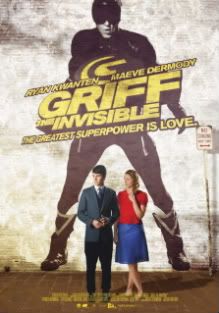
griff the invisible

Forever in my mind as Vinnie the hapless husband from the halcyon days of high school when my mother and I obsessively watched Home and Away after dinner, Ryan Kwanten has done what only a handful of ex-H&A-types have and is now gleefully in the middle of an awesome local and international career. And you can see why—in Griff the Invisible as the titular Griff, he is so far removed from the world of Jason Stackhouse both literally—Griff is an Australian film—and emotionally, as he doesn’t exude the confident ridiculousness of Jason but instead is so put upon and quirky you just want to give him a hug. Or an AFI. Maybe both.

In the dark of night, when crime is creeping up on unsuspecting civilians, the person to save them is Griff: clad in a yellow-and-black suit, strong and brave, he will defend the citizens of his town the best he can. With an amazing security system and cameras all over his neighbourhood, he knows where to go and when to help. But when daytime rolls around, he struggles in normal society. Bullied at work by the mean-spirited Tony, he stammers and blushes his way through social interactions and only slight loosens up around his own brother, Tim. It’s Tim himself who first reveals, holding up a poster of a poorly-drawn representation of the costumed Griff that are plastered around the neighbourhood saying DO YOU KNOW THIS MAN?, that this is not new, and that Griff has been in trouble for this before. And before long, you are left questioning: is he a superhero? Does he have superpowers and a line straight to the unnamed commissioner?

There are a lot of everyday-superhero movies out at the moment, from the recentish Kick-Ass to the very recent Rainn Wilson vehicle Super, and it has become such a genre of its own that I couldn’t even convince my spouse to see it with me, so bored was he of the idea. But the limited scope of Griff—you never go out of the neighbourhoods he works and lives in—means it becomes much more personal and involving, less about action and fight sequences and more about the mental state of its main characters. Along with the painfully shy Griff, there is Melody (Maeve Dermody), Tim’s new love interest and a scientist who believes she should be able to walk through walls. And while it
’s Tim who finds Melody at a Chinese takeaway restaurant, it’s she and Griff together, realising almost instantly that they have found a kindred spirit in each other, that make the film so wonderful: they are cuteness personified, laden with quirk and attractive without the overly made-up perfection of Hollywood movies. Despite the superhero plotline, it’s a movie that smacks of familiarity, and can I just say, it is so nice to see an Australian movie that’s not about a) bogans, b) death, or c) bogans dying. There are suitably Australian turns of phrase but with none of the cultural cringe that movies like Sanctum make you suffer from. (The phrase “yum yum chook’s bum” is uttered, but it’s contextually appropriate and kind of funny.) It’s the kind of Australian film you wouldn’t be embarrassed sending to your overseas pals on DVD if not for those pesky regions.

It’s a gorgeous-looking film, with the reveals of Griff’s surroundings over time heartbreaking and simplistic. The camera loves the beautiful Melody, and it’s well-shot even within the confines of the limited areas and spaces used. The soundtrack is good enough to make me go to work and whine that we don’t have it in yet, and the sound design also zippy. The film, however, does drag on a bit, despite its short running time, and goes through so much happy! sad! together! apart! that you’re a bit done with it by the end. There’s also a couple of fun things, like Griff’s fights with steampunkers in alleys, and Melody’s habitual clumsiness, that happen at the start and then vanish towards the end, leaving you feel cheated of the things that made you feel so warm towards it in the first place. But really, it’s the characters that make Griff the Invisible so great, with Tony someone you’d really like to see blasted into space by a cannon (spoiler: this doesn’t happen), Tim someone well-meaning but ultimately painful to talk to (“Anyhooo, we better goooo,” he will say awkwardly), Melody’s concerned but adoring parents (Heather Mitchell and the always utterly utterly fabulous Marshall Napier), and Griff and Melody themselves, superheroes, super weird and a couple to be held in high esteem by outsiders everywhere.

In Summary: Meets Expectations. I couldn’t say it’s the greatest movie of our time, but it is absolutely a sweet little movie to spend an afternoon watching, and then you could go out afterwards and take Melody’s advice: protest a protest, or Google Google. Or go punch a bad guy in the street. Whatever floats your boat.

Monday, March 21, 2011

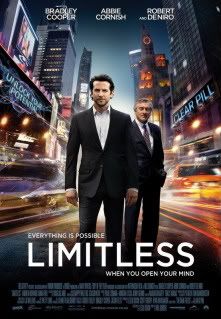
limitless

At the beginning of Rango, a few owls kicking around in mariachi gear and wielding instruments start singing laments to our lizardy hero, who, they declare, will inevitably die. It’s a bit confronting for a kids movie, and just to go off on a small and not really movie-ruining spoiler, isn’t true: by the end, they confess they meant it in the we’ll-all-die-eventually kind of way. At the beginning of Limitless, Eddie Morra (Bradley Cooper) is standing in a dapper suit on the edge of a building’s balcony about to fling himself off and pondering what happened to get him to this point. And then we go back to the start of the story and, in a small but not really movie-ruining spoiler, when we get back to him on the edge of his balcony, he changes his mind—it’s not the end of the movie at that point and there’s still plenty of danger to follow, in case you were wondering. But honestly, what is it with movies at the moment where they feel the need to signpost the fact that there is a threat to the main character? Of course there is going to be some kind of drama, that is the whole point of films. But all these flicks where we’re supposed to assume the main character dies, only to have them not actually be dead—it’s frustrating. No, of course I didn’t want Rango to die. (Note I am less vehement about Bradley Cooper.) But just stop it, film industry, okay? We’re perfectly capable of sitting through the start of a movie knowing there’s action to come, and we don’t need it pointed out. That’s what ads are for and frankly, we’ve already paid for our tickets at that point, haven’t we?

With that rant over, now to get into Limitless proper. If you’ve ever heard the old trope about how we only use 20% of our brain and the other 80% is just lying around letting us knock over glasses of water because we’re uncoordinated, this plotline may be of interest. Struggling writer Eddie is moping about with no motivation and a ponytail (that’s how you know he’s downtrodden, apaprently), and has been dumped by his straightlaced girlfriend Lindy (soon to be Sucker Punched Abbie Cornish). At this low point, he meets up with his ex-brother-in-law Vernon (Johnny Whitworth), who used to deal drugs in his past and has now come up in the world, so to speak—the drugs he now peddles are worth $800 a pop. Against his better judgement, he accepts a single pill from Vernon—and suddenly that other 80% of his brain is firing on all cylinders. And one pill—you’ll be shocked at this—just ain’t enough. Despite the minor blip in the radar that is Vernon turning up in the next scene with a bullet to the head, Eddie secures a stack of pills and then becomes a kind of SuperEddie, all-round genius, social networker, lady puller and stockmarket genius—all of which happens, obviously, only after he loses the ponytail and gets a nice suave haircut. But such a fabulous drug doesn’t come without its consequences, and along with a loan shark and a creepy stalker, the awesome solution starts to screw with his sanity.

Limitless is actually pretty good. What couldn
’t be entertaining about seeing someone know everything, learn languages in hours, take over the stockmarket and have photographic recall of everything in his past that he has ever seen, even briefly? It taps into everyone’s dream of what you could achieve if all your brainspace wasn’t taken up by useless facts like Hey There’s That Guy From The Bourne Supremacy etc.

Bradley Cooper, king of Alpha Male roles, barely convinces at the start when Eddie is a slouchy deadbeat, but (gasp) does wonderfully as a smooth operator when high, and then alarms completely with his third haircut. Abbie Cornish is fairly restrained as Eddie’s staid love interest, but it makes for a convincing and interesting scene later on when she refuses the drug despite knowing what it could do for her. Robert De Niro turns up as finance wrangler Carl Van Loon, keen on Eddie’s newfound stock knowledge and his insight on a merger with another company. Rounding out the major players is professional lowered brow Andrew Howard as Gennady, the man who lent Eddie a hundred grand when he was starting out and now wants in on the altered reality.

It’s exciting, every new situation doused in a hearty amount of pop culture—see Eddie’s fight scene, his talents gathered from television and Bruce Lee flicks—and pretty non-stop entertainment-wise. As the scope of the drug’s hold becomes clear, and the unnerving problems arise, you are nervous for Eddie and his tenuous grip on reality. Good sound, great action
, cool idea—it’s what action movies are supposed to be.

In summary: Meets Expectations. It doesn’t exceed them because it is the right kind of entertainment from a blockbuster action film, but still has its flaws—the finance stuff does dull the excitement maybe a touch, even though you see why he’s doing it. The movie then has the monetary concerns of Inside Job plus the skewed-reality thrills of The Adjustment Bureau, a fact that maybe only I see because they’re two of the more recent movies I’ve seen. Actually, coupled with the similar intro of Rango, maybe there are just no new movie ideas. Anyway, there is also a frustratingly unsolved crime and a sense at the end that you’re not sure whether Eddie is a poor schmuck caught up in things beyond his control or an A-grade asshole straight out of The Hangover, which, god forbid, is about to spout a sequel. Still, there are some genuinely nifty moments in it, one involving a pool of blood that made the whole audience squirm (you’ll know it when you see it), and it sure holds you in thrall. Anyway, everyone should have to go see a film directed by a guy called Neil Burger, just to stick it to the people who probably bullied him at school.

Friday, March 18, 2011

rango

Ah, Rango. The movie posters up at a bus stop near you have a chameleon in a Hawaiian shirt clutching a wind-up fish toy and staring anxiously out. What message about the story does this convey? First, that we’re in a world where animals wear people clothes—and yes, they all do, but we never encounter any humans having a reaction to it—and secondly, that Rango and his pet wind-up fish are going to get up to all sorts of adventures. But alas, the poster lies, and those of you who are fans of wind-up fish toys in their movies are going to be sorely disappointed when he is cast aside within three minutes.

Of course the Wind-Up Fish Fan Club has a pretty small following but honestly, the advertising campaign for this movie has it all wrong. I went to see Rango because I’ll go see virtually anything that is animated (though the godawful trailer for Mars Needs Moms will nix that particular movie) but I wasn’t expecting much, just the silliness provided by the ad and a vacant-eyed fish that for all I know would end up talking a la Gnomeo & Juliet/Toy Story 3. I’m also a bit sick of Johnny Depp parading around in his current only roles as Ham In A Silly Hat, and as he voiced Rango, I expected Ham Via Voice Only. Instead of all that, Rango is actually totally incredible, from its flawless animation to the western/Hunter S Thompson in-jokes to the not-for-toddlers drama and violence. It is an amazingly funny movie, Johnny Depp is restrained—and unless you’ve got an ear for such things, you won’t recognise any of the other famous actors either—and it is so much fun you should barrel right over there to see it now. Quick, open another tab on your computer, see where Village is showing it near you (they have better popcorn, though Hoyts have a good point system. Join up and Palace is cheapest, however. Anyway do what I do and join them all. Memberships make me feel important.)

Depp is Rango, a chameleon cast accidentally out of his happy tank life on a trip through the desert. (That scene, of Rango flying along the ground on a piece of shattered glass, is one of the first visually magical moments in the film; there are at least a hundred more.) During his quest for water in a place so hot liquid evaporates on the ground upon contact, Rango happens upon a lizard named Beans (Isla Fisher, unrecognisably twangy), who alarmingly has bosoms, wears a prudish Southern dress, and freezes completely when alarmed. She leads him to her home village of Dirt, a desolate desert town where all the buildings are animal-sized (and all the animals sized the same as each other, but hey, it’s not like everything else is realistic here until that point) and the people all in desperate need of water. But something sneaky is happening to the water, and Rango, the newcomer who uses his theatrical skills to pretend he is tough when in fact he’s a city slicker like you probably are (and I certainly am) is declared the salvation the town is waiting for.

This is Industrial Light and Magic’s first foray into entirely animated film, and I will throw down and say it’s the best-animated movie I’ve ever seen. We’ve all seen talking animals before, but all these animals are so gloriously convincing, full of expression and texture, that it will blow your mind. Seeing it on the big screen was really something else. Other than that (because really, half of my notes on the film were things like “it looks fucking amazing”, but you probably get the hint by now) I’d like to first express that it’s not really a film for the littlies, with nightmarish dream sequences and an armadillo squashed on the road in the first five minutes with a tyre print along his now-flat belly. (He’s actually fine—or at least a talking ghost, who knows—but I did hear a little whimpering and even some little gasps from the adults, and possibly me.) Another amusing scene ends up with a squished villain, which is funny, and a relief, but still pretty violent.

Cutting insults include “Missing your mommy’s mangoes?” and “If I see your face in this town again, I’m going to slice it off and use it to wipe my unmentionables”, and also confusing to small children would be this line: “We’re experiencing a paradigm shift.” (My favourite noted line was “I’m gonna strip away this mystery and expose its private parts.”) The start is pretty existential, though amusing all the same. And in case you didn’t already get a Fear & Loathing in Las Vegas vibe from Johnny Depp and his alarming shirt, an actual cameo from Duke and Dr Gonzo careening past in their car will get the point across.

My only issue with Rango was that it petered out a bit at the end once it started following a predictable storyline when Rango’s lies catch up with him—it’s a story we’ve seen before, and up until that point it had been so fabulously original I was sad to see it happen. It remained completely hilarious and entertaining, though, so I don’t really mind. And if this is ILM’s first outing, I am desperate to see their second.

In summary: Exceeds Expectations. An all-round wonderful movie and yet another lesson, started with KFC’s Colonel, that anyone wearing white in the dusty South is up to no good.

Image via movieposterdb.com

Tuesday, March 8, 2011

unknown

Unknown was pretty average and thus, after a few false starts, gets only a short amount of my mental energy expended on it.

Liam Neeson is on a plane with his hot wife and her improbable hair. Upon landing in Berlin, where he’s about to give a speech on bio-who-cares, he gets in a taxi which swerves to avoid a fridge and then lands in the river. When he gets out of hospital and barrels towards his hotel, no one knows who he is—his wife doesn’t recognise him, and someone else is standing in his place, with his name tag on. Was he never who he thought he was? If he is, what is happening? And why didn’t he get a haircut before the movie started so it wouldn
’t flop everywhere and distract the viewer?

This movie had a lot of potential—Neeson is a solid actor, the idea is pretty interesting, and the actual outcome not at all flat. But it
’s stuck with some overly ridiculous car chase scenes—not one but two separate incidents with cars driving down pedestrian paths (once backwards!) with no honking, and all you can do is think: is this one person’s life/sanity worth the potential death of everyone who decided daringly to walk on the footpath today? And while on the carnage discussion, why does pretty much everyone involved, or barely involved, have to die? I just stopped being concerned about people because I assumed they would be eventually shot in the head, and never was invested enough in the characters in the first place to care.

In Summary: Below Expectations. There’s probably a worse movie out there at the moment (I’m making brash assumptions here about Disney’s Handy Manny Motorcycle Adventure, which is unfair of me) but it couldn’t be more middle of the road if it were that machine what paints stripes in the middle of roads.

Sunday, March 6, 2011

the adjustment bureau

Despite initial reservations, about fifteen minutes into this movie I turned to Chris and said, “I am enjoying this movie.”

Half an hour later I whispered to him, “No, I’m really enjoying this movie.”

And by the end, a big happy smile on my face, I declared to everyone within yelling distance: “WHAT A GREAT MOVIE!” and then attacked the poor cinema attendant with my full-force Good Movie Beam and actually, cheesily, thanked him.

The Adjustment Bureau. The Bourne-type posters, with ex-Bourne Matt Damon hanging onto Emily Blunt’s hand as they are mid-run, make you think it’s going to be some sock-em smackdown movie. Instead, it has much less bloodthirsty action than you’d expect and more talking and romance, yet despite that midly depressing description, still manages to be completely entertaining. Damon is David Norris, running for the New York senate, and about to blitz the election with a huge lead. After a picture is leaked of him after an unfortunate mooning incident, he is in a bathroom preparing his losing speech when he discovers a beautiful young ballet dancer, Elise Sellas (Blunt), hiding from security in one of the toilets. One hypercharged conversation later, they are making out on the sinks and thus their relationship begins.

Fate seems to have brought them together, especially when he meets her on a bus again the next day, but in reality fate is a team of guys in hats who do their best to keep the world on the correct path. This is the Adjustment Bureau, who know that Elise and David must be kept apart and do everything in their power to manipulate their relationship. While they sneak mysteriously around in their fancy headgear, freezing time and fixing people
’s thoughts, our two heroes want nothing more than each other.

This movie works so well because of Damon and Blunt: their chemistry is stronger than a year eight science lab accident. If you weren’t emotionally invested in their relationship the film would fall completely flat, but right from their first chat you are cheering the two of them on. Damon makes a speech about how his team hired a seven thousand dollar consultant to determine how scuffed a politician’s shoes should be; Blunt dunks his phone in his coffee when it rings too much; they are, honestly, completely hilarious. Their angst at being apart becomes your angst. David’s anger at the Adjustment Bureau is justified and it’s all you can do not to boo them when they appear on-screen with the books they each hold, dictating the future of the world. When one of the Bureau takes pity on the beleaguered couple, you are delighted.

In stark contrast to recent action flick Unknown’s constant fighting, this has a very satisfying lack of danger to the public on the whole, with few car chases and limited strangers getting pushed over and no one getting shot by the bad guys, whose power remains solely in their hats. Not to say it doesn’t have an edge—one particular crash jolted me right out of my mellow complacency—but I have lost a little faith in action movies after Unknown and it was good to see something that still held the excitement level of a thriller without having to watch some pointless carnage. And this is from someone who likes pretend carnage: Machete is still my favourite movie of 2010, and possibly of all time.

With Terrence Stamp grey and ominous as Bureau member Thompson, and rather attractive Anthony Mackie as Bureau turncoat Harry Mitchell—not to mention the cameo appearances by the likes of Jesse Jackson and David’s amusing interview with Jon Stewart—the casting choices round out nicely. The cinematography does the movie wonders, following the characters at pace and making the fun action—the Bureau members can go into a door in one place and careen out of a door on the other side of town—easy to follow and super enjoyable. The only bone I have to pick is with the soundtrack: unnecessary twee in places and invasive in others, it became something noticeable rather than a backdrop to what was really happening on screen. Still, not enough for me to do anything more than note; I won’t be writing a strongly worded letter to director/screenwriter George Nolfi or to the estate of Philip K Dick, whose short story “Adjustment Team” this was based on.

In summary: Exceeds Expectations, is a total blast, and you’ll secretly wish for Damon and Blunt to ditch their respective partners and hook the hell up. It is much better than the other ballet-related flick of 2011 (*cough*BlackSwanwasstupid*cough*). Also, anyone who walks past you wearing a hat will be in immediate danger of getting crash-tackled to the ground with you yelling, “I AM A MASTER OF MY OWN FATE!”

Or that could just be me. Sorry, general public.

Monday, November 29, 2010

monsters

If you hadn’t seen the posters or read about the plot, a movie with a name as subtle as Monsters could be understandably visualised as some kind of schlock horror film that may be either taking the piss out of horror (a la Scary Movie) or perhaps actually just some big, stupid monster flick about aliens that no one will go and see (except that mantle has been taken by Skyline at the moment.) Having read about Monsters’ guerrilla shooting style, the minimal budget, the frisson of excitement surrounding it in Empire magazine and the fact that the lead couple are, in reality, married, I was interested to see how the film would go. So, on a Saturday night in a movie theatre filled with twelve-year-old boys who were undoubtedly disappointed in the lack of boobies, we went to the flicks to see what would happen.

The film has a nicely original starting point where we are not witnessing the Attack of the Monsters, or How America Beat the Monsters with One Guy and a Well Placed Bullet, but how society is going seven years after octopus-like aliens have landed on Earth via a space probe that broke up in Central America. That area has been cordoned off as the Infected Zone, and with great big walls erected on both the Mexican and US sides of the zone, the creatures are kept isolated. There are occasional attacks outside the zone, and the film begins with the destruction of a hotel in Mexico and the unexpected pairing of attack survivor Sam (Whitney Able) with Kaulder (Scoot McNairy), a photojournalist pressured by his boss—Sam’s father—into helping her get home to safety. The course of a monster movie escape never runs smooth, however, and the seemingly quick journey home becomes an unnerving trip right through the Zone itself.

Monsters is not really about monsters, though you will see them and be scared. Monsters is allegorical and sentimental in equal parts. Mexico and the United States have erected enormous walls on either side of the Infected Zone, but that hasn’t stopped the aliens from breaching the defences and getting all up in society’s face. The high walls themselves are a perfect vision of terror, and supply some of what was, for me, the most chilling moments in the film. Seeing Mexico’s giant wire fence was genuinely spooky, like when I was eleven and watching Jurassic Park and waiting for the T-Rex to sidle up to his giant electric fence and eat his goaty breakfast. You kind of wanted one of the aliens to come up to the fence, all tentacles and spiky legs, tentatively touch the fence, get zapped and then run off, yelping, just to dissipate the fear of that giant structure. The reality of walls between societies is not lost on anyone, with the horrors of war made clear. Kaulder points out to Sam—who is appalled by his photography at inappropriate times—that her father pays fifty thousand dollars for a picture of a kid killed by an alien and nothing at all for a picture of a happy child.

The sentiment lies in the relationship between Sam and Kaulder, one that is by turns spiky, playful, and tender. It is easy to forget the pair are a real couple despite the chemistry they share; they seem genuinely annoyed by each other at times and then newly excited in others. It is quite sweet watching them get closer, as the slightly jerky but amiable Kaulder does his best to impress engaged rich-girl Sam, and all done with only a vague script and a large amount of ad-libbing. When Kaulder makes Sam laugh it is uplifting, and when they huddle together in fear you hope desperately that they survive. A cheesy moment in a hotel room, where a David Attenborough-type documentary on mating plays in the background while Sam and Kaulder are trying to work out where their relationship stands, was a little forced, but the rest of their scenes felt uninhibited by constraints.

It really is a movie about adapting: watching people adapt to new people and experiences, no matter how shocking or horrific; watching the world adapt to these new alpha critters on the food chain; adapting enough to a new life to be able to appreciate the beauty of the monsters themselves. The casual, documentary feel to the camera work lends itself to lots of close-ups of faces and brings the raw emotion of the characters to the fore. It also enables lots of soft-focus and outright fuzziness, especially when it comes to gore; most of the worst scenes are tempered by photographic haze. It makes the scenes both awful in what they don’t show but also more palatable for the teen market (and there was a six-year-old in the cinema, which was pretty unnerving, though he seemed more bored than scared and mostly sang to himself in the corner and ate chips.)

The music is lovely, and the scenery is mind-blowing at times and eerie in others; lush forests, amazing landscapes, hidden treasures amongst the trees, destruction, husks of buildings, rusting planes. What is most amazing is that this entirely professional-looking movie was made on a budget of only $200,000, which, well, isn’t an amount to sniff at, (grumble about housing prices) but in film terms, it can be the cost of a single explosion. Few of the cast are actors, just given an outline of the scene and filmed from there. It makes the film so much more natural and believable, a down-home gritty reality instead of a shiny surreal world that $500,000,000 will get you. (Yes Avatar, I’m looking right at you and shaking my head, sighing.) Director Gareth Edwards also wrote the story, was the cinematographer, and did the special effects himself—an A+ effort when you see them. The critters themselves are possibly not as perfectly lit as they could have been if another zero had been whacked onto the budget, but are still believable, completely incredible and, as they occasionally make their own light source, forgivable.

Less forgiving is the one irritating monster movie flaw that Jurassic Park 3 started with that stupid dinosaur that ate the mobile phone: creatures sneaking up silently behind someone to deliver a shock but spending every other moment walking around the land causing the earth to shake and bone-chilling thuds to be heard from miles away. Hundred-metre-high octopi are not the same as the bad guy in Scream. They cannot sneak. They do not need to sneak. They have the upper hand. Eight of them, even. (Boom-tish.)

In summary: Exceeds Expectations. It’s not perfect, but it’s a great three-and-a-half star movie that is touching while still being scary enough to be a proper, pacy monster movie.

Monday, November 15, 2010

machete

Only a few reviews ago I was raving about The Social Network being the best movie of the year. In retrospect, that was a ridiculous thing to say when there was a new Robert Rodriguez movie released within weeks. The Social Network is great, sure, but Machete takes that movie, shoots it in the face, straps a bomb to it, and then sets it on fire.

You know how in relationships, you always end up having the discussion about who the one famous person is you are allowed to have an affair with if the possibility ever arises? Chris usually picks Sarah Chalke, who plays Elliott in Scrubs, and while I’ve discussed my secret boyfriends in the past on this blog, I’m pretty confident that my number one affair-inducer is Robert Rodriguez. I am a fan of him in every shape and form. He is cute, wears a bandanna, directs, writes, edits, composes, and gets his family and friends involved in pretty much every movie that he makes. And they are some of the best movies I’ve seen. I don’t know what it is about his films that I love so much, but he absolutely hits every button with me. Embarrassing as it is, there got to a certain point during Machete where I was enjoying it so much—not laughing, just smiling—that I actually shed a tear. I did. I cried with excitement over a schlock action film. AND I WILL DO IT AGAIN.

Machete began as just a glimmer in Rodriguez
’s eye years ago, then properly as a fake preview in Rodriguez’s ill-fated (but brilliant) Grindhouse collaboration with Quentin Tarantino. With Danny Trejo decked out in an array of machetes and knives, he shoots, stabs, gets shot, bonks pretty ladies and comes flying through the air out of an explosion on his motorbike. It received such love from the crowds that Rodriguez turned it into a feature length movie, and we are all the better as a world because of it.

Machete (Trejo) is an ex-Federale, working illegally as a day labourer in the Texas after a series of unpleasant events involving crossing drug lord Torrez (Steven Seagal), watching his wife be killed, and being stabbed and left for dead in a fire. A lot is going on in Texas: Senator John McLaughlin (Robert DeNiro) is launching a campaign targeted at getting rid of immigrants—he calls them “parasites”—while The Network, run by the elusive Shé, is doing what they can to help those crossing the border. When Machete is hired to assassinate McLaughlin, ostensibly to stop him from taking away the cheap labour Texas needs to survive, he finds himself part of an even bigger plot that goes all the way back to Mexico and to the man he hates the most.

From the opening scene with Machete crushing a police two-way radio in his bare hand, what follows is excessive amounts of gore, blood, and nudity—if you wanted to see Jessica Alba (as immigration official Sartana Rivera) in the shower, or Lindsay Lohan (as wayward daughter April) naked in a pool but for a huge blonde wig, this is the film for you. Michelle Rodriguez keeps her kit on but is amazing as Network leader Luz, saving the world from her taco van. The casting is always incredible in these films, and also usually share a few of the same actors: Cheech Marin returns as Machete’s padre brother, meaning Rodriguez can have his usual church shoot-em-up (“I absolve you of all your sins, now get the fuck out”); blue-eyed Jeff Fahey is Michael Booth, political aide and the conniving schemer behind the hit; Tom Savini—he of the glorious groin-gun in From Dusk Til Dawn—plays Osiris, hired by Booth to kill Machete. This movie also “introduces” Don Johnson as border vigilante Von Jackson. Seagal is utterly excellent and looks about eleven feet tall next to Trejo (who isn’t a tiny man), and as ominous, unmoving and square as a detention centre in his Kim Jong-Il outfit.

Things get blown up. Limbs and heads go flying. Everything is ridiculous and overdone. Sartana kills someone armed only with her red stiletto shoes. A particular self-induced death scene is the most calm and memorable you’ll ever see. Booth walks through a house shooting everyone there is without breaking a sweat. In my favourite scene by far, Machete jumps out of a hospital window using still-attached intestines as a rope. It’s absolutely silly, fun and cartoonish. While this blog is okay with differences of opinion, and if you hate schlock movies then that’s fine, but the reviews I’ve read that dislike this seem to be taking it far too seriously. I mean, honestly. At one point Sartana yells at Machete for not contacting or texting her and Machete says, monotone, “Machete don’t text.” It’s brilliant. Even despite its silliness, Sartana’s speech at the end as she rallies the immigrant workers of Texas, saying: “We didn’t cross the border, the border crossed us!” made chills run up my spine. I think I am the Target Market here.

Rodriguez makes the most out of close-ups, not holding back from the actors’ flaws. His cinematography has always been wonderful, at the right place at the right time, and totally immersive. The sound is predictably wonderful, loud and chaotic and full of zest.

In summary: Exceeds Expectations, and is the greatest movie ever. Apparently, an even more violent director’s cut will be on the DVD release, leaving me searching wildly for a time machine that can shoot me into next January to buy it.

ETA: After extensive fawning over Wikipedia, I have discovered that Robert Rodriguez has broken up with Rose McGowan. Bye all, I’m off to Texas.

Friday, November 12, 2010

red

Some actors can pull off any film you stick them in. I’d be hard pressed to find someone who doesn’t like Bruce Willis (even after Surrogates), Helen Mirren (who looks hotter in a red bikini than I ever will), Morgan Freeman (whose voice weakens knees) and John Malkovich (mostly evil, always cool). Make the four of them ex-CIA agents, trying to keep themselves alive after a case from their past comes to light, and you get action-packed quality that could boast the stupidest script ever and you’d still watch it. Luckily, it’s not the stupidest script ever either.

Adapted from Warren Ellis and Cully Hamner’s comic, Red opens with retired agent Frank Moses (Willis) waking up and moving around the house to the kind of jaunty soundtrack that opens an indie character piece. He gets on the phone to Sarah Ross (Mary-Louise Parker), who deals with his pension cheques and who shares with Frank a shy, fledgling phone-relationship. Then, in one incredibly destructive scene—why use a wrecking ball to destroy a house when enough people with machine guns could do the same?—Frank is forced to escape, get help, and assist the girl he has a crush on—and who he has been endangering just by talking to her.

Moses rustles up old friends and foe, from nursing-home-bound rascal Joe Matheson (Freeman) to the bonkers Marvin Boggs (Malkovich), living alone on an island, hiding in trees and paranoid only in the sense that occasionally he is wrong that people are out to get him. Add to the mix the elegant Victoria (Mirren) and Russian agent Ivan (Manhunter’s Lector-playing Brian Cox, who has amusingly been in a previous movie called Red), and you have one of the most elderly death squads since the other day when I went to see The Expendables. Except that instead of oversized biceps and hilarious hair, it was more oversized talent and hilarious jokes. Well, corny jokes.

The story itself was not quite as twisty as expected, being a fairly straight action movie with all the requisite one-liners and romance. The audience around laughed so hard and loud at the most obvious jokes (and a lot were signposted) that I was beginning to wonder if I’d stumbled into an audience of people that had never actually seen a film before, and then I thought I was a bit of a monster for analysing why a crowd would laugh at a joke. If this movie had been filmed with up-and-coming actors, it would have barely made it to theatre—not to say it’s terrible plot-wise, but really, this is a movie to see for the acting alone.

Bruce Willis plays exactly what you imagine of him—a tough guy, but a bit old (though he doesn’t really look it) and gone all soft for Parker’s Sarah, who he kidnaps to save her. Parker does a wonderful job of actually doing her best to escape from a guy she had previously been into but who now appears to be a criminal, but then starts to enjoy the ride he’s taken her on—though it never seems contrived (well, in an entirely contrived movie, but she still does a convincing job of it.) Malkovich is only a year or two older than Willis, but with a proper amount of crazy white hair he looks sufficiently old and batshit, and is absolute fun as Boggs, jumpy and watchful and who was the subject of LSD experiments in his past. Morgan Freeman doesn’t get enough time on screen, but as a sneakily dignified gent, fools everyone. Much has been said of Helen Mirren shooting people with a machine gun and how awesome that is, and let me tell you internets, it is. She was the Queen of England, and now she’s shooting CIA agents and you’re cheering her on. On the youth front, Karl Urban, current CIA agent and the man who doesn’t have the full story but is trying to stop Frank from killing everyone, works nicely from a fairly bland beginning to a much more emotive ending, though he does get the shit kicked out of him at one point but then appears the next day with barely a scratch on his previously swollen and bloody face. His motivations are also tricky to decipher, but oh, who cares. It’s an action comedy. And he’s pretty cute.

In summary: Meets Expectations. Predictable and silly, but great fun.

Saturday, July 10, 2010

predators

The notion of a new Predator movie may inspire thrills in many, but the idea didn’t really fly with me straight away. I’ve seen the original Predator, which was good, and Aliens vs Predators, which was laughable, and that’s it. But then I heard that it was being made by Troublemaker Studios, which is owned by Robert Rodriguez and—well—that was it. I had to see it. Rodriguez is one of my heroes: a man who, with his talent for making solidly fun movies without budget blowouts, could probably have done Avatar for forty-six dollars and a six pack if James Cameron had bothered asking. So with the movie out yesterday but me at work, I barrelled towards the cinema for the first Friday showing, armed with popcorn and the stupid, adoring smile reserved only for Robert Rodriguez. And all he did was produce the thing.

It’s the story of eight people who are dropped from the sky with nothing but a parachute and the weapons they were last carrying. They’re all fighters—mercenaries, yakuza, soldiers, murderers—and despite being naturally wary, they band together to try and figure out what’s going on. It soon becomes clear that they are on another planet and that something is hunting them. Whatever could it be? Oh, yes, Predators, that’s right.

So does it hold up? Well, it’s a physical impossibility for Robbo to make a terrible film, so yes. If you wanted to go see a movie about humans fighting Predators, then you’ll find all you want in it. Surprise deaths, gore, explosions, the chasing of something that can be virtually invisible. The cast is solid, including the likes of Rodriguez regular Danny Trejo, surprise tough guy Adrien Brody, and serial creeper Walton Goggins. There are moments of tension and drama, and while the humans are generally a reprehensible lot of killers, you still feel for them and don’t really want them to die. (Shocking spoiler: not everyone survives.) Brody’s Royce takes charge, along with Israeli Defence Force sniper Isabelle (Alice Braga) who supports him and also does all those womanly things like have emotions and get nauseous at the sight of an eviscerated carcass. They need to find a way off the planet, and with the help of an unexpected cameo appearance (not from Arnie, keep your panties on), they may have a chance.

Predators is a good movie that does what it says on the box. It’s formulaic, but it’s not B-grade, or too corny (though there are a few clichéd lines thrown in there, like “Storm’s coming. Better get to shelter” and “I can’t do it alone!”) and it’s well-made. The Predators are big and enormously-mandibled, but for me—who didn’t see Predator as an impressionable teenager but as a cynical adult—they just look like oversized people and aren’t that scary to me. I like to be frightened, and this movie had some jumpy parts, but I couldn’t help finding the Predators faintly ridiculous. At one point, a monster rips out a human’s spine with skull still attached, a serious and awful moment that seemed so overdone that I burst into giggles.

For a studio known for pretty fun and dependable special effects, one explosion looked far too fluffy and fake, which was a great shame, and another visual flaw came in the scene where our heroes are able to see the sky properly for the first time and the shot of nearby planets looks lifted straight from a motivational poster. Some of our humans aren’t developed enough as characters for us to do anything but say “ew” when they die. There are a few other flaws—why are there Earth plants on a different planet? why do they comment that the sun doesn’t move but then suddenly they’re in night? why do the Predators occasionally stand up and dither before making the kill, leaving nearby shooters able to get their targets carefully positioned?—but on the whole, seeing as you’re already buying into a plot where aliens farm violent humans to indulge their hunting habits sans pickup truck, the problems aren’t that large. All in all, the movie remains a satisfying bust-up on a beautifully rendered planet, and while it’s a bit carnage-by-numbers, it’s still absolutely worth watching, even if just to see Adrien Brody a bit nude and covered in mud.

Tuesday, June 22, 2010

the a-team

It was my birthday on Sunday. This is relevant to The A-Team for two reasons: one, because part of my list of birthday demands included seeing a movie, and that the movie couldn’t be depressing; and two, because I turned twenty-eight, meaning I was born just about when the television series wrapped up. So we went to see The A-Team wanting nothing but fun, and I wasn’t in the least emotionally invested in the franchise because I never watched the show. This obviously means that I’m here wearing my movie critic hat while not having the full amount of background information. But no movie should be only relevant to those who are going in with all the history behind the subject; it could be better for those people, but it shouldn’t be the whole point. So that is my angle—I am uneducated in the subject of A-Teamerism, and only know Mr T from his cameos in ads for Snickers bars and his sympathetic emotions about people who are not as clever as he.

Really, you can’t fault The A-Team for its sheer bravado and willingness to be ridiculous. We are introduced to our first member of the Team, Hannibal Smith (Liam Neeson), as he is getting beaten by some ruffians just below the United States border. After his inevitable escape (involving the greatest moment of dealing with frothy Rottweilers this particular animal-sook reviewer has ever seen) he fatefully carjacks one Bosco “B.A.” Baracus (Rampage Jackson) and together they run off to save crafty ladies’ man Face (Bradley Cooper) from getting set on fire by some angry and corrupt policemen. To escape this particularly angry bunch of cops, they enlist the help of batshit pilot Murdock (District 9
’s Sharlto Copley and a myriad of accents), currently a psychiatric inmate at a hospital but soon to be piloting our heroes with a hospital helicopter out of international airspace and back home to a big fricking explosion and where the opening credits finally end, stamping out: THE A-TEAM. It’s gloriously stupid and fun, and sets the tone for the whole stupid and fun movie to follow.

After eight years together saving the world, the Team are in Iraq. They are asked by CIA agent Lynch (Patrick Wilson, unrecognisably skinny and blonde and playing the polar opposite to soft touch Nite Owl II from Watchmen) to recover some American banknote plates that are conveniently just around the corner in Baghdad. Their commander pleads with Hannibal not to take the job, but they do. Of course. Because it’s the heroic thing to do, right? So our four boys launch themselves into a complicated mission to recover the plates, which is loud, explody and successful—to a point. Finding themselves framed for the murder of a dear friend, they are stripped of their ranking and shipped into different prisons—because having them altogether would mean they’d bust out in twenty minutes. Instead, and with help, it’s six months.

The subsequent escapes and journey to clear their names are chock full of corn and fun. In prison, B.A. has renounced violence, leaving him unable to kill anyone, even those who killed his friend. He is also scared of flying, and thus continually tricked into getting on planes and helicopters. The rest launch themselves into every situation—including falling out of a plane in a tank with parachutes—with abandon. And I was happy to abandon myself into a world where this was all entirely feasible. I had a blast.

While the surprise enemy is fairly predictable (Chris got it, but I did lead him on with some partially inaccurate speculation of my own) and the message unknown (blow shit up?) the film itself loves to surprise you with wacky plans and is fairly light on seriousness, blood and sex. On the girl front, Captain Charisa Sosa (Jessica Biel, in a surprising love-interest role where she never has to get her kit off or do anything out of character for a member of the United States Army) is Face’s romantic past, and apparently the only one with honourable intentions in wanting to capture them. I was interested to see if the movie would use B.A.’s need for peaceable outcomes as a device to save the day in a convoluted, pain-free way, but an unexpected and depressing Gandhi quote from Hannibal makes him reconsider and created the only aspect of the movie that felt awkward. (Perhaps the message is: Killing is okay if Liam Neeson says so in that lovely voice of his?)

I may have missed some glaring in-jokes, and perhaps they ruined the original A-Team’s carefully constructed vibe. But from an outsider’s perspective, this was a pretty good movie. If you’re desperate for cameos from some of the original cast, you’re going to have to sit through the end credits to get to them. If you’re desperate to see the original B.A., you may as well stay home with the television and wait for the ads. All I know is that if they bother to repeat the tv show now, I will definitely be watching.

Monday, February 1, 2010

law abiding citizen

*stretch* Well, the holidays are well and truly over now, and therefore I am back to wielding a pen keyboard and writing reviews in a frenzy. Hopefully. While I always expect my holidays to entail much relaxing on the beach and reading tremendously clever books and watching desperately anguished movies about Important Things, I found there was some going to the beach (mostly to splash about and giggle) and a little too much sleeping, but mostly eating. Maybe I should change this blog to read, watch, listen, scoff. In lieu of reviews of all of my meals (“Walked to service station, bought a bag of Red Rock Deli chips for tea, regret followed”), here is a blockbuster to begin the new year with properly.

Sometimes, your fellow audience at the cinema plays quite a part in the movie you watch. They can yap all the way through a deeply poignant picture with many scenes of quiet contemplation. They can open packets of chips when someone’s whispering an important line. They can be tall and sitting in front of you—the most abominable of all cinema tomfoolery. During our viewing of entertaining action frenzy Law Abiding Citizen, I felt like someone should have been recording audience reaction.

When something gory happened—and it wasn’t just once—everyone joined in a moving chorus of “ewwww”. When something surprising happened, the entire audience would rock back, gasping in shock. If something was funny, the theatre next door knew about it too. Someone kindly brought their small baby into this 9:30pm session, and occasionally said child would also participate in the reactions, though usually off-cue and with more of a “waahhh”, which I translated as “Hey mum and dad, I know you aren’t aware of this but you just let me witness a dismembering and I am now traumatised forever, thank you very much.”

It was the kind of movie that demanded a visceral reaction. With a startling opening scene that doesn’t beat around the bush—just around Gerard Butler’s head—you are firmly on the side of Butler’s Clyde Shelton, who witnesses the senseless murder of his wife and daughter while completely powerless to stop it. Attorney Nick Rice, played by Eric Bishop (otherwise known as Jamie “I am so awesome that one X can’t explain it alone” Foxx), is hoping to keep his 96% conviction rate, and makes a deal with one of the murderers so that he testifies against the other (and arguably more blameless) one and gets a light sentence while the other gets the death penalty. Clyde is understandably upset that Rice won’t stand up for him, but as Foxx points out with complete lack of any emotion or charisma, with the damaged evidence they have, it’s better to get some conviction that none.

Ten years pass. Rice is going up in the world; you can tell because his appearance is identical but his wife’s hair is nicer. Played by Regina Hall, until now known mostly for screeching and giving one of the Jigsaw villains a sexually transmitted disease as Brenda in the Scary Movie franchise, she is Rice’s missing moral compass and unimpressed by the fact he has yet to turn up to one of his daughter’s cello recitals. We join Rice as he escorts his protégé Sarah to witness the execution of one of the Shelton family murderers. What should have been a nice day out at a death scene turns into unspeakable horror when the execution does not go to plan. And at this point you strap yourself in and watch Clyde Shelton as he turns the tables on an entire city, from the two pathetic killers to everyone who let his family down by allowing the justice system to dictate what common sense says was wrong.

When Clyde, arrested for the murders of the two murderers, explains to a shocked courtroom exactly why the system is wrong, it’s one of the most entertaining scenes I’ve seen. He berates them for planning to let him go due to lack of evidence and is sent back to prison where—despite being behind bars—nothing stops him from killing off the people who let him down. And at first, you’re cheering for him. His family didn’t receive justice. You don’t feel bad for the murderers’ painful deaths; instead, you revel in it like you can only in fiction. But he walks a thin line from the start, and barely halfway through the film, pretty much jumps over it and does a little dance. His methods of killing remain fascinating in a repulsive way—and will scare you away from your mobile phone forever—and are a large part of what keeps you watching this movie, which is essentially a big stupid blockbuster.

One of the movie’s major flaws is Foxx himself, who, despite winning an Oscar for Ray, is absolutely unappealing in this movie as ice. From his unflagging arrogance to his lack of anguish regarding the death of those around him, it appears he took this role for the money and didn’t bother to invest his character with any depth. The rest of the cast holds up well, with Butler filled with calculated blind rage and occasionally abandoning himself to a moment of grief; Regina Hall devastated at Foxx’s terrible acting; their daughter, played by Emerald-Angel Young, filled with adoration for her father even though he is completely useless; and Rice’s protégés all realistic, mostly because they wonder if perhaps they brought this upon themselves, when Foxx blusters about declaring he has never done a thing wrong. I’m not advocating mass murder for revenge, but Foxx’s lack of remorse just renders him completely unlikeable. As a result, you’re not quite sure who you’re supposed to be siding with—Butler’s wronged but clearly overreacting victim? Foxx’s permanently cranky lawyer with nothing but nice ties to redeem him? The only likeable character who gets exploded about two-thirds of the way through the movie?

The biggest problem with this movie, overpowering even Foxx—or perhaps because of him—is the ending. Up until the last ten minutes you’ve been enjoying the ride, covering your eyes from the icky parts, having moments of quiet reflection regarding the fairness of the justice system in regards to the victim, and laughing maniacally when someone gets their overdone comeuppance. Then the ending comes—altogether ridiculous even in this movie’s reality, with a lack of police backup in a highly secure area, then a move by Foxx that baffles all notion of time and, well, sanity, and will surely have made for a mass of awkward paperwork for whoever deals with such dramatic and violent happenings.

In summary, go see it for kicks—then leave just as Foxx and the much better named Colm Meaney are speeding to town hall, and paste the ending of Bernard and Manny’s kids story from Black Books on instead: “Then they all drank lemonade. The End!”